UPI MDR on Hold as UPI Hits 25.47 Billion in October
UPI MDR, the proposed 0.4% merchant discount rate on specified person-to-merchant UPI payments above ₹2,000 a payment, is still on hold. NPCI deferred it from 15 October to an unnamed date after Diwali. Meanwhile UPI set a record of 25.47 billion transactions worth ₹31.53 lakh crore in October 2026, according to NPCI data. Large-ticket merchants should prepare now.
This matters because the fee, when it arrives, hits a specific group: businesses that take big UPI payments. Distributors, hospitals, pharmacies, auto dealers, schools, B2B suppliers and anyone whose average ticket is above ₹2,000 per payment. As of 10 November, merchants were still waiting for a revised rollout date, IANS reported. That gap is useful. It gives finance and IT teams a few weeks to measure exposure, fix reconciliation and decide on pricing before the charge is switched on.
TL;DR
- UPI processed 25.47 billion transactions in October 2026, up 5.8% on September and 23% on a year earlier, NPCI data show.
- Average daily value reached ₹1,01,707 crore, the first month above ₹1 lakh crore a day, Outlook Money reported.
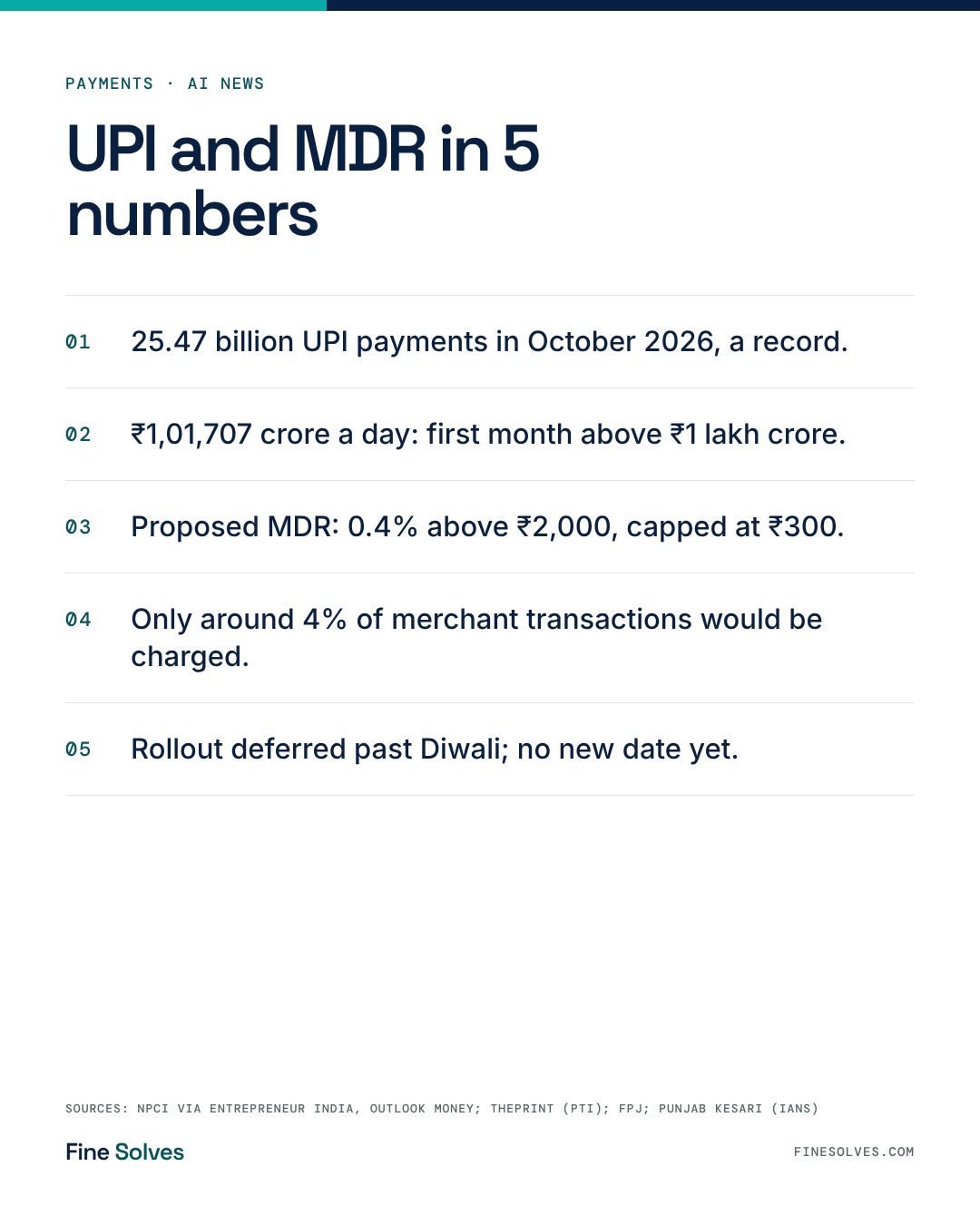
- The proposed UPI MDR is 0.4% on specified merchant payments above ₹2,000, capped at ₹300 for payments of ₹75,000 or more.
- Only around 4% of merchant transactions are expected to fall under the framework; the Finance Ministry says about 96% are unaffected.
- NPCI deferred the 15 October start on 13 October; no new date had been announced by 10 November.
What did UPI record in October 2026?
UPI handled a record 25.47 billion transactions worth ₹31.53 lakh crore in October 2026, crossing 25 billion in a month for the first time.
According to NPCI data reported by Entrepreneur India, volume rose 5.8% from 24.07 billion in September and value rose 7.4% from ₹29.37 lakh crore. Year on year, volume was up 23% and value up 16%. The Federal notes that October 2025 saw 20.7 billion transactions worth ₹27.28 lakh crore. Monthly value also crossed ₹30 lakh crore for the first time; the previous high was ₹29.90 lakh crore in May 2026, Outlook Money reported.
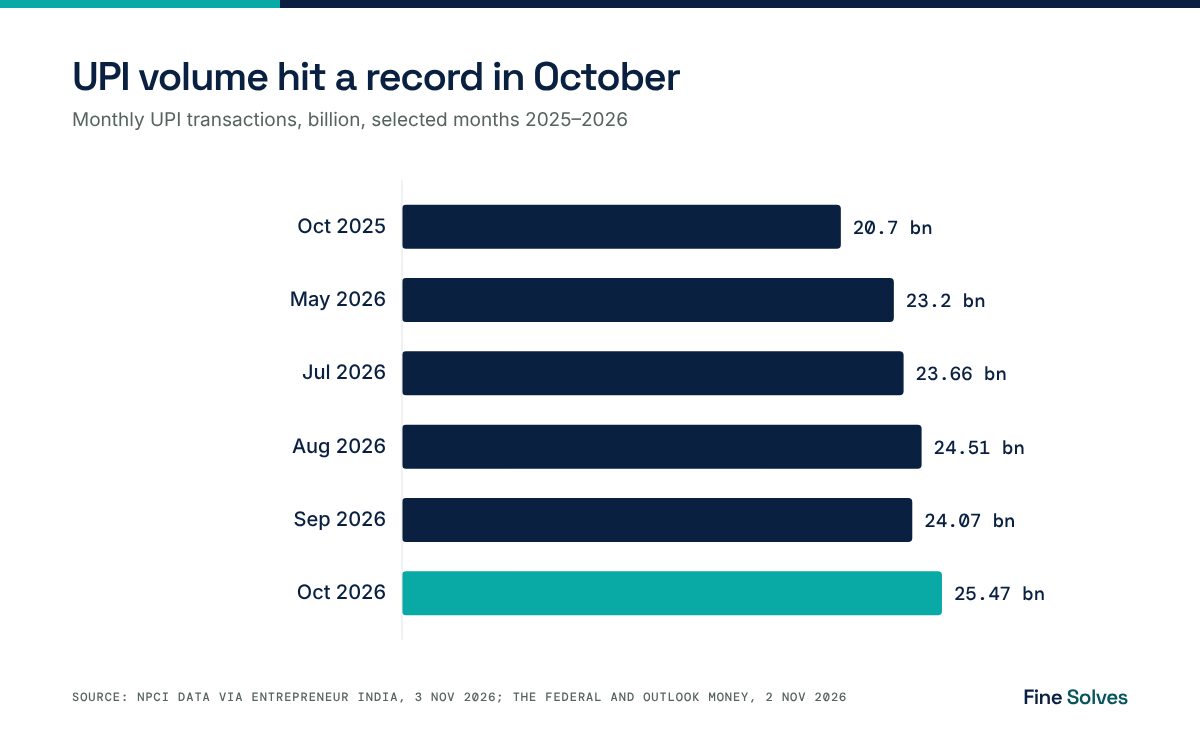
The daily numbers tell the same story. UPI averaged 822 million transactions a day in October, up 2.5% from 802 million in September. Average daily value rose to ₹1,01,707 crore from ₹97,913 crore, Outlook Money reported. Angel One noted that daily value had stayed around ₹96,000 crore from April to August before the festive pick-up.
| Metric | September 2026 | October 2026 | Change |
|---|---|---|---|
| Monthly transactions | 24.07 billion | 25.47 billion | +5.8% |
| Monthly value | ₹29.37 lakh crore | ₹31.53 lakh crore | +7.4% |
| Daily transactions | 802 million | 822 million | +2.5% |
| Daily value | ₹97,913 crore | ₹1,01,707 crore | First month above ₹1 lakh crore a day |
Source: NPCI data via Entrepreneur India (3 Nov 2026) and Outlook Money (2 Nov 2026). Monthly volumes in the chart: October 2025 20.7 billion; May 2026 23.2 billion; July 2026 23.66 billion; August 2026 24.51 billion.
For context on the year so far, NewsBytes reported about 145 billion UPI transactions in the first half of FY27, up 27% from 114 billion, with value rising to ₹177 lakh crore from ₹148 lakh crore. The rails businesses settle on are not slowing down.
What is the proposed UPI MDR?
The UPI MDR is a fee merchants pay their bank or payment provider: 0.4% on specified person-to-merchant UPI payments above ₹2,000, capped at ₹300 per transaction.
According to PTI, as carried by ThePrint, the cap applies to payments of ₹75,000 or more. Railways, telecom, fuel and insurance would pay a flat ₹5 per transaction above ₹2,000, and capital-market payments such as mutual funds and stockbroking a lower 0.02%, also capped at ₹300 per payment. Person-to-person transfers stay free. NewsBytes reported that merchants, not consumers, bear the charge. In rupee terms, WION worked out that 0.4% is about ₹8 on a ₹2,000 payment and ₹40 on a ₹10,000 payment. On a ₹1 lakh payment the fee would be ₹400 before the cap brings it down to ₹300, IANS reported.
| Payment type | Proposed charge | Cap |
|---|---|---|
| Person-to-person transfers | Free | — |
| Merchant payments up to ₹2,000 | Free | — |
| Specified merchant payments above ₹2,000 | 0.4% | ₹300 (at ₹75,000 and above) |
| Railways, telecom, fuel, insurance above ₹2,000 | Flat ₹5 | — |
| Capital markets (mutual funds, stockbroking) | 0.02% | ₹300 |
Source: NPCI framework as reported by ThePrint (PTI), 13 Oct 2026, and Punjab Kesari (IANS), 10 Nov 2026.
Why was UPI MDR deferred, and when will it start?
NPCI deferred UPI MDR on 13 October, saying it would start immediately after Diwali on a date to be notified separately; no date had been announced by 10 November.
The deferral followed opposition from traders and politicians. PTI reported that a delegation of trade leaders met the Finance Minister on 30 September, and the traders' body CAIT welcomed the pause. The framework is also being challenged in the Supreme Court. Elets BFSI reported that NPCI filed an affidavit on 5 November defending it, arguing that small merchants are the group it protects. The Court had earlier refused to stay the decision. Treat the start date as weeks away, not months, and plan accordingly.
Who actually pays UPI MDR?
Most merchants pay nothing: only around 4% of merchant transactions are expected to fall under the framework, while payments up to ₹2,000 and small merchants stay exempt.
Free Press Journal (IANS) reported that over 95% of person-to-merchant transactions remain exempt, and the Finance Ministry put the unaffected share at about 96%, according to Outlook Money. Elets BFSI reported that merchants receiving up to ₹1 lakh a month through UPI QR codes keep zero MDR, and that 5% of MDR collections will fund UPI adoption by small merchants with annual turnover up to ₹20 lakh. The exposure therefore sits with mid-size and large merchants that take high-value UPI payments: hospitals collecting admission deposits, distributors collecting from retailers, dealers, schools and B2B sellers.
Where does the MDR money go?
The fee is split four ways: 40% to the customer's bank, 30% to the payment gateway, 20% to the UPI app and 10% to the app's sponsoring bank, PTI reported.
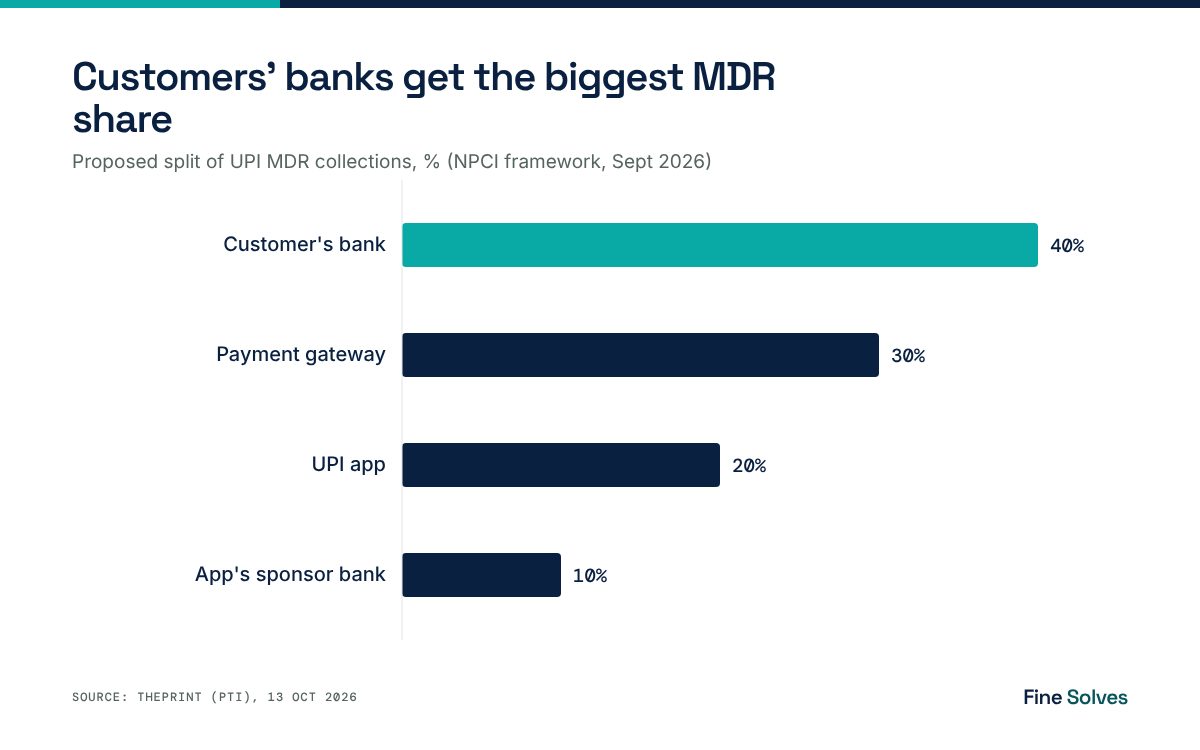
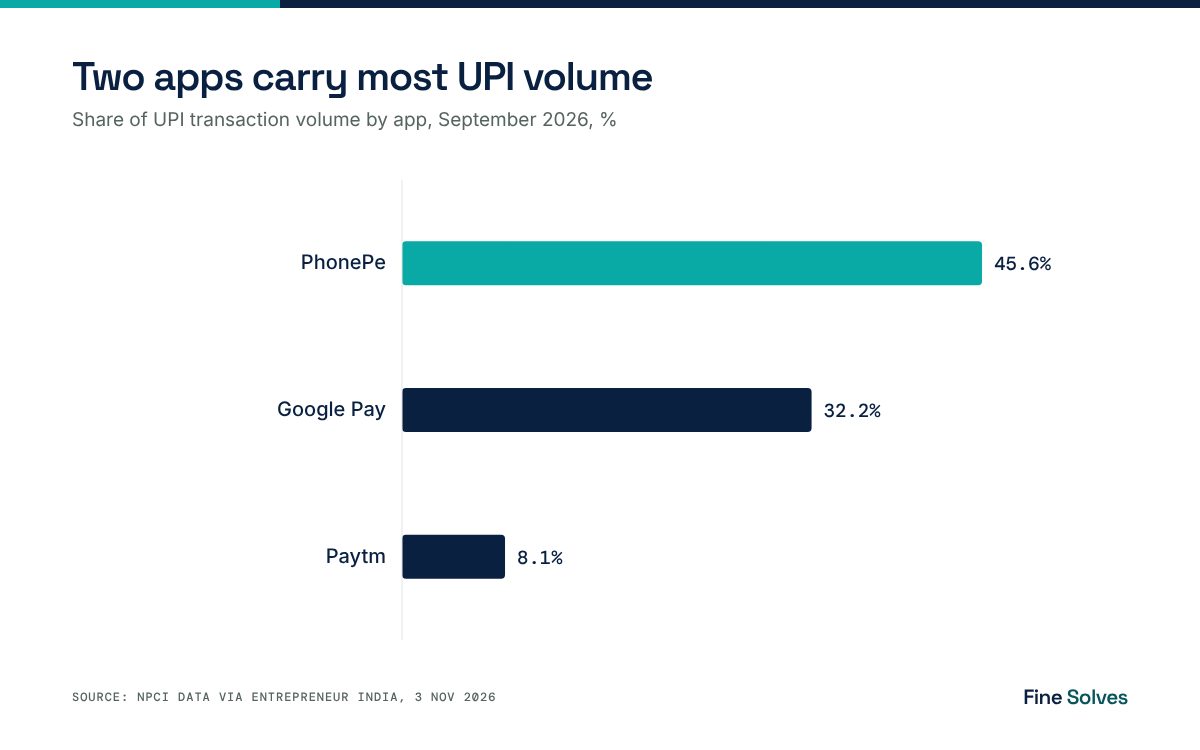
That split explains why the industry pushed for MDR. UPI has run at zero merchant cost for years while banks and apps carried the processing load. Concentration adds to the pressure. According to NPCI data cited by Entrepreneur India, PhonePe had 45.6% of UPI volume in September, Google Pay 32.2% and Paytm 8.1%. For merchants, the practical point is that the payment gateway gets a share, so expect gateway contracts and settlement reports to change when MDR goes live.
How should Indian businesses prepare for UPI MDR?
Measure how much of your UPI revenue comes in tickets above ₹2,000, then fix pricing, reconciliation and reporting before the date is notified.
- Size the exposure. Pull 90 days of UPI settlements and split them at ₹2,000 and ₹75,000 per payment. Multiply by 0.4% (or the flat ₹5 if you are in an essential-services category). This is your monthly cost if nothing changes.
- Check your category. Confirm with your bank or gateway whether you fall under the standard, essential-services or capital-markets tier, and whether any of your QR codes qualify as small-merchant.
- Update UPI payment reconciliation. Settlements will arrive net of MDR. Your ERP or accounting system must book the fee as an expense and match the net amount to the invoice, or receivables will show false short payments.
- Decide on routing for large tickets. For very large payments, compare UPI with the capped fee against NEFT, RTGS or IMPS. The Federal reported IMPS handled 375 million transactions worth ₹7.63 lakh crore in October, up 19% in value.
- Review pricing and invoices. Decide whether to absorb the fee or reflect it in pricing, and make sure any change follows your contracts and applicable rules.
- Watch the notification. Assign one owner to track NPCI circulars and your gateway's notices so the switch-over date does not surprise finance.
Is this an AI story or a payments story?
It is a payments story with a data and automation problem underneath: the cost is small per transaction but the reconciliation work scales with volume.
At 822 million UPI transactions a day nationally, manual matching does not scale even for a mid-size merchant. This is where rule-based matching plus AI-assisted exception handling earns its keep: auto-matching net settlements to invoices, flagging MDR deductions that don't fit the published rate, and classifying payments by tier. From the way we build finance integrations, the hard part is rarely the model. It is getting clean settlement files from each gateway into one place.
What this means for Indian businesses
UPI is now the default rail, with roughly 100 million merchants using it, WION reported. A fee on 4% of merchant transactions sounds minor, but for a hospital, distributor or dealer that 4% can be a large share of its UPI revenue. Use the deferral window to measure exposure and fix reconciliation, so the start date becomes a setting change rather than a month-end fire drill. If your settlement data sits across several gateways and spreadsheets, that is the first thing to fix. Talk to Fine Solves about connecting payments data to your ERP.
Frequently asked questions
What is UPI MDR?
UPI MDR (merchant discount rate) is a fee a merchant pays its bank or payment provider for accepting a UPI payment. NPCI's proposed framework sets 0.4% on specified person-to-merchant payments above ₹2,000, capped at ₹300 for payments of ₹75,000 or more per payment. Person-to-person transfers and merchant payments up to ₹2,000 remain free.
When does UPI MDR start?
No date has been fixed. NPCI originally planned to start UPI MDR on 15 October 2026, but deferred it on 13 October to "immediately post Diwali on a date to be notified separately". As of 10 November 2026, merchants were still awaiting a revised date, according to IANS.
Do customers pay UPI MDR?
No. The UPI MDR is charged to merchants, not to the customer making the payment, according to NPCI's framework as reported by NewsBytes and Outlook Money. Person-to-person transfers between individuals carry no charge. A merchant may choose to adjust its prices, but the fee itself is deducted from the merchant's settlement.
Which merchants are exempt from UPI MDR?
Payments up to ₹2,000 are exempt, which covers over 95% of person-to-merchant volume. Elets BFSI reported that merchants receiving up to ₹1 lakh a month through UPI QR codes keep zero MDR. Railways, telecom, fuel and insurance pay a flat ₹5 per payment above ₹2,000 instead of 0.4%.
How many UPI transactions happened in October 2026?
UPI processed a record 25.47 billion transactions worth ₹31.53 lakh crore in October 2026, according to NPCI data. That was 5.8% more than September and 23% more than October 2025. Daily value averaged ₹1,01,707 crore, the first month above ₹1 lakh crore a day.
Sources
- UPI Hits Record 25.47 Bn Transactions in October, Daily Value Crosses INR 1 L.Cr — Entrepreneur India, 2026
- UPI Average Daily Transaction Value Crosses Rs 1 Lakh Crore For First Time Ever In October — Outlook Money, 2026
- UPI Transactions Hit 25.47 Billion In October, Value Soars To ₹31.53 Lakh Crore — Free Press Journal (IANS), 2026
- Rs 1 lakh cr a day: Record UPI volumes mask uneven growth in digital payment ecosystem — The Federal, 2026
- UPI's Record-Breaking October Puts Merchant Monetization Back in Focus — Analytics Insight, 2026
- UPI transactions soar to 145B in H1 FY27 — NewsBytes, 2026
- UPI Daily Transactions Crossed 800 Million for First Time in September 2026 — Angel One, 2026
- NPCI defers levy of MDR on UPI transactions; no new date announced for implementation — ThePrint (PTI), 2026
- NPCI postpones UPI MDR charges rollout to post-Diwali — WION, 2026
- Merchants await clarity on UPI MDR rollout after Diwali — Punjab Kesari English (IANS), 2026
- NPCI Defends UPI MDR Framework Before Supreme Court — Elets BFSI, 2026
Last updated: 11 November 2026. Published by Fine Solves — an AI software development company in Ahmedabad building custom software and AI systems for Indian businesses. finesolves.com