
Technical Debt Cost: 2026 Benchmarks for Indian CIOs
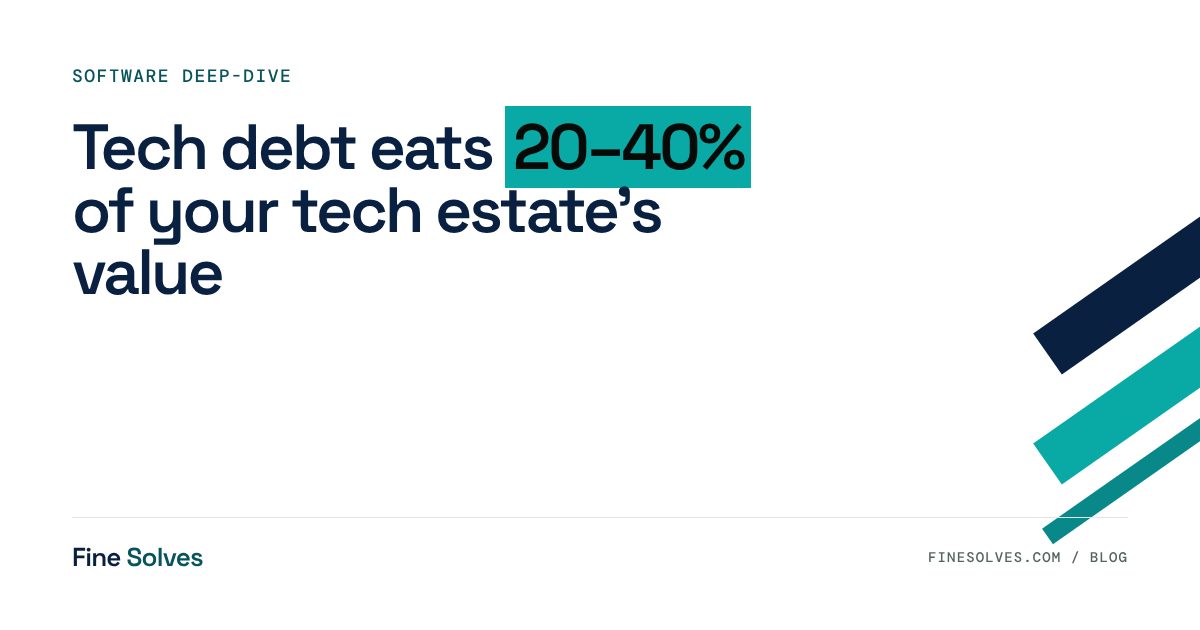
Technical debt cost is the extra money and lost speed a business pays for software built on shortcuts or left to age. CIOs surveyed by McKinsey estimate it at 20–40% of the value of their entire technology estate, and Accenture's analysis suggests about 15% of IT budgets should go to paying it down. For Indian firms spending heavily on AI, it is now a budget line, not a backlog item.
This matters now because Indian enterprises are in a spending burst. Bain's India Enterprise Technology Report 2026 expects IT spending to rise about 6%–8% this year, faster than global peers. Bain also warns that platforms bought in earlier bursts turned into "legacy" within 3–5 years. Money going into AI today will sit on top of whatever debt is already there. If that foundation is weak, the new spend inherits the old problems.
TL;DR
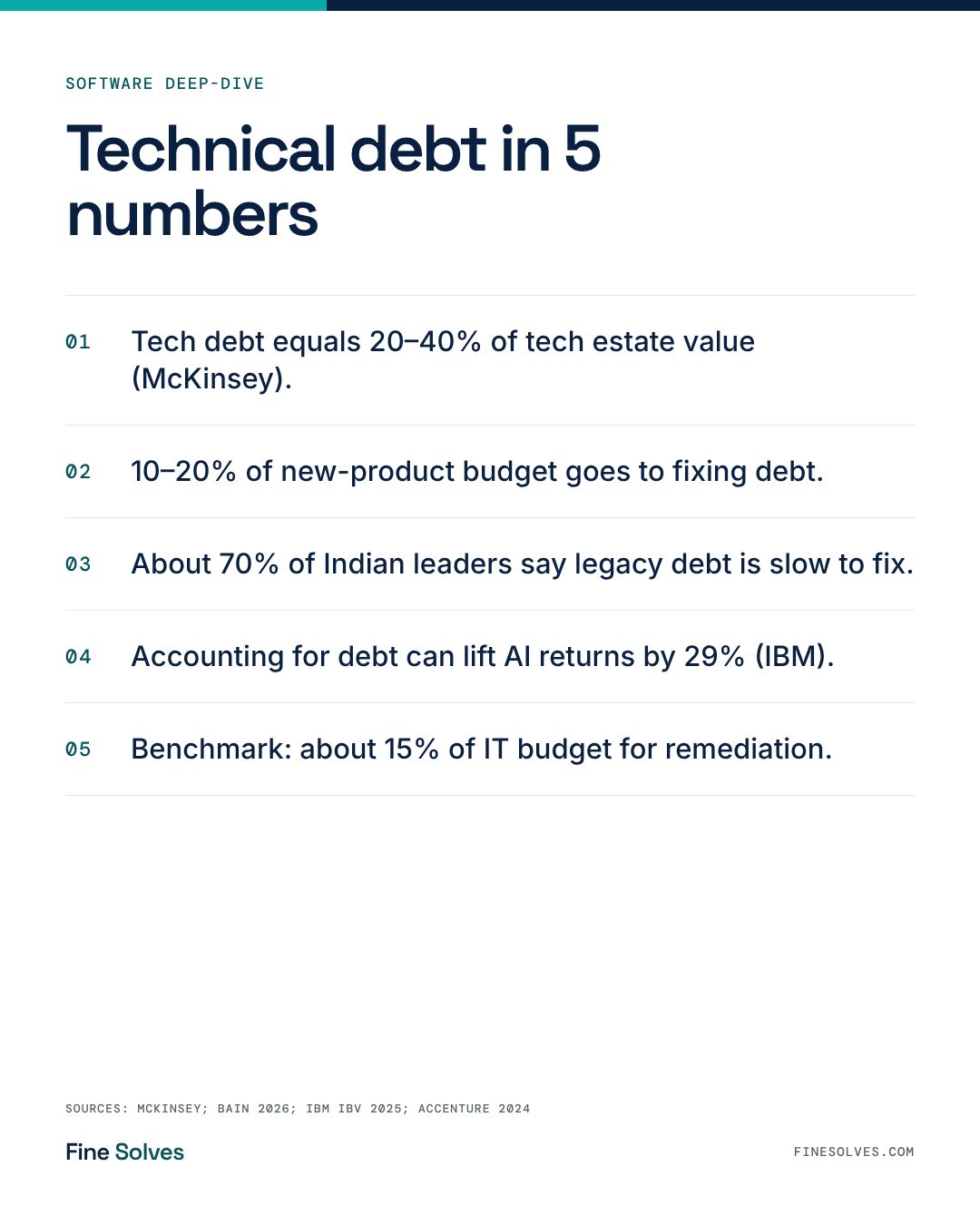
- McKinsey's CIO survey found 10–20% of new-product technology budget is diverted to tech debt, and debt equals 20–40% of the tech estate's value.
- About 70% of Indian leaders surveyed by Bain say legacy technical debt will take significant time to overcome; about 90% call their data foundations weak.
- Almost 70% of executives in IBM's research expect tech debt to make some AI initiatives financially untenable.
- IBM found that putting tech debt remediation inside AI business cases can boost AI returns by 29%.
- Accenture's benchmark: spend about 15% of the IT budget on remediation; firms with an advanced digital core and balanced debt report 60% higher revenue growth rates.
What is technical debt cost, in numbers?
Technical debt cost is the ongoing price of old or rushed software: rework, slower releases, outages and budget diverted from new work. The best-known estimates put it in the trillions of dollars nationally and at a fifth or more of a company's tech estate.
At the economy level, the Consortium for Information & Software Quality (CISQ) estimated that poor software quality cost the US $2.41 trillion in 2022, and that accumulated technical debt had grown to about $1.52 trillion. There is no equivalent official number for India, but the mechanics are the same in a Pune plant or a Mumbai bank.
At the company level, McKinsey reports that CIOs estimate tech debt at 20–40% of the value of their technology estate before depreciation. In the same survey, CIOs said 10–20% of their new-product technology budget is diverted to fixing tech-debt issues, and 60% said their debt had risen perceptibly over the past three years. McKinsey adds a useful threshold: debt above 50% of an organisation's tech asset value should normally be treated as a net detriment.
At the team level, Stripe's Developer Coefficient study found developers spend more than 17 hours a week on maintenance work such as debugging. Stripe estimated that the share spent fixing bad code alone costs about $85 billion a year globally, and that using developers well could add $3 trillion to global GDP over a decade. The figures are from 2018, but the pattern is still familiar to any engineering lead.
How big is the technical debt problem for Indian enterprises?
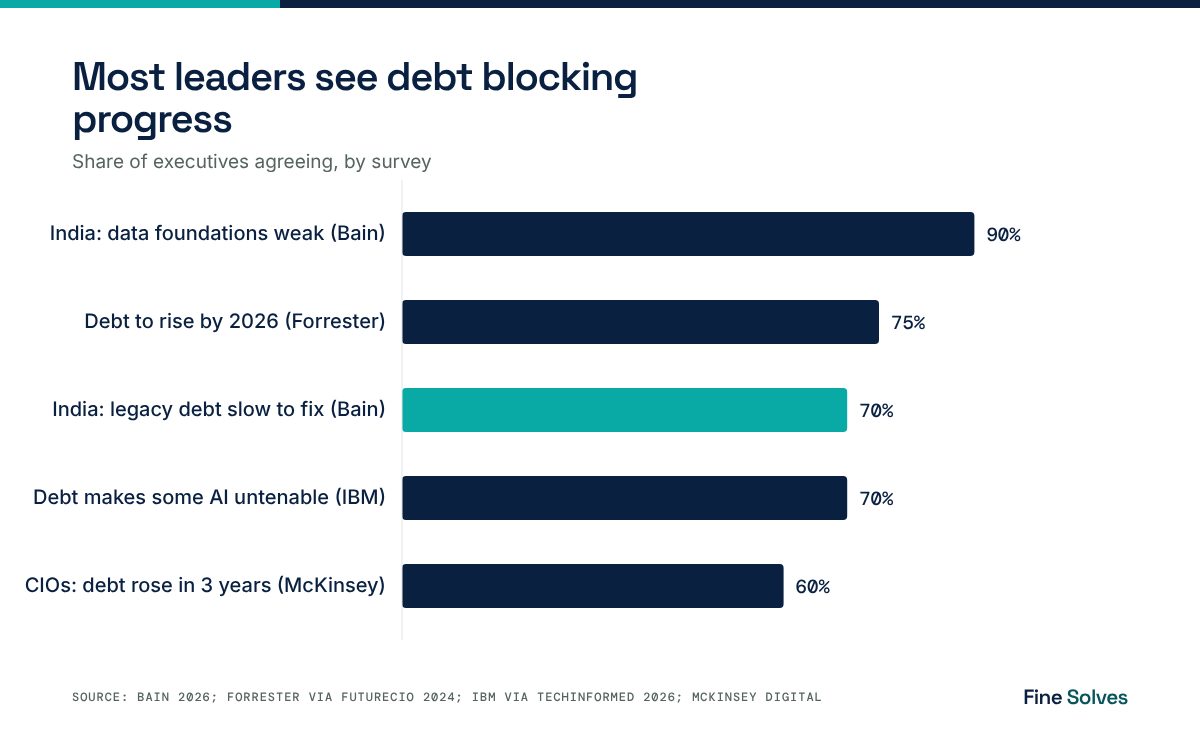
It is large and widely acknowledged: about 70% of Indian business leaders in Bain's 2026 survey say the technical debt of legacy systems will take significant time to overcome.
Bain surveyed more than 250 CIOs, CDOs, CAIOs and CXOs across Indian enterprises. Its other findings explain why debt keeps building. About 90% said their data foundations are weak and not fit to scale. Only 15% of business leaders see IT as truly strategic. Three out of four cited poor alignment between business-unit and IT goals.
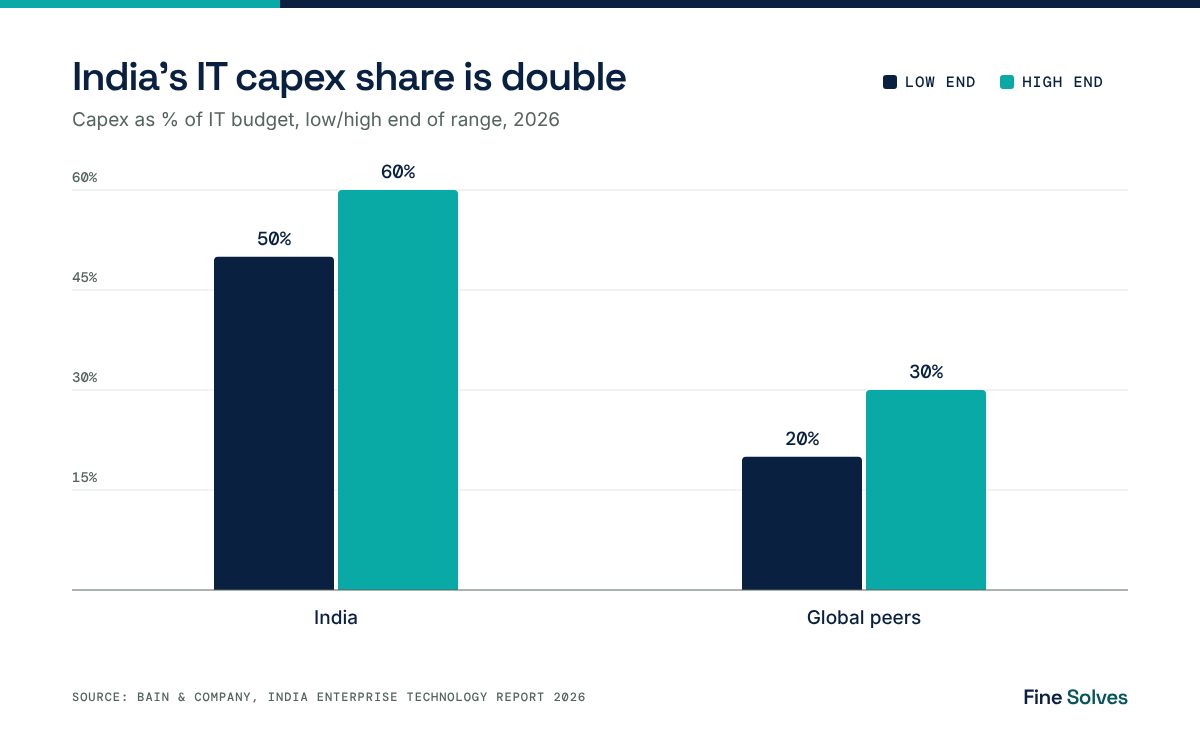
The way Indian firms spend makes the problem sharper. According to Bain, capex makes up 50%–60% of IT budgets in India, against only 20%–30% for global peers. Heavy capex means more new systems bought or built in bursts. Each burst adds integrations, custom code and data copies that someone has to maintain later.
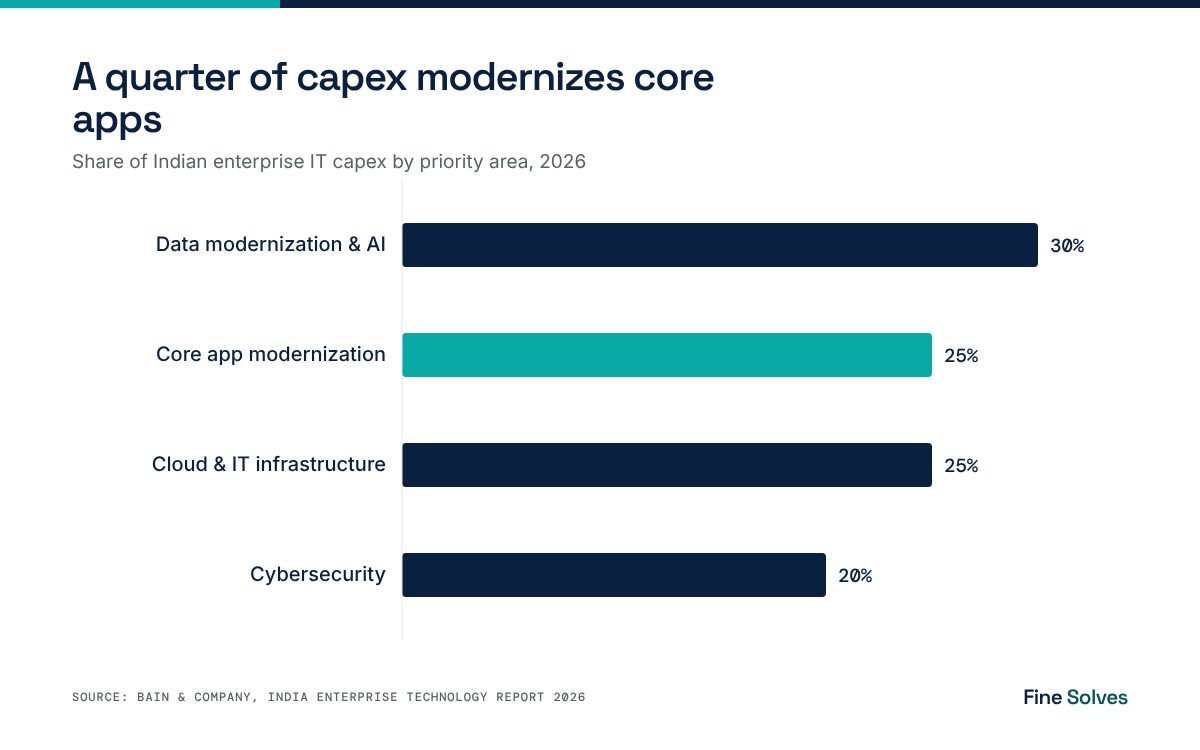
Where does that capex go? Bain's breakdown shows data modernization and AI infusion take 30% of capex, core application modernization 25%, cloud and IT infrastructure 25%, and cybersecurity 20%. In other words, at least a quarter of capex is already being spent on modernizing what exists.
Why does technical debt cost more in the AI era?
AI projects sit on top of existing data, integrations and applications, so every weakness underneath raises their cost and lowers their return. IBM's research shows executives now see debt as a direct threat to AI budgets.
According to IBM's "The tech debt reckoning", as reported by TechInformed, almost 70% of executives expect technical debt to make at least some AI initiatives financially untenable. Nearly 60% report pressure to cut non-AI technology spending to fund AI, which often means cutting the maintenance that keeps debt in check.
The returns are thin already. IBM's survey of 1,250 IT executives found large enterprises report an average AI ROI of just 17%. Its 2026 Tech Leader Study found 85% of technology leaders lack real-time visibility into AI spending, and cloud costs are running nearly 50% above initial projections. Forrester, in its 2025 predictions, reported that 75% of technology decision-makers expected their technical debt to reach moderate or high levels by 2026.
The good news is in the same data. IBM found that accounting for technical debt in AI plans can boost returns by 29%. The firms that do this treat modernization as part of the AI project, not a separate wish-list item.
Technical debt benchmarks at a glance
The table below collects the benchmarks most useful for an Indian IT budget discussion. Use them as reference points, not targets, since each comes from a different survey and method.
| Benchmark | Figure | Source |
|---|---|---|
| Tech debt as share of tech estate value | 20–40% | McKinsey CIO survey |
| New-product budget diverted to tech debt | 10–20% | McKinsey CIO survey |
| Recommended IT budget for debt remediation | about 15% | Accenture, 2024 |
| Capex share of IT budget: India vs global | 50%–60% vs 20%–30% | Bain, 2026 |
| Indian leaders: legacy debt will take significant time | about 70% | Bain, 2026 |
| Indian leaders: data foundations weak | about 90% | Bain, 2026 |
| Executives: debt makes some AI untenable | almost 70% | IBM via TechInformed, 2026 |
| AI return uplift from accounting for debt | 29% | IBM IBV, 2025 |
| Indian IT capex on core app modernization | 25% | Bain, 2026 |
Source: McKinsey Digital; Accenture 2024; Bain & Company 2026; IBM Institute for Business Value 2025; TechInformed 2026.
How much of your IT budget should go to paying down technical debt?
About 15% of the IT budget is the benchmark Accenture's research points to; it describes that level as a sweet spot, with both higher and lower allocations performing worse.
Accenture analysed responses from 1,500 technology executives in 19 industries across 10 countries. Organisations with an advanced digital core, steady innovation spending and a balanced approach to tech debt achieved a 60% higher revenue growth rate and 40% higher profits. The point is balance. Spending everything on new features lets debt compound; spending everything on clean-up starves the business.
McKinsey's numbers show what happens without a set allocation. If 10–20% of new-product budget is already leaking into debt, the money is being spent anyway, just without a plan. One cloud provider's CIO told McKinsey that reworking debt management cut engineer time spent on the debt "tax" from 75% to 25%. A ring-fenced budget turns hidden leakage into a visible, managed line.
Is legacy system modernization better than a full rewrite?
Usually, yes: targeted legacy system modernization of the parts that block the business beats a full rewrite, which carries the most risk and delays value the longest.
Bain's warning that new platforms become legacy in 3–5 years applies to rewrites too. A rewrite that takes two years can be half-way to legacy on launch day. From the way we build at Fine Solves, the better pattern is to wrap, extract and replace in slices. Put a clean API in front of the old system. Move one high-value workflow at a time to new code. Retire the old module only when the new one has run in production.
Use this quick decision framework:
- Keep and contain if the system is stable, rarely changed and not on any AI or customer roadmap.
- Refactor in place if the code works but slows every release; ring-fence a share of each sprint for it.
- Extract and replace if one module causes most incidents or blocks data access for AI.
- Replace with off-the-shelf if the function is generic (payroll, email, basic CRM) and your custom code adds nothing.
- Rewrite only when the platform is unsupported, insecure, or cannot meet a regulatory requirement.
How do you measure technical debt cost in your own systems?
Measure it as time and money diverted from planned work, tracked per system, so the debt can be prioritised like any other budget item.
- List your top 10 systems by business criticality: ERP, WMS, HMS, core banking, customer apps.
- Track unplanned work. For one quarter, tag every ticket as planned, maintenance or incident. The maintenance and incident share is your debt "tax".
- Price the tax. Multiply those hours by loaded team cost, then add vendor support and cloud spend tied to each system.
- Map debt to the roadmap. Mark which systems block the AI or automation projects planned for the next 12 months.
- Set the budget. Start near Accenture's 15% benchmark and direct it at systems that score high on both cost and roadmap impact.
- Put it in the business case. Following IBM's finding, include remediation costs inside each AI project's ROI, not in a separate IT request.
- Review quarterly. Watch whether the unplanned-work share falls. If it does not, change the approach, not just the budget.
What this means for Indian businesses
Indian enterprises are spending more on IT than global peers, and more of it as capex. That is an advantage if it builds clean foundations and a liability if it stacks new tools on old debt. Bain's own estimate is that a handful of enterprises getting this right could see 15%–20% absolute EBITDA improvement.
For a manufacturing, logistics, healthcare or BFSI firm, the practical move is simple: name the debt, price it, and fund its removal inside the projects the board already wants. Fine Solves is an AI software development company in Ahmedabad that builds custom software and AI systems for Indian businesses, and much of that work starts with untangling what already exists. If you want a second opinion on your modernization plan, Talk to Fine Solves.
Frequently asked questions
What is technical debt in simple terms?
Technical debt is the future work created when software is built quickly, patched repeatedly or left to age. Like financial debt, it charges interest: every new feature takes longer, outages become more frequent and more of the team's time goes to maintenance. McKinsey's CIO survey estimates it at 20–40% of the value of a company's technology estate.
How much does technical debt cost a company?
Estimates vary by method, but McKinsey reports that CIOs see 10–20% of new-product technology budget diverted to tech-debt issues. At national level, CISQ estimated accumulated US technical debt at about $1.52 trillion in 2022. The practical measure for one company is the share of team hours spent on unplanned maintenance and incidents.
What percentage of the IT budget should go to technical debt?
Accenture's research suggests about 15% of IT budgets should be allocated to remediating technical debt. It found both higher and lower allocations were less effective. Companies that balanced debt reduction with innovation reported 60% higher revenue growth rates and 40% higher profits in its survey of 1,500 technology executives.
Does technical debt affect AI ROI?
Yes. In IBM's research, almost 70% of executives expect technical debt to make some AI initiatives financially untenable. IBM also found that accounting for technical debt when planning AI can boost returns by 29%. In practice, that means data, integration and infrastructure fixes are funded with the AI project instead of surfacing later as overruns.
Is technical debt a big problem in Indian companies?
Indian leaders say it is. In Bain's 2026 survey of more than 250 Indian technology and business leaders, about 70% said legacy technical debt will take significant time to overcome, and about 90% described their data foundations as weak and not fit to scale. High capex-led spending can add to the debt if new systems are not integrated well.
Sources
- Tech debt: IT's role in reclaiming your organization's tech equity — McKinsey Digital
- Cost of Poor Software Quality in the US: A 2022 Report — CISQ, 2022
- Developers Waste Time On Fixing Bad Code, Stripe Finds — PYMNTS, 2018
- CIOs to triple AIOps adoption to fight rising technical debt — FutureCIO (Forrester Predictions 2025), 2024
- India Enterprise Technology Report 2026 — Bain & Company, 2026
- The tech debt reckoning — IBM Institute for Business Value, 2025
- IBM says cloud costs and tech debt erode AI returns — TechInformed, 2026
- New research from Accenture finds digital core investments accelerate reinvention — Accenture, 2024
Last updated: 6 November 2026. Published by Fine Solves — an AI software development company in Ahmedabad building custom software and AI systems for Indian businesses. finesolves.com