SAHI Roadmap 2026: What India's AI Health Plan Means
The SAHI roadmap is the implementation plan for India's Strategy for AI in Healthcare, which sets out 32 recommendations across five pillars. On 2 November 2026 the National Health Authority held its fourth committee meeting to finalise who does what, by when and with what resources. For hospitals, it arrives as patients move first: BCG found 85% of Indian consumers already use AI tools for health.
Why this matters now: three timelines are converging on Indian hospitals. The SAHI roadmap is being closed after regional consultations. The national digital health rails are already at scale, with more than 110 crore health records linked to ABHAs, according to NHA data. And the DPDP Rules reach full compliance on 13 May 2027, roughly six months away, with penalties of up to ₹250 crore. This post sets out what was decided this week, the numbers behind it, and what a hospital or clinic chain should do before the final roadmap lands.
TL;DR
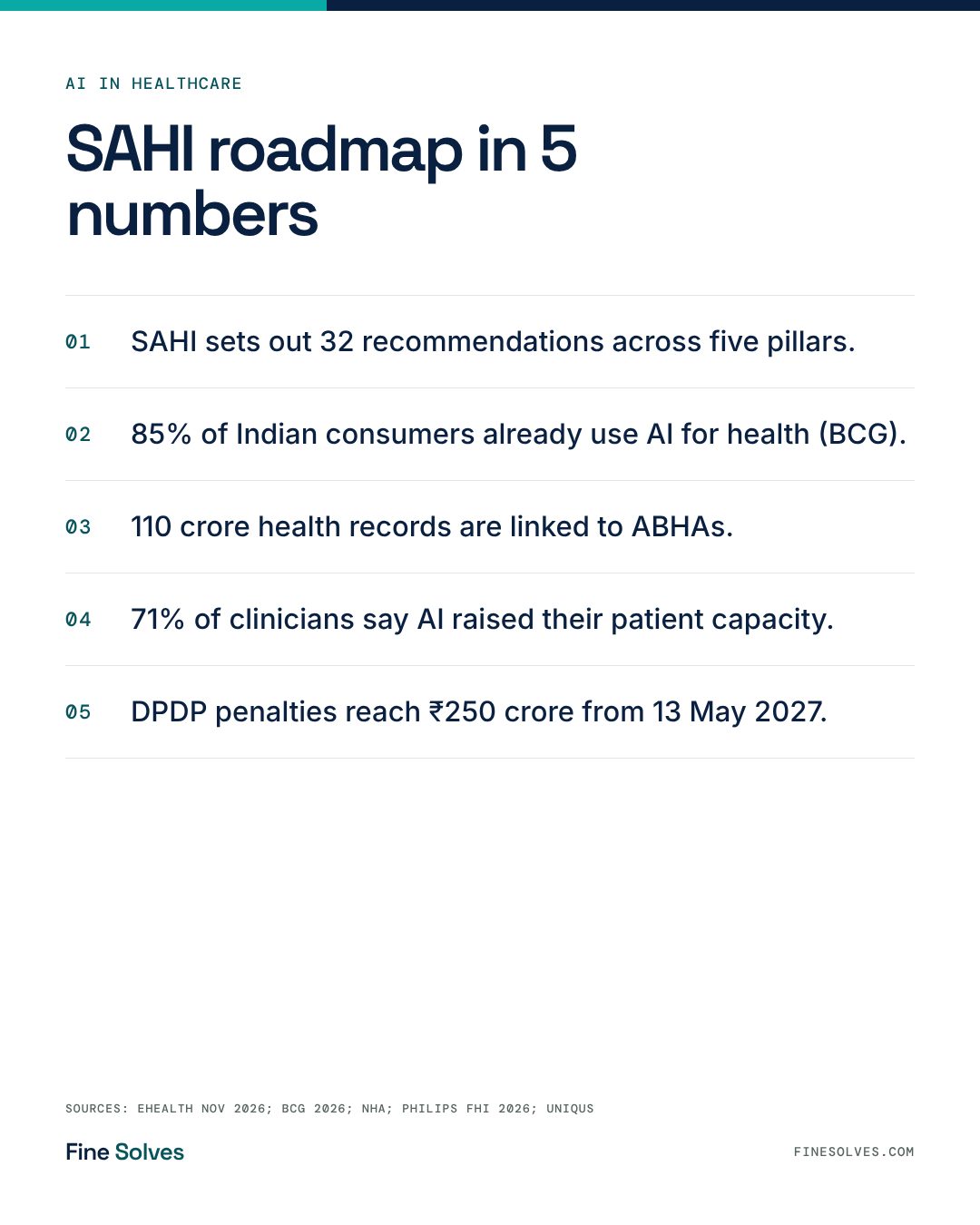
- SAHI has 32 recommendations across five pillars; NHA held its fourth roadmap meeting on 2 November 2026.
- BCG reports 85% of Indian consumers use AI for health, against 50% in the US and 43% in the UK.
- ABDM has 96.43 crore ABHAs and more than 110 crore linked health records as of August 2026.
- Philips' Future Health Index 2026 says 71% of healthcare professionals report AI increased their patient capacity.
- DPDP penalties reach ₹250 crore for weak security safeguards; full compliance is due 13 May 2027.
What is the SAHI roadmap?
The SAHI roadmap is the action plan that turns India's Strategy for AI in Healthcare into named owners, deadlines and budgets across the Centre, states and regulators.
SAHI itself was launched in February 2026 around the AI Impact Summit, alongside BODH, a benchmarking open data platform for health AI built by IIT Kanpur with the National Health Authority. The strategy is guidance, not a statute. It tells states, regulators and private programmes how to adopt AI responsibly. The roadmap is the missing operational layer. According to eHealth's report on the meeting, NHA CEO Dr Sunil Kumar Barnwal chaired the session, and attendees included the health ministry, state governments, regulators, academia and AI companies. NHA has not announced a release date for the final document.
What happened at the 2 November meeting?
NHA's committee worked on three things: pushing inter-ministerial consultations forward, folding in regional input, and closing the draft implementation roadmap.
The regional input is the part to watch. eHealth reports an eastern consultation in Bhubaneswar with 11 eastern and north-eastern states, and a northern consultation in New Delhi with eight states and institutions. That matters for private hospitals because health is a state subject. Procurement rules, empanelment terms and data-sharing expectations will be set state by state. A roadmap built with state health departments in the room is more likely to show up in tender documents and scheme guidelines than a strategy paper written only in Delhi.
What are SAHI's five pillars?
SAHI groups its 32 recommendations under five pillars: governance and trust, data and infrastructure, workforce and change management, research and evidence, and ecosystem enablement.
| SAHI pillar | What it covers | What a hospital should prepare |
|---|---|---|
| Governance, regulation and trust | Rules for safe, accountable AI use | A register of every AI tool in use, with an owner and a review date |
| Health data and digital infrastructure | ABDM rails, data quality, interoperability | ABDM-enabled HMS, clean master data, consent logs |
| Workforce, capacity and change management | Training clinicians and administrators | Short role-based training for doctors, nurses and front desk |
| Research, innovation and evidence | Validation and benchmarking, including BODH | Before-and-after metrics for every AI pilot |
| Ecosystem enablement and global leadership | Startups, industry and international partnerships | Vendor contracts that cover data rights and exit |
Source: pillar names from eHealth (Elets), November 2026; preparation column is Fine Solves' guidance.
How far ahead are Indian patients on AI?
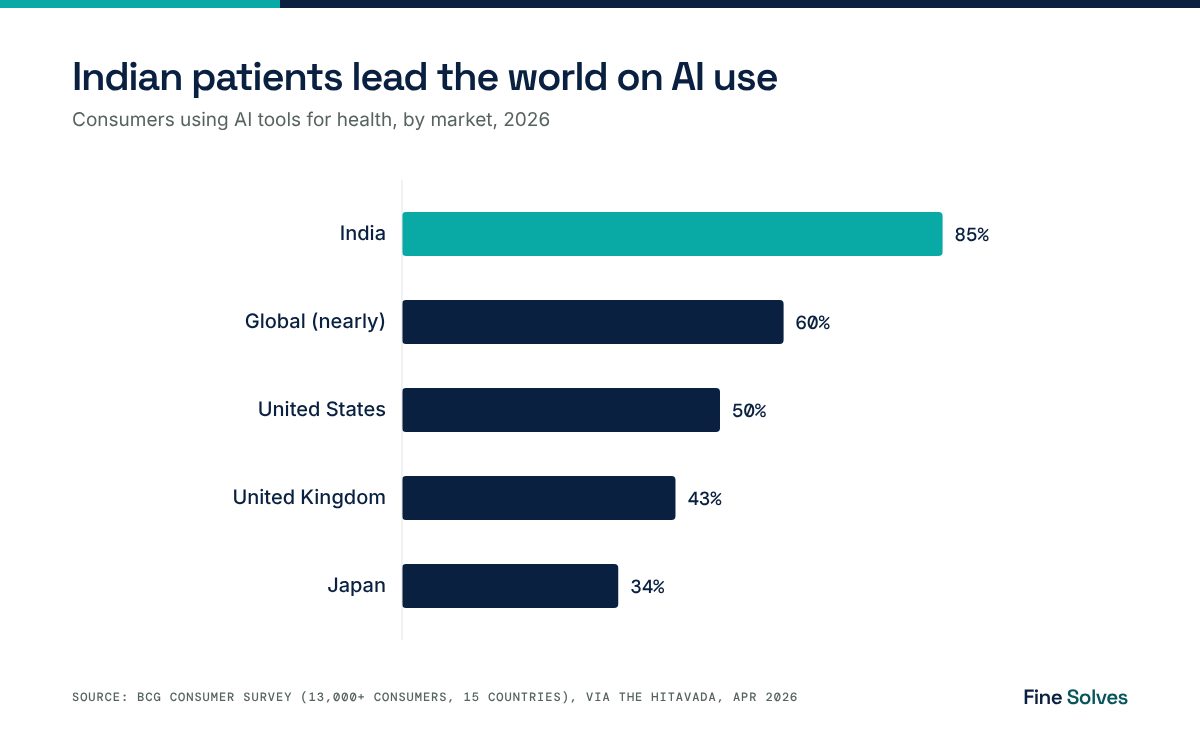
Well ahead: BCG's survey of more than 13,000 consumers in 15 countries found 85% of Indian respondents already use AI tools for personal health.
The same BCG survey, as reported by The Hitavada, puts the US at 50%, the UK at 43% and Japan at 34%, with nearly 60% of respondents globally using AI for health purposes. A separate Bain & Company report covered by MedBound Times found 78% of Indian consumers use generative AI to better understand diagnoses and treatment options, and 73% use it to prepare for appointments. The point for operators: patients arrive having already asked a chatbot. A hospital whose own systems can't answer a simple question about a report, a bill or a slot is now competing with a free app on the patient's phone.
| Market | Consumers using AI for health |
|---|---|
| India | 85% |
| Global (15 countries) | nearly 60% |
| United States | 50% |
| United Kingdom | 43% |
| Japan | 34% |
Source: BCG consumer survey, reported by The Hitavada, April 2026.
Bain's data also shows where patients feel friction: 93% of Indian respondents want a single point of coordination across their care journey. India's alternate site-of-care adoption is 42%, below the APAC average of 57%, according to the same report. Coordination, not diagnosis, is where most hospitals can act first.
Is the ABDM data layer ready for AI in healthcare India needs?
The patient side is ready; the provider side is catching up. NHA data shows 96.43 crore ABHAs and more than 110 crore linked records as of 12 August 2026.
Indian Pharma Post, citing NHA, reports linked records went from 50 crore in February 2025 to more than 100 crore by May 2026, with nearly 10 crore records now linked every two to three months. Uttar Pradesh leads with over 15.03 crore linked records, followed by Andhra Pradesh at more than 11.95 crore. On the supply side, Digital Health News reports more than 5.47 lakh facilities on the Health Facility Registry and more than 10.50 lakh professionals on the Healthcare Professionals Registry. Any SAHI recommendation on data and infrastructure will build on these rails, so ABDM integration is the entry ticket for AI that uses patient history.
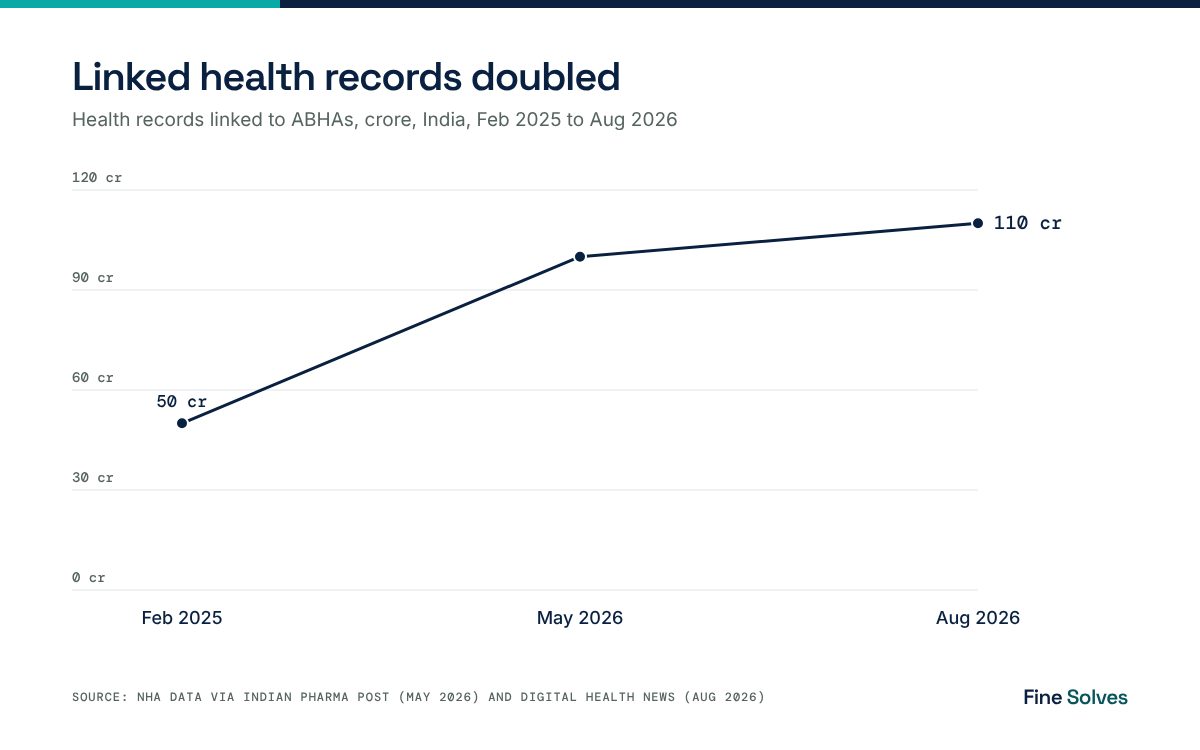
Data in chart: 50 crore (Feb 2025), 100 crore (May 2026), 110 crore (Aug 2026). Sources: Indian Pharma Post; Digital Health News, both citing NHA.
Why does the DPDP deadline change the SAHI timeline for hospitals?
Because AI runs on patient data, and from 13 May 2027 every misuse of that data carries DPDP penalties of up to ₹250 crore.
Uniqus' timeline of the DPDP Rules splits the 18 months into a build phase to November 2026, an implementation phase to May 2027, and enforcement after that. Its penalty table is the part boards will read: up to ₹250 crore for failing reasonable security safeguards, up to ₹200 crore for failing to notify a breach, up to ₹200 crore for violations involving children's data, up to ₹150 crore for Significant Data Fiduciary lapses, and up to ₹50 crore for other violations. Breaches need a detailed report to the Data Protection Board within 72 hours. Hospitals hold children's records, so the ₹200 crore line applies directly.
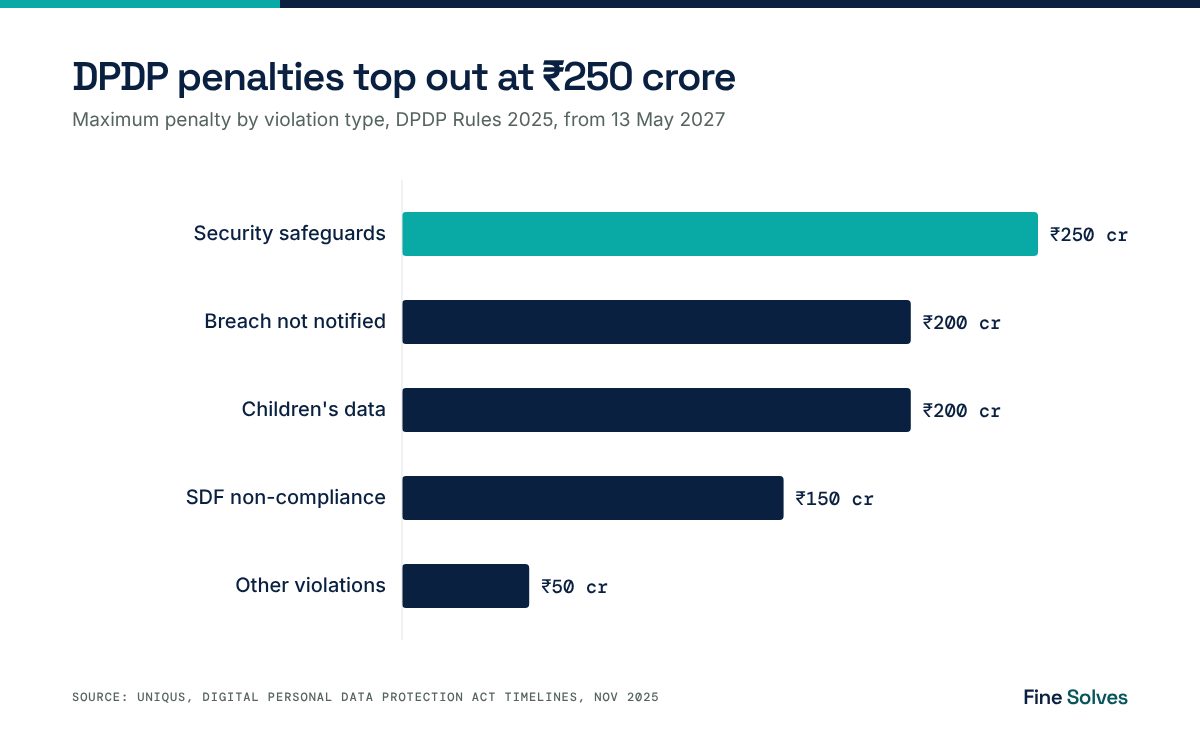
| DPDP violation | Maximum penalty | Hospital example |
|---|---|---|
| No reasonable security safeguards | ₹250 crore | Lab reports shared on unsecured links |
| Breach not notified | ₹200 crore | Leaked HMS export not reported |
| Children's data violations | ₹200 crore | Paediatric records used without guardian consent |
| Significant Data Fiduciary lapses | ₹150 crore | No data protection officer or audit |
| Other violations | ₹50 crore | Missing consent notice at registration |
Source: Uniqus, DPDP Act timelines, November 2025. Examples are illustrative.
Should hospitals wait for the final SAHI roadmap before buying AI?
No. The roadmap will set direction, but the groundwork it will assume, ABDM integration, clean data and DPDP-grade consent, has to be done anyway.
Clinicians are already reporting gains. Philips' Future Health Index 2026, the largest global survey of its kind with more than 2,000 healthcare professionals and 20,000 patients in 10 countries, reports 71% of healthcare professionals say AI has increased their capacity to care for more patients. Money is following. Towards Healthcare estimates the India AI in healthcare market at $2.13 billion in 2026, rising to $50.35 billion by 2035 at a 42.1% CAGR. Treat that forecast as a vendor estimate, not a plan. The safer bet is narrow, measured deployments in operations: documentation, billing, scheduling and report delivery.
How to prepare your hospital for the SAHI roadmap: a 6-step checklist
- List every AI tool in use. Include transcription apps, chatbots and anything a department bought on a card. Name an owner for each.
- Finish ABDM integration. Register on HFR and HPR, enable ABHA at registration, and link discharge summaries and lab reports.
- Map patient data flows. Where do reports go: WhatsApp, email, a portal? Each flow needs consent, logging and a breach plan that works in 72 hours.
- Pick one operational use case. Billing pre-checks, discharge summaries or report delivery. Measure turnaround and errors before and after.
- Fix vendor contracts. Add clauses on where data is stored, who can train models on it, and how you exit.
- Train by role. A front-desk user and a consultant need different 30-minute sessions, not one generic workshop.
What this means for Indian businesses
The SAHI roadmap signals what states and regulators will ask hospitals for: traceable AI use, ABDM-linked records and consent you can prove.
Patients are already there, at 85% AI use; the gap is in the provider's systems, and DPDP compliance for hospitals is now part of the same project. From the way we build hospital software at Fine Solves, the work that pays first is unglamorous: clean master data, ABDM-ready workflows and reports that reach patients securely. FineHealth by Fine Solves is built around those operations, from HMS and billing to WhatsApp report delivery. If you want to map your SAHI and DPDP readiness before the deadlines bite, Talk to Fine Solves.
Frequently asked questions
What does SAHI stand for?
SAHI stands for Strategy for AI in Healthcare for India. It was launched in February 2026 as national guidance for responsible AI adoption across states, regulators and private programmes. It sets out 32 recommendations across five pillars, from governance and data infrastructure to workforce, research and ecosystem enablement. The National Health Authority is now finalising the roadmap that assigns owners and timelines.
When will the final SAHI roadmap be released?
No date has been announced. The National Health Authority held its fourth committee meeting on the roadmap on 2 November 2026, after regional consultations in Bhubaneswar and New Delhi. The meeting focused on inter-ministerial consultation, regional input and closing the draft, so release could follow once ministries sign off.
Is SAHI legally binding on private hospitals?
No. SAHI is a strategy and guidance framework, not a law. Private hospitals are bound by laws such as the DPDP Act, whose full compliance date is 13 May 2027. In practice, SAHI recommendations are likely to reach hospitals through state scheme guidelines, empanelment terms and tenders, so it pays to align early.
How does ABDM relate to the SAHI roadmap?
ABDM is the data layer SAHI builds on. It provides ABHA health IDs, facility and professional registries, and consent-based record exchange. NHA data shows 96.43 crore ABHAs and more than 110 crore linked records by August 2026, so hospitals without ABDM integration will struggle to use AI that depends on patient history.
What is the biggest DPDP risk for hospitals using AI?
Security safeguards. Failing to protect personal data carries a penalty of up to ₹250 crore, the highest in the DPDP schedule. Hospitals that send reports through unsecured links, share exports with AI vendors without contracts, or lack breach processes are most exposed. Breaches must be reported to the Data Protection Board with a detailed report within 72 hours.
Sources
- NHA Moves to Finalise SAHI Roadmap for AI in Healthcare — eHealth (Elets), 2026
- ABDM crosses 100 crore ABHA-linked health records milestone — Indian Pharma Post, 2026
- India's state-wise digital health progress in 2026 — Digital Health News, 2026
- India tops global AI health adoption at 85% (BCG survey) — The Hitavada, 2026
- India among APAC's most AI-ready healthcare markets (Bain & Company) — MedBound Times, 2026
- Future Health Index 2026: AI in practice, India report — Philips, 2026
- Digital Personal Data Protection Act timelines — Uniqus, 2025
- India AI in Healthcare Market — Towards Healthcare, 2026
Last updated: 10 November 2026. Published by Fine Solves — an AI software development company in Ahmedabad building custom software and AI systems for Indian businesses. finesolves.com