SaaS Sprawl in 2026: Cost Benchmarks for Indian Firms
SaaS sprawl is the slow build-up of overlapping software subscriptions that nobody owns end to end. Zylo's 2026 SaaS Management Index found organisations leave an average of 36% of their SaaS licenses unused, and business units, not IT, now control 81% of SaaS spend. For Indian firms adding AI tools on top, the waste compounds through renewals, integrations and rework.
This matters now because software budgets are growing faster than almost any other line. Gartner forecasts India's software spending will rise 17.6% in 2026 to $24.7 billion, after growing 12.1% in 2025. Worldwide, Gartner's April 2026 forecast, as reported by SaaStr, puts software spend at $1.44 trillion, up 15.1%. When budgets grow that fast, the tool count grows with them, and so does the share of spend that buys nothing. This deep-dive pulls together four data sources on what software sprawl costs and how to cut it.
TL;DR
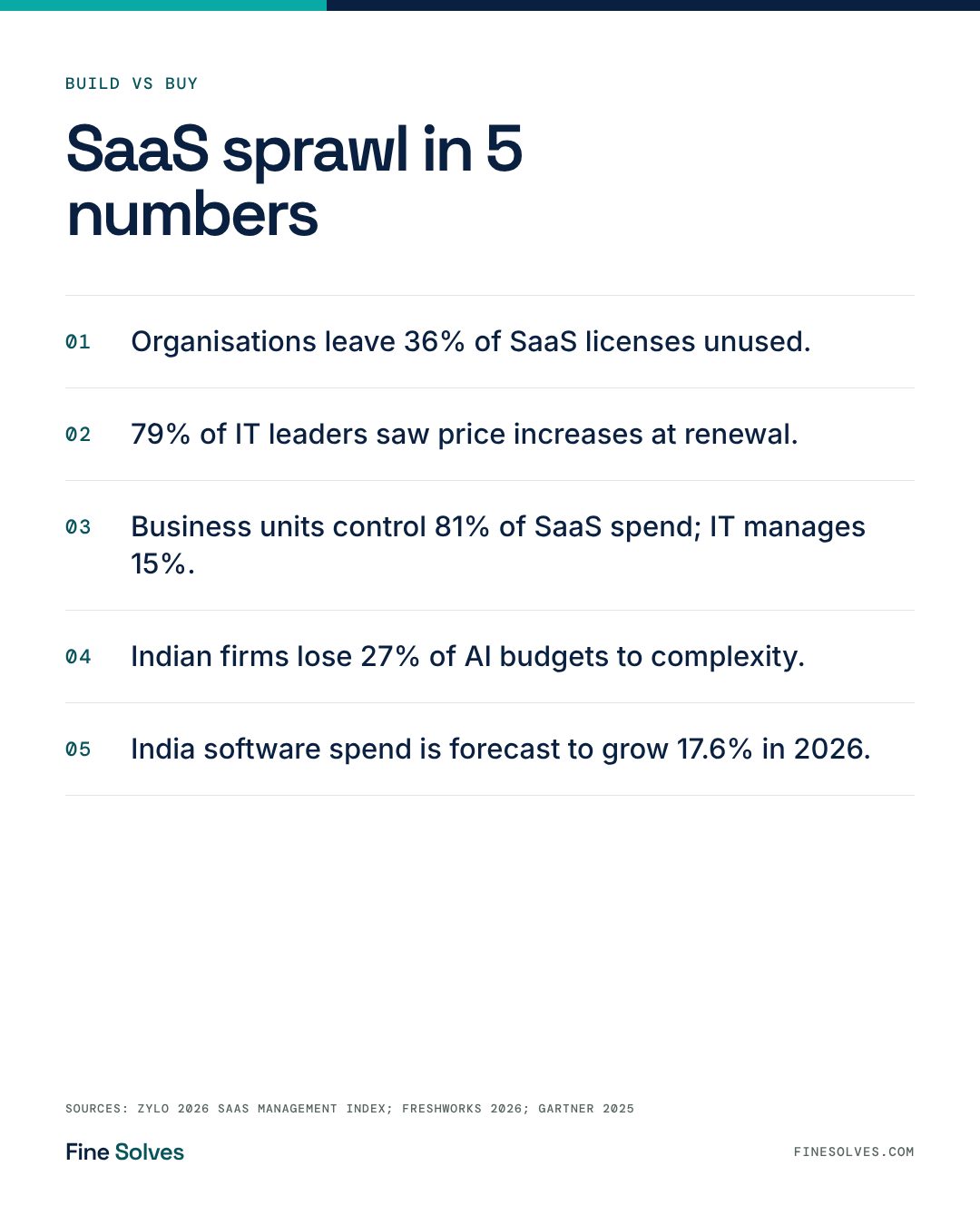
- Organisations leave 36% of SaaS licenses unused, and the median SaaS spend per employee is $9,455 (Zylo, 2026).
- 79% of IT leaders faced price increases at renewal, and renewals make up 87% of total software spend.
- 78% of IT leaders were hit by unexpected AI or usage-based charges; 61% had to cut projects because of unplanned SaaS costs.
- Indian mid-market firms lose 27% of their AI budgets to complexity, about ₹33,000 crore a year, against a 25% global average (Freshworks).
- India's software spend is forecast to grow 17.6% in 2026, the second-fastest IT segment after data center systems (Gartner).
What is SaaS sprawl?
SaaS sprawl is when a company accumulates more software subscriptions than it can track, use or integrate, so licenses, renewals and data silos grow faster than value.
It rarely starts as a decision. A sales team buys a CRM add-on on a card, operations signs up for a scheduling tool, finance adds an AI note-taker. Each purchase is small and sensible. Together they create overlapping tools, duplicate data and renewals that roll over without review. Zylo's index, built on more than 40 million licenses and $75 billion in spend under management, shows how this happens structurally: business units control 81% of SaaS spend while IT directly manages just 15%. Spending without central visibility is the root of tool sprawl.
How much does SaaS sprawl cost a company?
Zylo's 2026 data puts average annual SaaS spend at $55.7 million per organisation, with roughly a third of licenses unused, so the waste runs into millions even for mid-sized portfolios.
The averages are skewed by large enterprises, so the median is more useful: Zylo reports median annual SaaS spend of $20.6 million and median spend of $9,455 per employee. Across Zylo's dataset, license waste fell from $20.9 million to $19.8 million as utilisation improved from 47% to 54%. Better, but still a large bill for seats nobody uses.
Freshworks puts a different frame on it. Its Cost of Complexity survey of 706 practitioners across six countries, India included, found 20% of software budgets are wasted on unnecessary complexity, and that complexity drains an average of 7% of annual revenue. More than half, 53%, said they had not received the ROI they expected from their software, and 43% said implementations had gone over budget in the last 12 months.
| SaaS sprawl benchmark | Figure | Source |
|---|---|---|
| Unused SaaS licenses (average) | 36% | Zylo, 2026 |
| IT leaders facing price increases at renewal | 79% | Zylo, 2026 |
| IT leaders hit by unexpected AI or usage charges | 78% | Zylo, 2026 |
| Organisations that cut projects over SaaS costs | 61% | Zylo, 2026 |
| Share of software budget wasted on complexity | 20% | Freshworks, 2025 |
| Organisations lacking a single source of truth | 37% | Freshworks, 2025 |
Source: Zylo 2026 SaaS Management Index; Freshworks Cost of Complexity Report (November 2025).
Why do SaaS costs keep rising even when the tool count is flat?
Costs rise because renewals, not new purchases, drive most of the bill, and vendors are raising prices and adding usage-based AI charges at renewal.
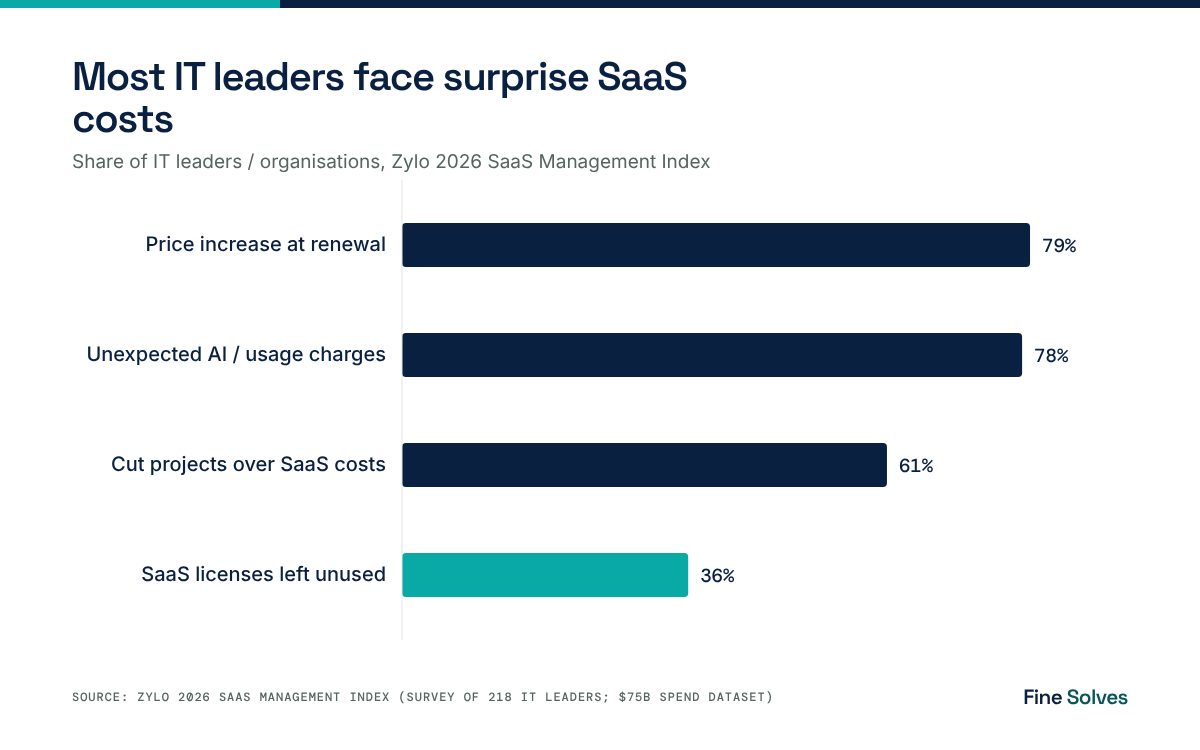
Zylo found application counts were broadly flat year on year, yet total SaaS spend still increased 8%. Renewals account for 87% of total software spend, and 79% of IT leaders saw price increases at renewal in the past year. On top of list-price increases, 78% reported unexpected charges tied to consumption-based or AI pricing, and 61% said unplanned SaaS cost increases forced them to cut projects.
AI is the new accelerant. Spend on AI-native apps rose 108% year on year overall and 393% in organisations with more than 10,000 employees. Expense-based SaaS spend, bought through employee expense claims rather than procurement, grew 267%. Zylo also reports that 60% of IT leaders lack visibility into all the generative AI tools in use, and 77% have found AI features or apps running without IT's knowledge.
Is SaaS sprawl worse for Indian companies?
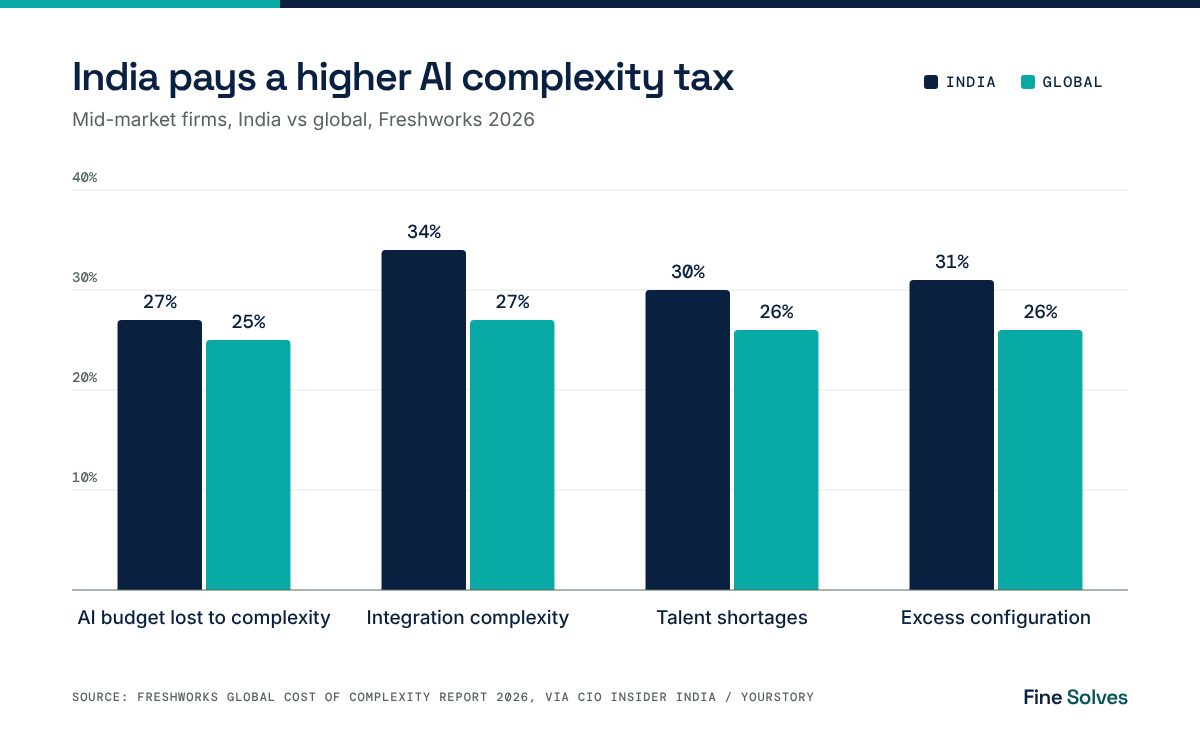
On AI tools, yes: Freshworks found Indian mid-market firms lose 27% of their AI budgets to complexity overhead, above the 25% global average, or about ₹33,000 crore a year.
The same Freshworks study, covering more than 9,000 mid-market IT decision-makers across six countries, reports that Indian firms run an average of 4.6 AI tools against 4.2 globally. Indian respondents also cite every major barrier more often than the global sample: system integration complexity at 34% versus 27%, skilled talent shortages at 30% versus 26%, and excessive configuration at 31% versus 26%.
Expectations are high too. According to CIO Insider's report on the study, 74% of Indian executives expect AI investments to pay back within eight months, while YourStory reports that 88% of Indian IT leaders say managing AI complexity has increased their workloads. Fast payback targets and growing tool counts pull in opposite directions.
| Measure (mid-market firms) | India | Global |
|---|---|---|
| AI budget lost to complexity | 27% | 25% |
| System integration complexity as a barrier | 34% | 27% |
| Skilled talent shortages | 30% | 26% |
| Excessive configuration requirements | 31% | 26% |
Source: Freshworks Global Cost of Complexity Report: The Mid-Market AI Complexity Trap, via CIO Insider India and YourStory (2026).
Where is Indian software spend heading in 2026?
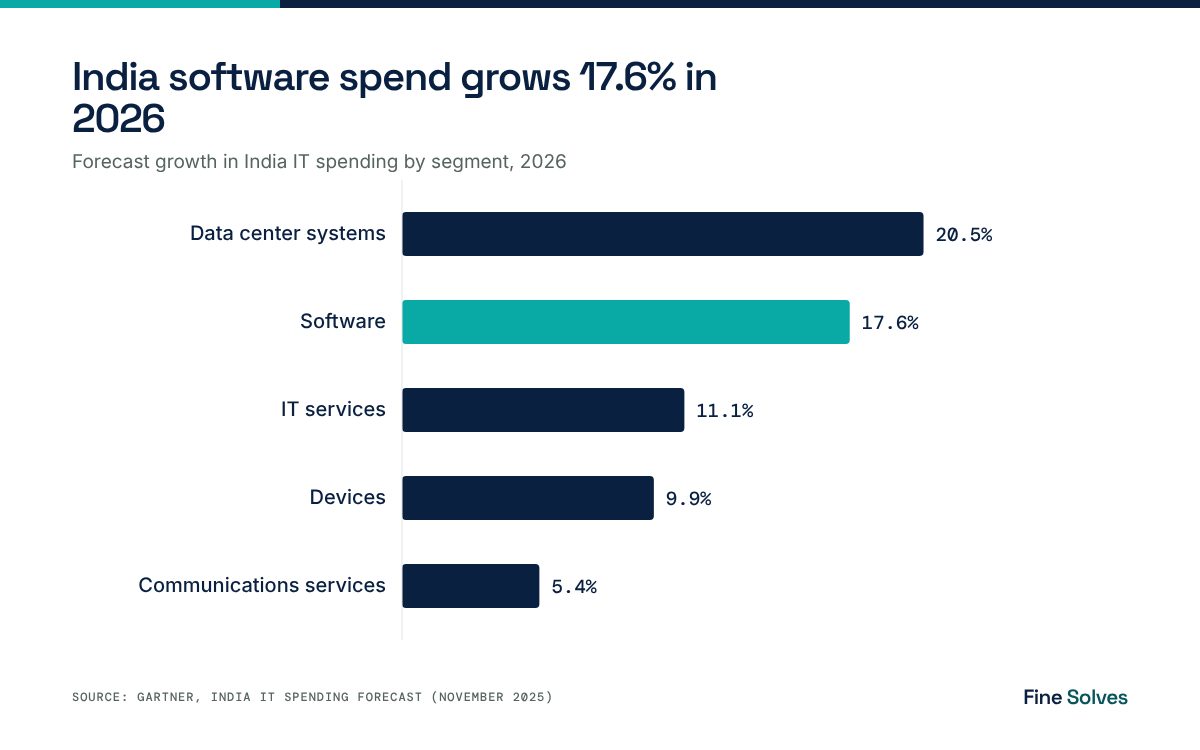
Gartner expects India's software spend to grow 17.6% in 2026, faster than every IT segment except data center systems, within total IT spending of $176.3 billion.
Total Indian IT spending is forecast to grow 10.6%. Data center systems lead at 20.5%, followed by software, IT services at 11.1%, devices at 9.9% and communications services at 5.4%. Globally, the SaaStr summary of Gartner's April forecast puts total IT spending at $6.31 trillion, up 13.5%. More money flowing into software is not a problem in itself. The problem is that without ownership and integration, a growing share of it pays for idle seats and duplicate tools.
How do you cut SaaS sprawl? A 30-day playbook
Start with an inventory and the renewal calendar, then remove unused licenses and duplicate tools before deciding where integration or a custom build would cost less.
- Build one inventory. Pull every software line from accounts payable, corporate cards and expense claims, not just IT's contracts. With business units controlling most of the spend, the expense trail is where the hidden tools are.
- Map renewals 90 days out. Put every renewal date, owner and notice period on one calendar. Renewals are where price increases land, so they are where negotiation has to start.
- Measure real usage. Compare paid seats against active users from each tool's admin logs. Downgrade or remove inactive seats before the next renewal, not after.
- Group tools by job. List what each tool does. Three tools doing the same job is the clearest consolidation target.
- Cap usage-based AI charges. Ask every vendor how AI credits or per-resolution pricing are billed, set budget alerts, and route new AI tools through a light approval step.
- Fix the data path. Choose a system of record for customers, orders and inventory, and integrate the rest to it. Duplicate data entry is the hidden labour cost of sprawl.
- Decide build vs buy per workflow. Where you are stitching several subscriptions together to run one core process, compare that bill with a single custom application built around the workflow.
When does custom software beat another subscription?
Custom software makes sense when a core workflow needs several SaaS tools plus manual glue, or when integration and configuration effort exceeds what the subscriptions save.
The Freshworks data points at the trigger. Indian firms name integration complexity and excessive configuration as top barriers more often than their global peers, and 37% of companies in the broader survey say they lack a single source of truth. If your team re-keys the same order into three tools, pays for seats in each, and still cannot get one report, the subscription model is costing more than it appears. From the way we build at Fine Solves, the useful test is simple: buy commodity functions such as email, payroll and accounting, and build the workflow that makes your operation different.
What this means for Indian businesses
For Indian SMB and mid-market firms, SaaS sprawl is now an operating cost, not an IT housekeeping issue. Software budgets are growing at 17.6% a year, renewals are getting pricier, and AI add-ons arrive with usage-based bills. The firms that come out ahead will run a quarterly software review, own their renewal calendar, and replace patchworks of subscriptions with integrated systems where it matters. If your stack has grown faster than your team can manage, Talk to Fine Solves about consolidating it into software that fits how you work.
Frequently asked questions
What causes SaaS sprawl?
SaaS sprawl is caused by decentralised buying. Zylo's 2026 index found business units control 81% of SaaS spend while IT directly manages only 15%, so teams buy tools on cards and expense claims without a central inventory. Auto-renewals, free trials that convert to paid plans, and new AI tools added on top of existing ones make the portfolio grow faster than anyone reviews it.
How many SaaS licenses go unused?
According to Zylo's 2026 SaaS Management Index, organisations leave an average of 36% of their SaaS licenses unused. Utilisation across Zylo's dataset improved from 47% to 54%, which means a large share of paid seats still sits idle. Reviewing active users before every renewal is the fastest way to recover that spend.
How much do Indian companies lose to software complexity?
Freshworks' 2026 mid-market study estimates Indian firms lose 27% of their AI budgets to complexity overhead, or about ₹33,000 crore in wasted AI spend each year. That is higher than the 25% global average. Integration complexity, cited by 34% of Indian respondents, is the most common barrier.
How do you reduce tool sprawl without disrupting teams?
Start with visibility, not cuts. Build one inventory from finance and expense data, map renewal dates, and measure active usage. Remove unused seats first, then consolidate tools that do the same job. Involve each team's owner before removing a tool, and integrate the remaining systems so data is entered once.
Is building custom software cheaper than SaaS?
Not always. Buying is usually cheaper for commodity functions like email, accounting or payroll. Custom software tends to pay off when a core workflow needs several subscriptions plus manual work to connect them. Compare the total cost of seats, integration and rework over three years with the cost of building and maintaining one system.
Sources
- Zylo's 2026 SaaS Management Index — Zylo, 2026
- SaaS Statistics for 2026 (Spend, Usage & Waste) — Zylo, 2026
- 20% of Software Budgets Wasted on Unnecessary Business Complexity, Freshworks Survey Finds — Freshworks, 2025
- India Leads Mid-Market AI Push Amid Rising Complexity Costs — CIO Insider India, 2026
- India's mid-market firms lead in AI adoption but face rising complexity costs: Freshworks Report — YourStory, 2026
- Gartner Forecasts India IT Spending to Exceed $176 Billion in 2026 — Gartner, 2025
- Gartner: Software Spend Now $1.44 Trillion in 2026 — SaaStr, 2026
Last updated: 9 November 2026. Published by Fine Solves — an AI software development company in Ahmedabad building custom software and AI systems for Indian businesses. finesolves.com