
Logistics Cost in India at 7.97% of GDP: 2026 Guide
Logistics cost in India was 7.97% of GDP in 2023–24, according to the first official DPIIT–NCAER estimate. That is ₹24.01 lakh crore, and far below the 13–14% figure quoted for years. The national average hides the real problem: small firms carry more than double the burden of large ones, and road freight still costs almost twice as much as rail per tonne-km.
For a decade, Indian boardrooms planned around a logistics bill of 13–14% of GDP. That number was never measured. In September 2025 the Department for Promotion of Industry and Internal Trade (DPIIT) and NCAER published a survey-based estimate built from more than 500 industry users and 3,000 service providers. The headline is good news for India's competitiveness. The detail underneath is more useful for an operations head, because it shows exactly where freight and warehousing money goes, and which levers a single company can pull.
TL;DR
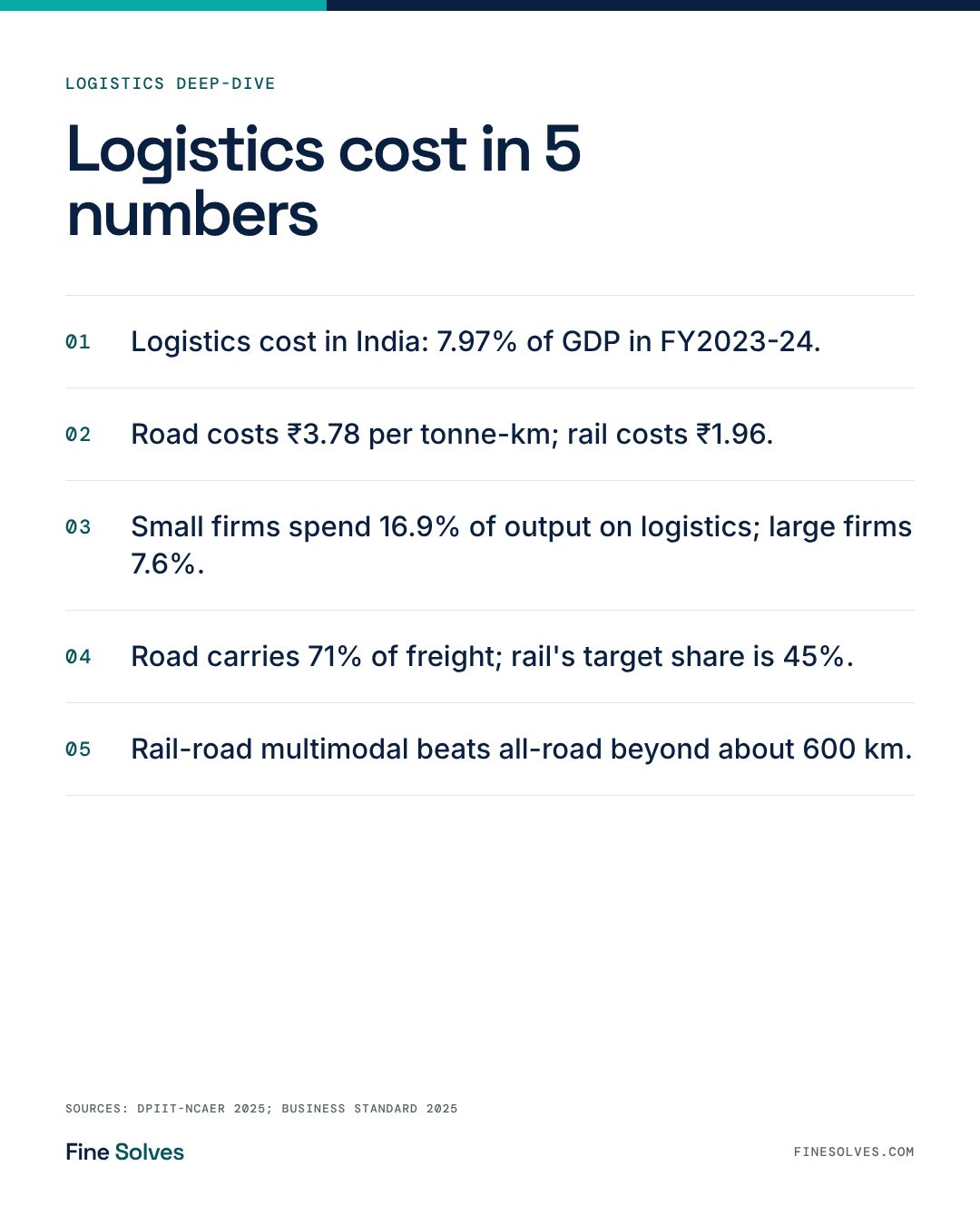
- Logistics cost in India is 7.97% of GDP and 9.09% of non-services output, per DPIIT–NCAER.
- Road costs ₹3.78 per tonne-km against ₹1.96 for rail and ₹1.80 for coastal shipping.
- Small firms spend 16.9% of output on logistics; large firms spend 7.6%.
- Road still carries a 71% modal share; rail has 27%, against a policy target of 45%.
- Rail-road multimodal becomes cheaper than all-road beyond roughly 600 km.
What is the logistics cost in India today?
The official figure is 7.97% of GDP for FY2023–24, or ₹24.01 lakh crore at current prices. The DPIIT–NCAER study also expresses it as 9.09% of non-services output, which covers agriculture, mining and manufacturing, the sectors that actually move goods.
The older 13–14% number came from external studies and partial datasets, as Commerce Minister Piyush Goyal noted when the report was released, according to ITLN. The new estimate is based on primary surveys and national accounts. It does not mean logistics in India suddenly became cheap. It means the measurement finally exists, and companies can benchmark against it.
How does India compare with the US, Germany and Australia?
India now sits inside the band of developed economies, which typically spend 7–8% of GDP on logistics, Maritime Gateway reports. Business Standard's analysis puts the US at 8.8%, Australia at 8.6% and Germany at 8%.
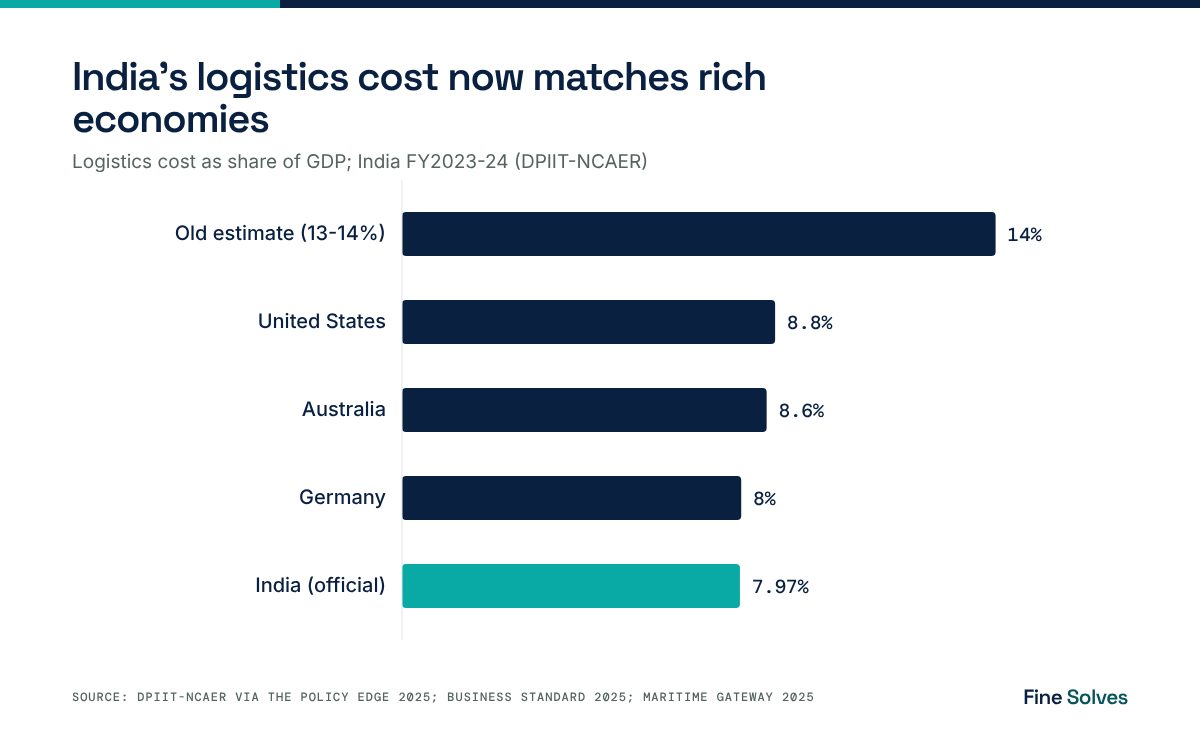
The comparison flatters India slightly. A services-heavy GDP lowers the ratio, which is why the 9.09% non-services figure is the better benchmark for a manufacturer. On the World Bank's Logistics Performance Index, India ranked 38 of 139 countries in 2023 with a score of 3.4, ThePrint reported. That is better than 44 in 2018, but still well behind the economies whose GDP ratio India now matches.
Why does road freight cost so much more?
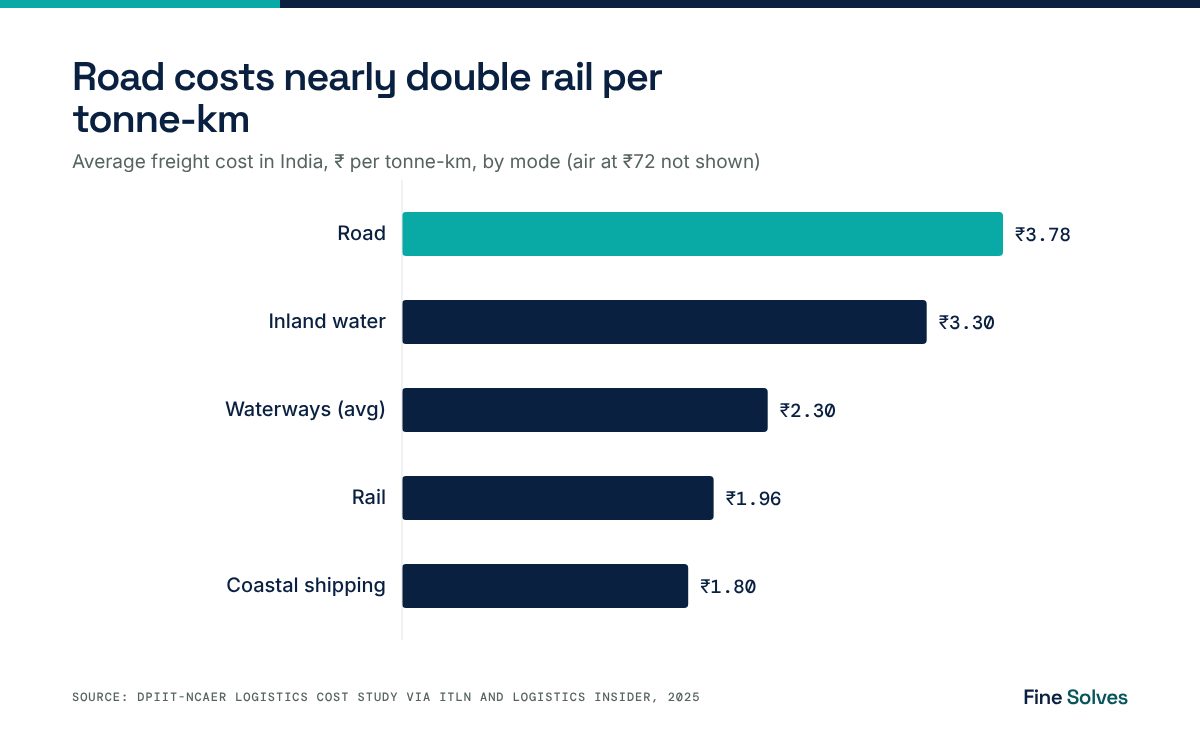
Road costs ₹3.78 per tonne-km, nearly double rail at ₹1.96, and road still carries most freight. The DPIIT–NCAER study found coastal shipping cheapest at ₹1.80, with air at ₹72 per tonne-km.
| Mode | Cost per tonne-km | Best fit |
|---|---|---|
| Coastal shipping | ₹1.80 | Bulk between port states |
| Rail | ₹1.96 | Long-haul, beyond about 600 km |
| Waterways (average) | ₹2.30 | Bulk, non-urgent cargo |
| Inland water transport | ₹3.30 | River corridors |
| Road | ₹3.78 | Short-haul, first and last mile |
| Air | ₹72 | High-value, time-critical |
Source: DPIIT–NCAER logistics cost study, via ITLN and Logistics Insider, 2025.
Speed is part of the problem. A year-long government study found commercial vehicles average 37–38 km/h on highways and 47–48 km/h on expressways, NewsBytes reported, even on roads designed for 100–120 km/h. Drivers can lose up to a day each at loading and unloading. Every hour a truck waits at a dock is paid for in the tonne-km rate.
Why do small firms pay twice as much for logistics?
Small firms spend 16.9% of output on logistics against 7.6% for large firms, according to the DPIIT–NCAER study, because they buy freight in small, irregular lots. Business Standard notes that firms with turnover below ₹5 crore spend close to a sixth of turnover on logistics.
The gap is structural. A small manufacturer ships part-truckloads, pays spot rates, rarely has the volume for a rail rake, and holds extra stock because it cannot trust delivery dates. Each of those habits adds cost. None of them is fixed by national infrastructure alone; they are fixed by better planning data inside the company.
Warehousing adds to the bill. The study puts average warehousing cost at ₹30 per sq ft per month, and ITLN reports that manpower is the largest component, at 30% of total warehousing expenses.
Is the shift from road to rail actually happening?
Slowly. Road holds a 71% modal share and rail 27%, Business Standard reports, while the National Logistics Policy projects rail rising to 45%. Road alone accounts for 42% of logistics cost.
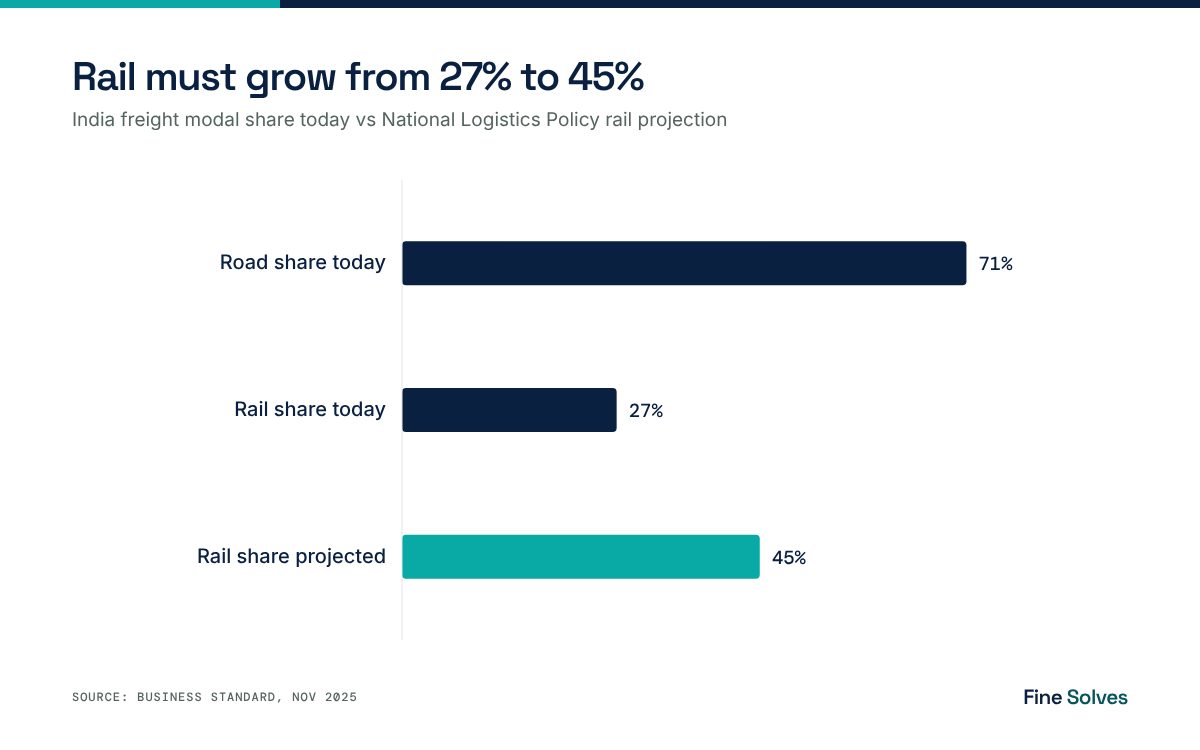
Road also accounts for 55% of India's diesel consumption, which ties freight cost directly to fuel prices. The policy aim is to keep logistics cost below 10% of GDP by 2030 and move closer to 7%. Infrastructure is following: 35 multimodal logistics parks have been approved. For a single company, the useful fact is the break-even. The study shows rail-road multimodal beating all-road beyond roughly 600 km, assuming a 500 km rail haul with 50 km of road at each end, according to The Policy Edge.
Where can AI in logistics cut cost for an Indian firm?
AI in logistics pays where it removes waiting, empty space and excess stock: route and load planning, dock scheduling, demand forecasting and mode selection. It cannot change the national tonne-km rate.
Ports show what digital visibility does. At Visakhapatnam, container dwell time fell from 32.4 days in 2015 to 5.3 days in 2019, ITLN reported in its coverage of the World Bank index. The same World Bank analysis found that digitalisation lets countries shorten port delays by up to 70%. The pattern holds inside a company: most freight savings come from knowing earlier where goods are and when they will be needed.
From the way we build these systems, the cost wins usually come from boring plumbing. That means one clean shipment record joined to orders, invoices and dock times, before any model is trained.
How to cut your logistics cost: a 6-step playbook
- Measure your own ratio. Add freight, warehousing, inventory carrying and admin cost, then divide by output. Compare it with 7.6% for large firms and 16.9% for small firms.
- Price every lane per tonne-km. Benchmark each lane against road at ₹3.78 and rail at ₹1.96 per tonne-km. Lanes far above the road average are your first targets.
- Test multimodal on long lanes. Any regular lane beyond about 600 km is a candidate for rail-road. Coastal shipping at ₹1.80 is worth pricing for port-to-port flows.
- Cut dock time. Slot booking and digital proof of delivery attack the day lost at loading and unloading.
- Consolidate part-loads. Pool shipments across plants, distributors or neighbouring firms to buy full truckloads.
- Forecast before you stock. Better demand forecasts reduce safety stock and the warehouse space, at ₹30 per sq ft per month, that holds it.
What this means for Indian businesses
The 7.97% figure gives every Indian company a defensible benchmark for the first time. Large firms are already near it. Mid-market and small firms are not, and the gap between 7.6% and 16.9% is mostly operating discipline: visibility, consolidation and mode choice. That is software and data work more than capex. If you want a second view on where your freight data is leaking money, Talk to Fine Solves.
Frequently asked questions
What is the logistics cost in India as a percentage of GDP?
India's logistics cost was 7.97% of GDP in FY2023–24, according to the DPIIT–NCAER study released in September 2025. In absolute terms it was ₹24.01 lakh crore at current prices. Measured against non-services output, meaning agriculture, mining and manufacturing, the ratio is 9.09%.
Why was India's logistics cost earlier quoted at 13–14%?
The 13–14% figure came from external studies and partial datasets, not from an official survey. The DPIIT–NCAER study was the first estimate built from primary data, covering more than 500 industry users and 3,000 logistics service providers, combined with national accounts data.
Which freight mode is cheapest in India?
Coastal shipping is cheapest at ₹1.80 per tonne-km, followed by rail at ₹1.96 and waterways at an average of ₹2.30 per tonne-km. Road costs ₹3.78 per tonne-km and air ₹72 per tonne-km. Rail-road multimodal becomes cheaper than all-road transport beyond roughly 600 km.
What is the National Logistics Policy target?
The National Logistics Policy, launched in September 2022, aims to bring logistics cost to global benchmarks by 2030. Business Standard describes the goals as keeping cost below 10% of GDP, moving closer to 7%, and raising rail's freight share from 27% to 45%.
How can a mid-sized company reduce its logistics cost?
Start by measuring logistics cost as a share of output and pricing every lane per tonne-km. Then move long lanes beyond about 600 km to rail-road, consolidate part-loads, cut dock waiting time, and use demand forecasting to hold less stock in warehouses.
Sources
- DPIIT Releases First Official Assessment of India's Logistics Cost — The Policy Edge, 2025
- India's Logistics Cost at 7.9% of GDP: DPIIT-NCAER Report — Logistics Insider, 2025
- Indian logistics costs at 7.97% of GDP, new study reveals — ITLN, 2025
- Confidence in India's logistics cost: The story of economic transition — Business Standard, 2025
- India's logistics costs fall to 7.97% of GDP in FY 2023–24: DPIIT — Maritime Gateway, 2025
- India jumps six spots to 38 in World Bank's Logistics Performance Index 2023 — ThePrint, 2023
- India jumps 6 places to 38 in global logistics performance Index — ITLN, 2023
- Why trucking in India is slow despite faster expressways — NewsBytes, 2026
Last updated: 5 November 2026. Published by Fine Solves — an AI software development company in Ahmedabad building custom software and AI systems for Indian businesses. finesolves.com