India's AI Complexity Tax: Why 27% of AI Budgets Leak
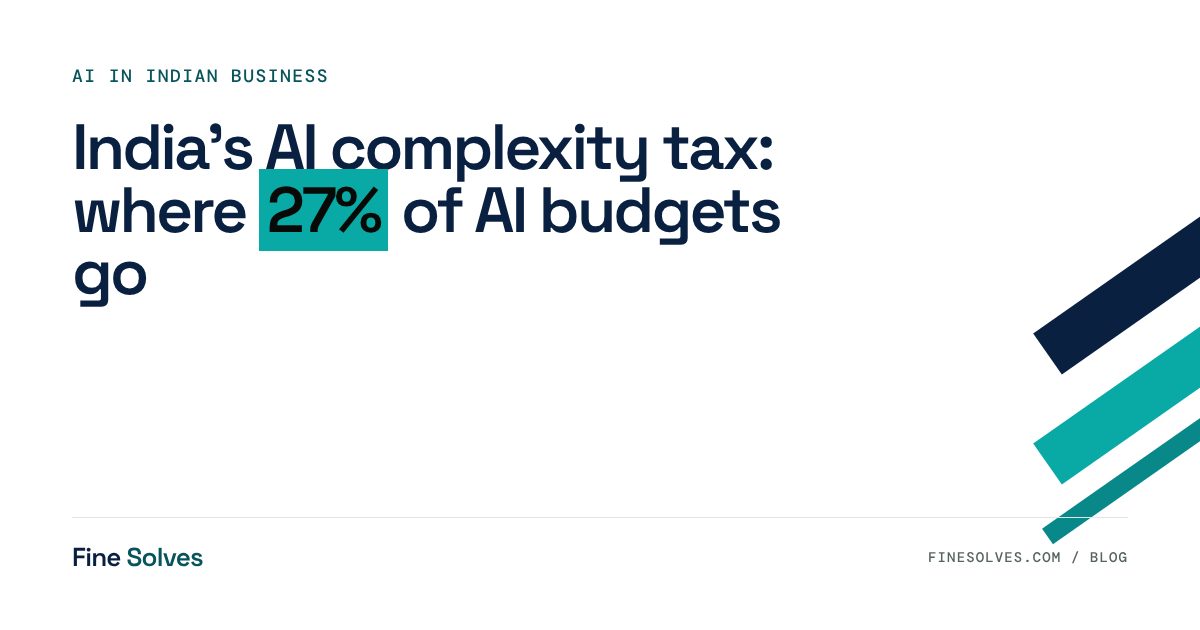
Indian mid-market companies lose about 27% of their AI budgets to "complexity overhead" — tool sprawl, integration work and configuration — rather than to the AI itself, according to Freshworks' 2026 Global Cost of Complexity Report. The fix is not more AI tools. It is fewer, focused systems built around one business bottleneck at a time.
India is now one of the fastest AI adopters in the world. The uncomfortable follow-up is that a large share of that spend is leaking before it ever reaches the shop floor, the warehouse or the hospital front desk. This post breaks down where the money goes, why it happens, and what a leaner approach to enterprise AI looks like for Indian SMBs and mid-market firms.
TL;DR
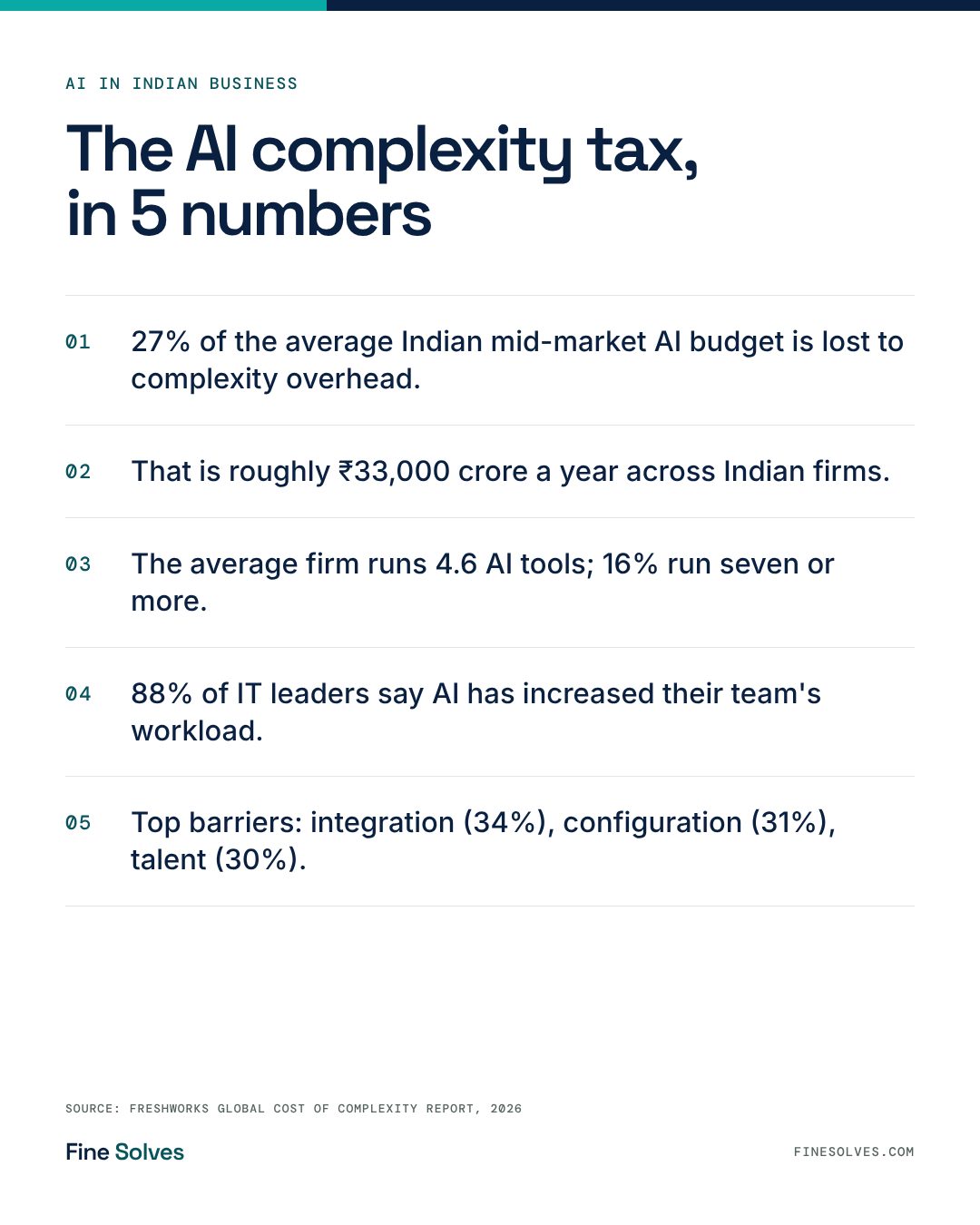
- 27% of the average Indian mid-market AI budget is lost to complexity overhead (global average: 25%).
- The average Indian mid-market firm runs 4.6 AI tools; 16% run seven or more.
- 88% of Indian mid-market IT leaders say managing AI has increased their team's workload.
- Top barriers: system integration (34%), excessive configuration (31%), skilled-talent shortages (30%).
- The leaner path: one bottleneck, one integrated system, a measurable result inside a quarter.
What is the "AI complexity tax"?
The AI complexity tax is the share of an AI budget spent on making tools work together rather than on the outcomes those tools were bought for. It shows up as duplicate subscriptions, custom connectors between systems that don't talk to each other, configuration time, retraining staff on every new interface, and IT hours spent firefighting.
Freshworks surveyed more than 9,000 mid-market IT decision-makers across six countries. In India, it put the leak at 27% of the average AI budget — an estimated ₹33,000 crore a year across Indian firms.
Why are Indian companies hit harder than the global average?
Because they are moving faster. The same Freshworks data shows 36% of Indian mid-market firms have AI embedded across multiple core operations, more than double the global figure of 15%. Deloitte's State of AI in the Enterprise: India Insights (2026) found that close to 40% of Indian companies use AI at scale, against a 28% global average — while India ranks low on deep technical expertise.
Speed without architecture produces sprawl. A CRM add-on here, a chatbot there, a forecasting plug-in bolted onto a spreadsheet — each purchase makes sense alone. Together they create a patchwork that someone has to maintain.
Where does the money actually leak?
- Integration. 34% of Indian mid-market leaders name system integration as a leading barrier. Every tool that can't read from your ERP, billing system or WMS needs a connector, and every connector needs an owner.
- Configuration. 31% cite excessive configuration. Generic platforms are built for every industry, so they fit none of them out of the box.
- Talent. 30% cite skilled-talent shortages. Running five AI tools means five sets of skills, five vendors and five escalation paths.
- Time-to-value. 74% of Indian executives expect AI to return its investment within eight months, yet deployment in most mid-market firms takes six to twelve months. The return window and the deployment window are often the same window.
Is agentic AI the answer — or more of the same?
Agentic AI — systems that plan and act across steps rather than answer one prompt — is where most enterprise roadmaps are heading. Everest Group's 2026 mid-market playbook (commissioned by R Systems) found that 43% of mid-market firms are skipping traditional maturity stages to move straight to agentic models, yet only 15% have actually scaled them.
Agents amplify whatever foundation they sit on. An agent connected to clean, integrated data closes the loop from insight to action. An agent dropped onto a tangle of disconnected tools simply adds a sixth tool to manage.
How do you avoid the complexity tax?
From the way we build at Fine Solves, five rules hold up across manufacturing, logistics and healthcare operations:
- Start with one bottleneck, not a platform. Pick the process that costs the most hours or rupees — billing errors, stock-outs, manual scheduling — and solve that first.
- Build on the data you already have. Integrate with the existing ERP, accounting or HMS instead of adding a parallel system that needs syncing.
- Prefer one focused system over several generic tools. A custom build scoped to your workflow often needs less configuration than an off-the-shelf suite that does everything.
- Set a 90-day result. Define the metric before you write a line of code: hours saved, error rate, turnaround time.
- Retire before you add. Every new system should replace at least one spreadsheet, tool or manual handoff.
What this means for Indian SMBs and mid-market firms
The opportunity is real: Indian companies are adopting AI faster than most of the world, and 94% of mid-market firms plan to raise AI spending over the next two years. The firms that win won't be the ones running the most AI tools. They will be the ones whose AI actually connects to how work gets done — fewer moving parts, faster payback.
That is the approach behind Fine Solves: precise, fast custom software and AI systems that return hours to your team. It is also how we built FineHealth by Fine Solves, an end-to-end hospital management system that brings OPD, IPD, billing and prescriptions into one place instead of five.
Have a process that's quietly eating your team's week? Talk to Fine Solves — we'll help you scope the one system worth building first.
Frequently asked questions
What percentage of AI budgets is wasted in India?
Freshworks' 2026 Global Cost of Complexity Report estimates that Indian mid-market firms lose 27% of their AI budgets to complexity overhead, slightly above the 25% global average — roughly ₹33,000 crore a year.
Why is AI adoption creating more work for IT teams?
Because most firms add tools faster than they integrate them. 88% of Indian mid-market IT leaders say managing AI complexity has increased their workload, driven by integration, configuration and vendor management.
Is custom software better than off-the-shelf AI tools?
Not always. Off-the-shelf works when your process is standard. Custom builds tend to win when the workflow is specific to your business, when several tools would otherwise need stitching together, or when integration with existing systems is the main cost.
How long should an AI project take to show ROI?
Most Indian executives expect payback within eight months. Scoping projects to a single bottleneck with a measurable 90-day target is the most reliable way to meet that expectation.
What is agentic AI?
Agentic AI refers to systems that can plan, decide and act across multiple steps toward a goal — for example, detecting a supplier delay, re-planning a production schedule and notifying the team — rather than answering a single query.
Sources
- YourStory — Freshworks Global Cost of Complexity Report (May 2026)
- CIO Insider India — India leads mid-market AI push amid rising complexity costs
- MediaNews4U — The complexity overhead in India's mid-market
- Business Today — Deloitte State of AI in the Enterprise: India Insights (2026)
- The Tribune — Everest Group / R Systems: Agentic AI 2026 Mid-Market Playbook
Published by Fine Solves — an AI software development company in Ahmedabad building custom software and AI systems for Indian businesses. finesolves.com