
India Manufacturing PMI at 54.7: What October Signals
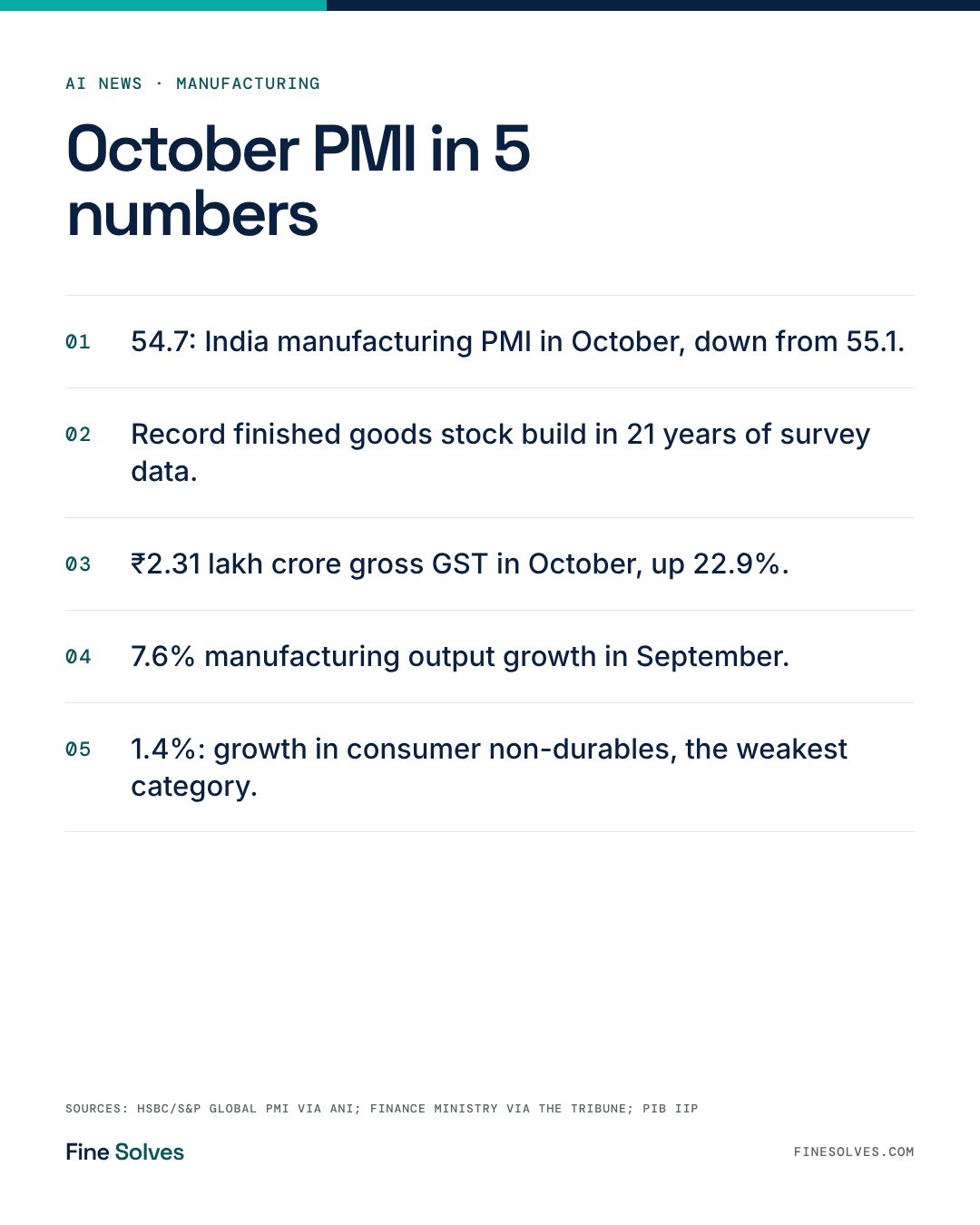
The India manufacturing PMI eased to 54.7 in October 2026 from 55.1 in September, according to the HSBC survey compiled by S&P Global. Factories are still growing, and export orders hit a six-month high. The warning sign is stock: finished goods piled up at a record pace while selling-price growth was the weakest in nearly four years.
The final October reading came out on 2 November, in the same week as October GST data and a few days after the September factory output numbers. Taken together, they show demand that is healthy but uneven, and factory floors carrying more stock than they have in the survey's history. For a plant head, a supply chain lead or a CFO in an Indian manufacturing or distribution business, the question this week is less about growth and more about how much inventory you are carrying into the post-festive months.
TL;DR
- The HSBC India Manufacturing PMI fell to 54.7 in October from 55.1, still well above the 50 mark, ANI reports.
- Finished goods stocks rose at a record pace in the survey's more than 21-year history, according to Maritime Gateway.
- Gross GST collections rose 22.9% to ₹2.31 lakh crore in October, with import GST up 42.2%, per Finance Ministry data reported by The Tribune.
- Manufacturing output grew 7.6% in September, but consumer non-durables grew only 1.4%, PIB data shows.
- McKinsey found AI-driven forecasting can cut supply chain forecast errors by 20% to 50%.
What did the October 2026 India manufacturing PMI show?
It showed slower but solid growth: the index eased to 54.7 from 55.1, with output and new orders still rising and export orders at a six-month high.
The flash estimate on 23 October had put the reading at 54.9, according to Trading Economics, so the final number was revised down. Any reading above 50 signals expansion. The survey is based on a panel of around 400 manufacturers, Maritime Gateway reports.
The headline hides more movement underneath. New export orders grew at their fastest pace in six months, with demand reported from markets including the US, the UAE, the UK and Saudi Arabia. Pranjul Bhandari, chief India economist at HSBC, said strong international demand pushed export orders to a "six-month high". Overall new business growth softened from September's seven-month high.
| PMI component | October 2026 signal | What it means for operators |
|---|---|---|
| Headline PMI | 54.7, down from 55.1 (flash estimate 54.9) | Growth continues, at a slightly slower pace |
| New export orders | Fastest growth in six months | Export-facing lines are carrying the demand |
| Finished goods stocks | Record rise in the survey's 21-year history | More working capital tied up in unsold goods |
| Input purchasing | Weakest growth in a 64-month expansion run | Buyers are already slowing raw material orders |
| Output prices | Slowest rise in nearly four years | Little pricing room to clear excess stock |
| Business confidence | About 18% expect higher output next year; below long-run average | Firms are planning cautiously |
Source: HSBC India Manufacturing PMI (S&P Global), via ANI and Maritime Gateway, 2–3 November 2026; flash estimate via Trading Economics.
Why does the record finished goods inventory build matter?
Because stock that piles up faster than sales ties up cash, and October's survey shows the fastest finished goods build on record while price growth slowed.
According to Maritime Gateway's summary of the survey, finished goods stocks rose at a record pace in more than 21 years of data. Input inventories also grew at the fastest pace in eight months. At the same time, raw material purchasing grew at its weakest rate in a 64-month expansion sequence, which suggests buyers have already noticed and are easing off.
Some of the build may be deliberate, since firms often stock up ahead of the festive peak. The risk is what happens after Diwali. If domestic sell-through slows while output stays high, the extra stock has to be discounted, held or written down. With output-price growth at its weakest in nearly four years, ANI reports, there is little pricing cushion to absorb that.
What do GST collections for October 2026 say about demand?
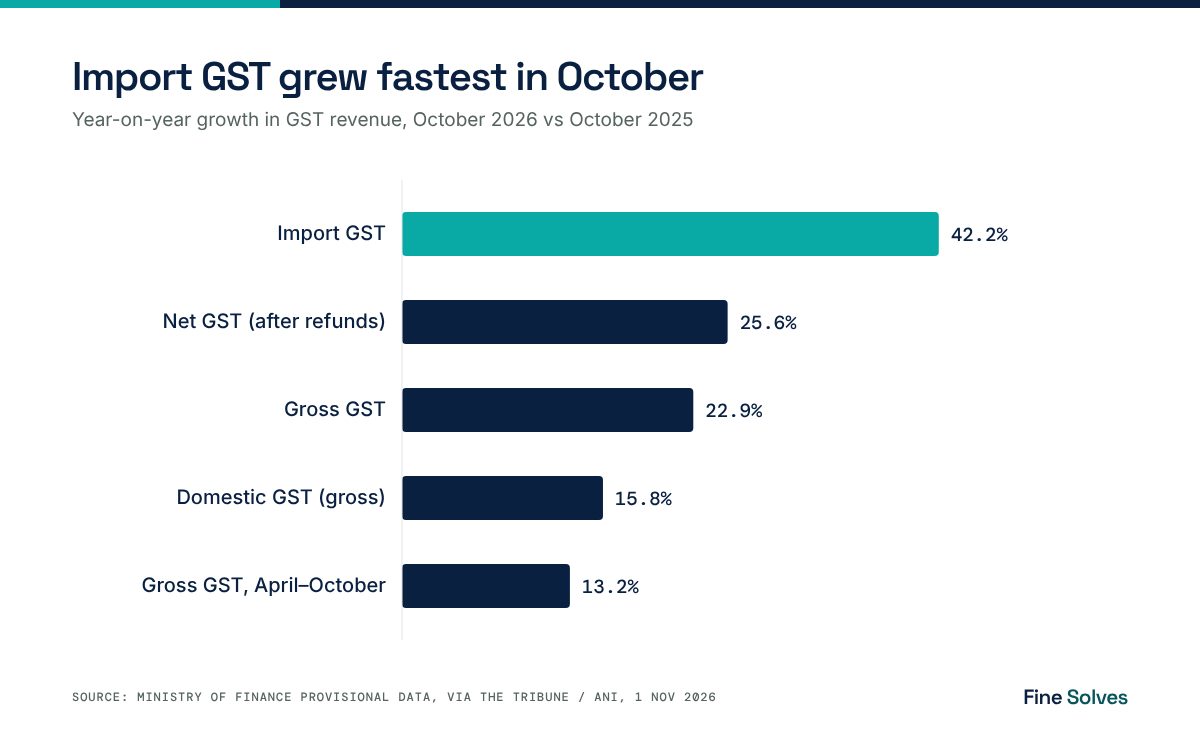
They say demand is strong in value terms: gross GST rose 22.9% to ₹2.31 lakh crore, but imports did much of the work.
Gross collections were ₹1.88 lakh crore in October 2025, according to provisional Finance Ministry data reported by The Tribune. Net revenue after refunds rose 25.6% to ₹2.03 lakh crore. GST on imports rose 42.2% to ₹72,246 crore, far faster than domestic GST, which grew 15.8% to ₹1.59 lakh crore.
The state numbers matter for anyone selling into the west. Maharashtra's domestic GST rose 13% to ₹35,150 crore and Gujarat's rose 16% to ₹13,516 crore. For April to October, gross collections reached ₹14.77 lakh crore, up 13.2% on last year. GST is a value measure, so it captures prices and imports as well as volumes. Read it alongside factory data, not instead of it.
Which manufacturing segments are growing fastest?
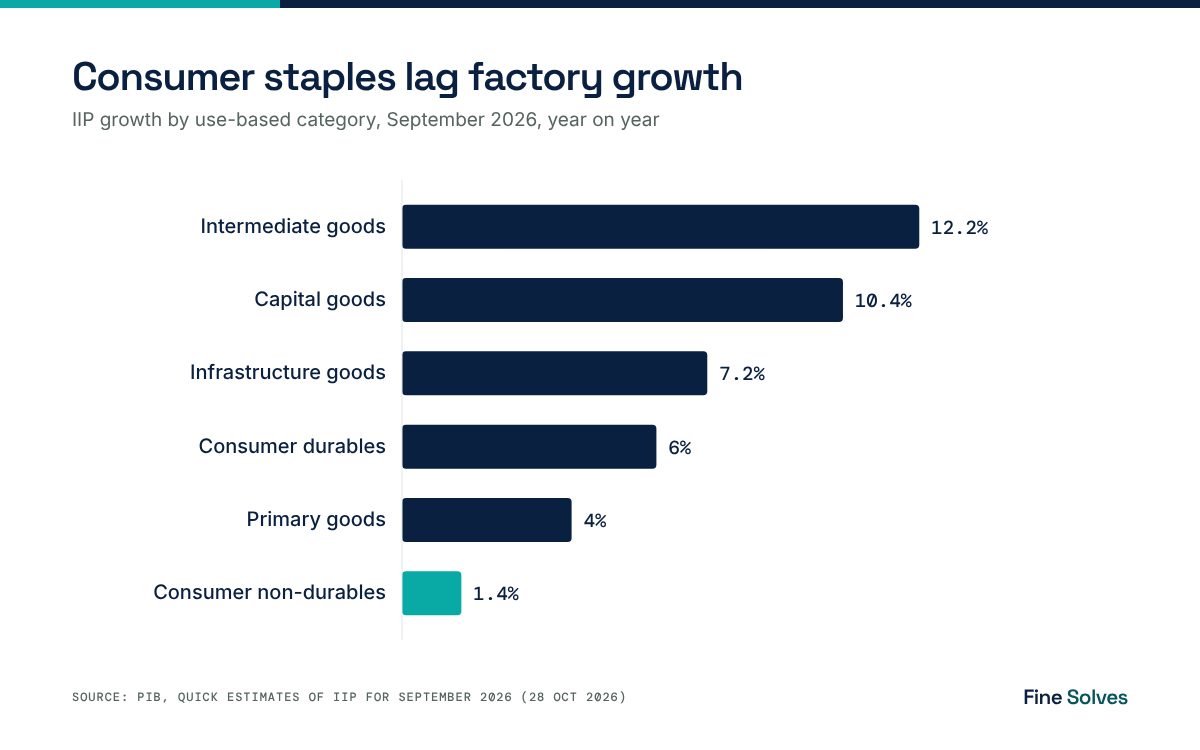
Intermediate and capital goods are growing fastest, at 12.2% and 10.4% in September, while consumer non-durables grew just 1.4%, according to the latest IIP data.
India's Index of Industrial Production grew 6.7% in September 2026, down from 8.0% in August, according to quick estimates released by PIB on 28 October. Manufacturing grew 7.6%, and 7.5% for April to September. Mining output fell 6.2%.
The industry detail points to an investment and components cycle, not a broad consumer surge. Electrical equipment grew 33.9%, rubber and plastics products 19.9%, and motor vehicles, trailers and semi-trailers 19.0%, the release shows. Infrastructure and construction goods grew 7.2%, consumer durables 6.0% and primary goods 4.0%. Everyday consumer goods, the 1.4% category, are where a stock build is most likely to sit unsold.
How can AI demand forecasting help manage inventory now?
AI demand forecasting helps by spotting slowing sell-through earlier at SKU level, so plants cut production or move stock before it ages, instead of after the month-end review.
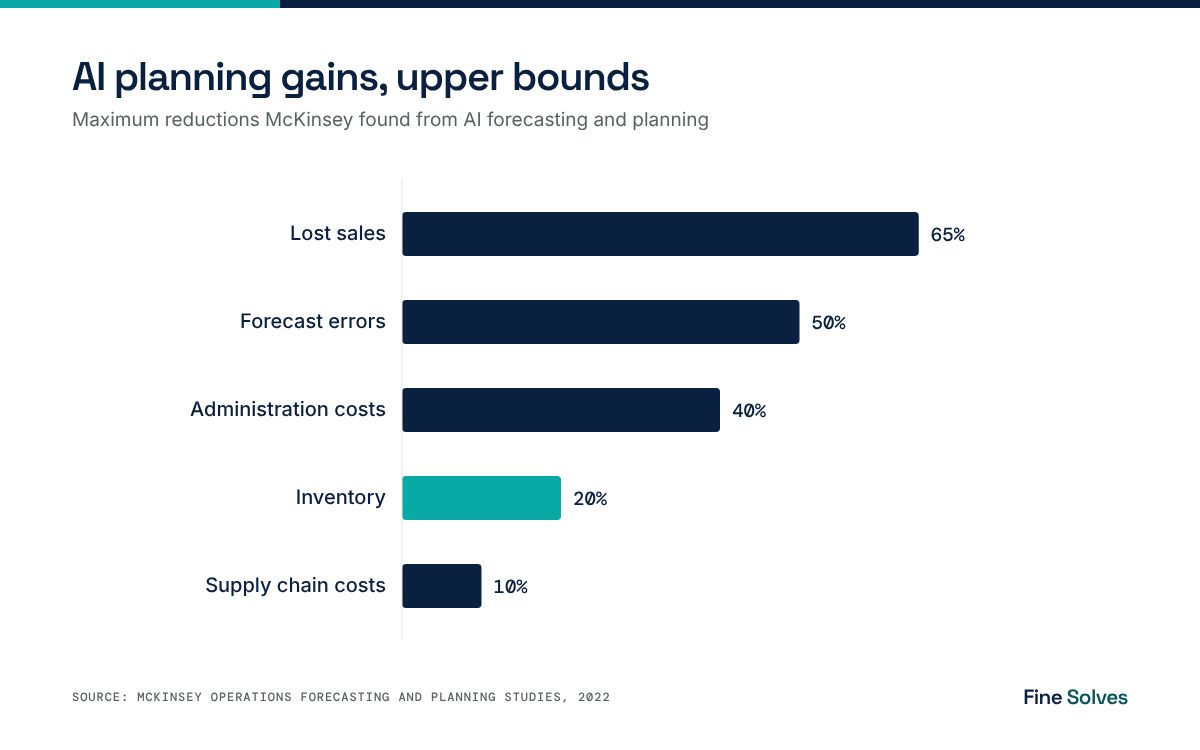
McKinsey found AI-driven forecasting can reduce supply chain forecast errors by 20% to 50%, and reduce lost sales and product unavailability by up to 65%. The same research found warehousing costs can fall by 5% to 10% and administration costs by 25% to 40%.
A separate McKinsey study of consumer goods planning reported inventory reductions of up to 20%, supply chain cost cuts of up to 10% and revenue gains of up to 4%. In one example, SKU-level forecast accuracy improved 10% to 12%, finished goods inventory fell 6% to 8% and order fill rates rose 3% to 5%. The first version was built in three months. The same study found about 80% of Asian consumer goods makers interviewed still ran traditional planning, and only 7% had adopted autonomous planning.
A 6-step inventory check for the post-festive months
- Pull days of cover by SKU, not by category. A category can look healthy while its slowest SKUs carry months of stock.
- Split demand into export and domestic. October's PMI shows export orders at a six-month high while overall new business growth softened. Plan each channel on its own trend.
- Compare dispatches with secondary sales. Shipments to distributors look like demand until the retailer stops reordering. Track both weekly.
- Re-forecast weekly through January. A monthly plan is too slow after a festive peak. Use the last 8 to 12 weeks, adjusted for the festive calendar.
- Set a trigger for production cuts. Agree in advance the stock level at which a line slows, so the call is not made in a crisis meeting.
- Start one AI forecasting pilot on your top SKUs. Pick a product family with clean sales history and measure forecast error before and after over one quarter.
What this means for Indian businesses
For most Indian manufacturers, October's data is not a reason to cut plans. Growth is intact, exports are firm, and GST shows money moving. It is a reason to look harder at inventory. The record finished goods build, the slowest price growth in nearly four years and 1.4% growth in consumer non-durables all point to the same place: the warehouse.
The firms that come through the post-festive quarter cleanly will be the ones that see slowing sell-through two or three weeks earlier than their competitors. That is a data and forecasting problem more than a sales problem. From the way we build planning tools at Fine Solves, the useful first step is small: one product family, weekly SKU-level forecasts, and a clear rule for what happens when stock crosses a threshold. If you want to scope that, Talk to Fine Solves.
Frequently asked questions
What is the India manufacturing PMI for October 2026?
The HSBC India Manufacturing PMI, compiled by S&P Global, was 54.7 in October 2026, down from 55.1 in September. The flash estimate was 54.9. A reading above 50 means factory activity is expanding, so October still shows growth, at a slightly slower pace than the previous month.
Why did finished goods inventory rise so fast in October?
The survey reported the fastest rise in finished goods stocks in its more than 21-year history. Firms usually stock up before the festive season, so part of the build is likely planned. The concern is that output-price growth was the weakest in nearly four years, which leaves less room to clear surplus stock after Diwali.
How much GST was collected in October 2026?
Gross GST collections were ₹2.31 lakh crore in October 2026, up 22.9% from ₹1.88 lakh crore a year earlier, according to provisional Finance Ministry data. Net revenue after refunds was ₹2.03 lakh crore. Import GST grew 42.2%, faster than domestic GST, which grew 15.8%.
Is Indian factory output still growing?
Yes. The Index of Industrial Production grew 6.7% in September 2026, and manufacturing grew 7.6%, according to PIB quick estimates. Growth was led by intermediate goods at 12.2% and capital goods at 10.4%. Consumer non-durables grew only 1.4%, the slowest of the six use-based categories.
How accurate is AI demand forecasting compared with traditional methods?
McKinsey research found AI-driven forecasting can reduce supply chain forecast errors by 20% to 50% and cut lost sales by up to 65%. Results depend on data quality and how forecasts feed production and replenishment decisions, so firms should measure forecast error before and after a pilot on their own SKUs.
Sources
- India's manufacturing PMI eases to 54.7 in October, export orders hit six-month high — ANI, 2026
- India's Manufacturing PMI Eases to 54.7 in October, but Export Orders Hit a Six-Month High — Maritime Gateway, 2026
- India Manufacturing Growth Slightly Eases (flash PMI) — Trading Economics, 2026
- Gross GST collections rise 22.9% to Rs 2.31 lakh crore in October, net revenue up 25.6% — The Tribune / ANI, 2026
- Quick Estimates of Index of Industrial Production for September 2026 — PIB, Ministry of Statistics and Programme Implementation, 2026
- Stronger forecasting in operations management, even with weak data — McKinsey, 2022
- Better supply-chain planning with AI and machine learning — McKinsey, 2022
Last updated: 4 November 2026. Published by Fine Solves — an AI software development company in Ahmedabad building custom software and AI systems for Indian businesses. finesolves.com