Health Insurance Claim Rejection in India: 2026 Data
Health insurance claim rejection in India is falling but still costly. According to IRDAI's 2024-25 annual report, insurers repudiated about 8% of health claims in FY25, down from 11% a year earlier. For hospitals, many avoidable rejections and cuts trace back to documentation, coding and pre-authorisation gaps, which are process problems a billing desk can fix.
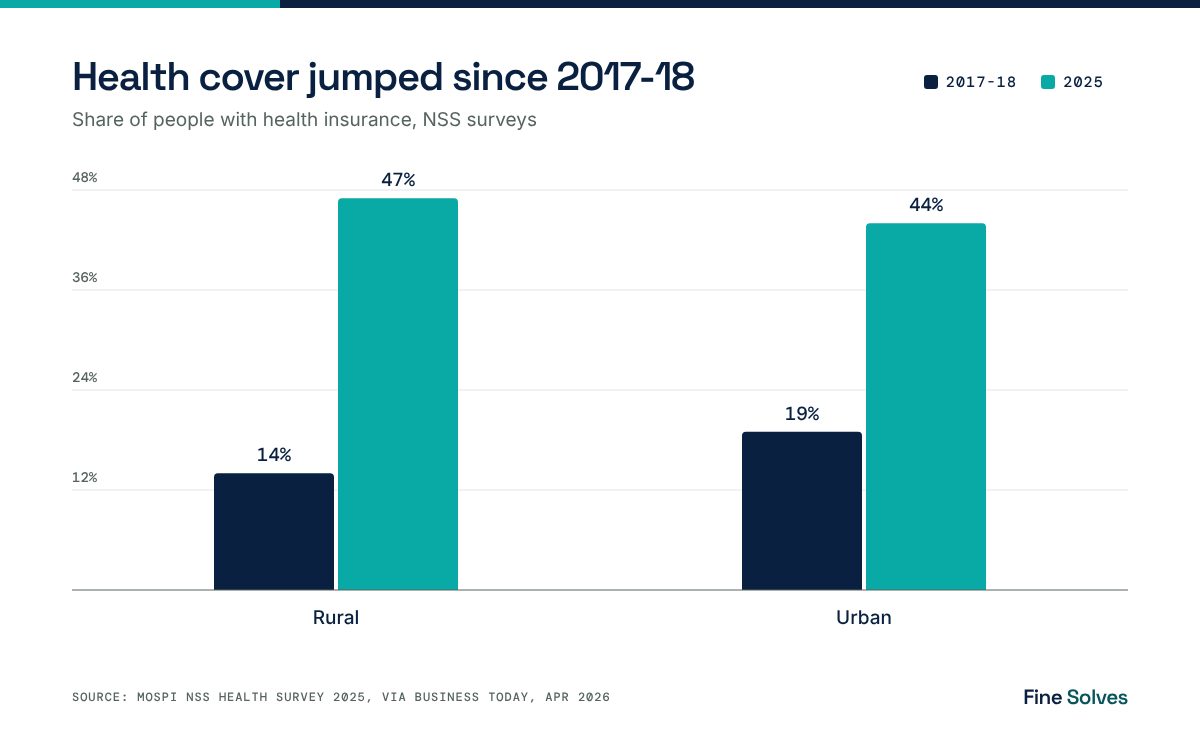
This matters now because claim volume is rising faster than most hospital billing teams. Insurers handled 3.26 crore health claims in FY25 and paid out ₹94,248 crore, up from ₹83,493 crore the year before. Coverage is widening too: MoSPI's 2025 NSS health survey shows 47% of rural and 44% of urban Indians now have health insurance. Every new insured patient is another file of discharge summaries, bills and queries. A hospital that handles that file badly loses cash, waits longer for it, and annoys the patient at the worst possible moment.
TL;DR
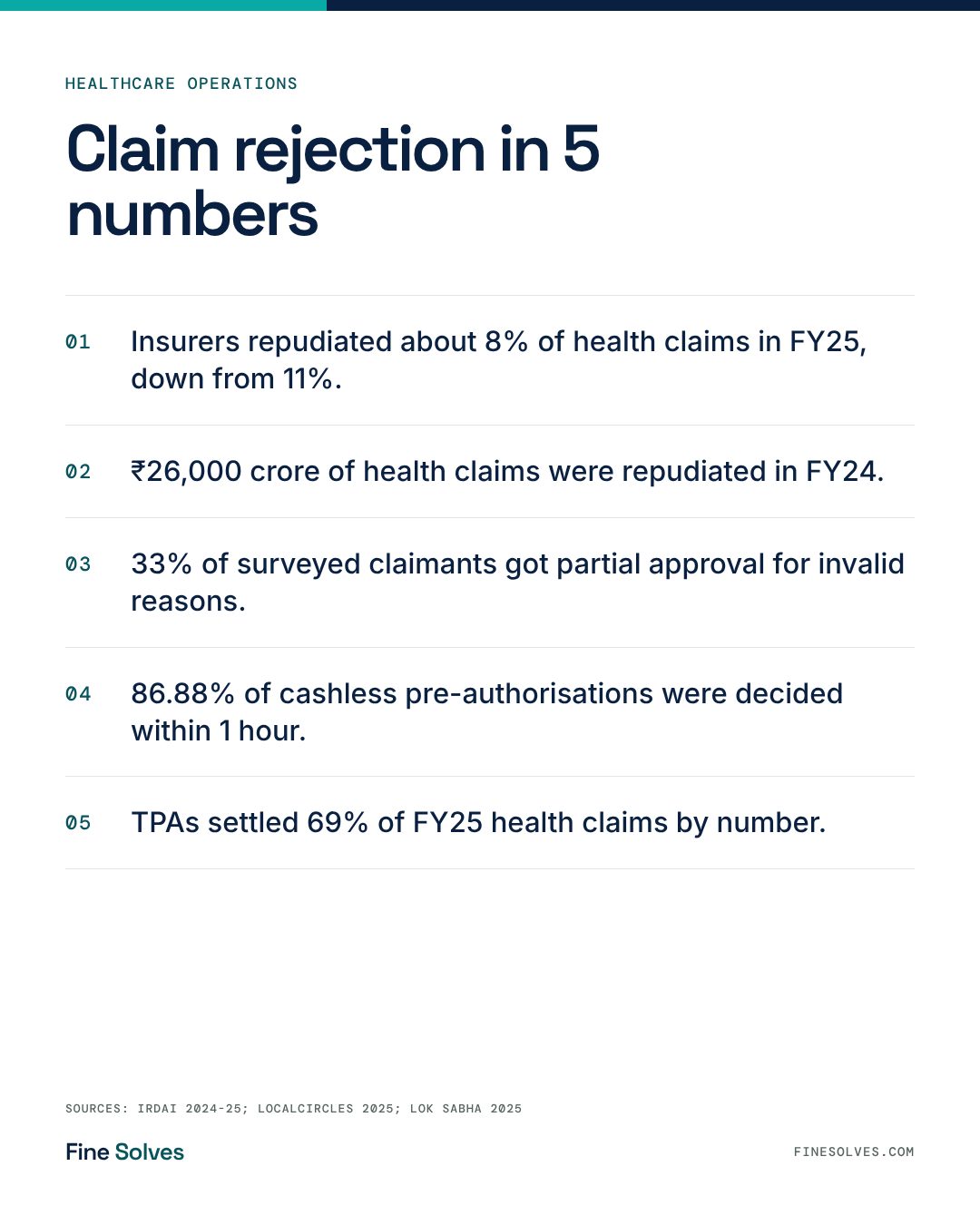
- Insurers repudiated about 8% of health claims in FY25, down from 11% in FY24, IRDAI data shows.
- Repudiated health claims were worth ₹26,000 crore in FY24, up 19.10% on the year before.
- In a LocalCircles survey, 33% of claimants said their claim was only partly approved for invalid reasons.
- 86.88% of cashless pre-authorisations were decided within 1 hour, the Finance Minister told the Lok Sabha.
- Third-party administrators handled 69% of FY25 health claims by number, so hospitals mostly deal with TPAs.
What is the health insurance claim rejection rate in India?
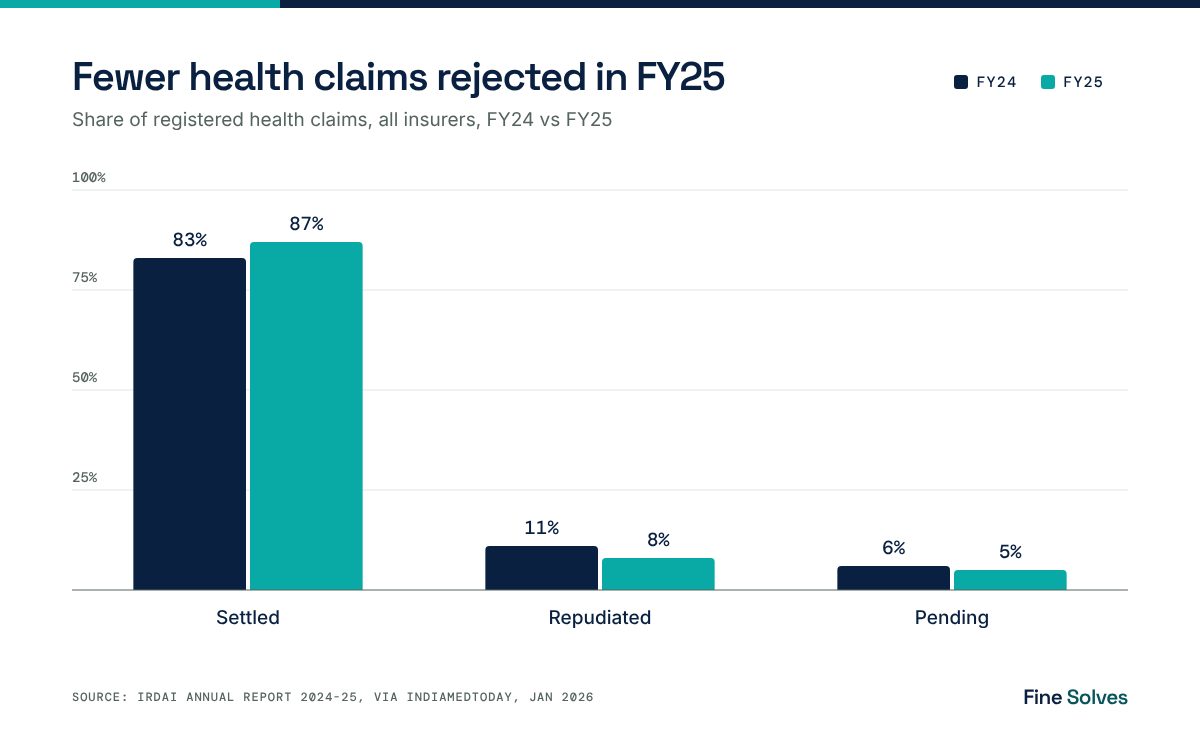
The health insurance claim rejection rate in India was about 8% of registered claims in FY25, according to IRDAI's annual report, down from 11% in FY24.
The same IRDAI data shows the claim settlement ratio rising to about 87% from 83%, while pending claims fell to roughly 5% from 6%. That is real progress. But the absolute numbers stay large. Business Standard reported that ₹26,000 crore of health claims were repudiated in FY24, a 19.10% rise over ₹21,861 crore in FY23.
The average cheque is also getting smaller. IndiaMedToday's summary of the IRDAI report shows the average payout per claim fell to ₹28,910 in FY25 from ₹31,086, as more lower-ticket claims entered the system. Smaller claims with the same paperwork mean billing cost per rupee collected goes up.
| Metric (all health insurers) | FY24 | FY25 |
|---|---|---|
| Claims settled (of registered) | 83% | 87% |
| Claims repudiated | 11% | 8% |
| Claims pending | 6% | 5% |
| Total payouts | ₹83,493 crore | ₹94,248 crore |
| Average payout per claim | ₹31,086 | ₹28,910 |
Source: IRDAI annual report 2024-25, as reported by IndiaMedToday, January 2026.
Why are hospital claims still rejected or cut?
Common causes are documentation gaps: wrong diagnosis codes, mismatched dates, missing policy details, and undisclosed pre-existing conditions or waiting-period breaches.
That list comes from NewsBytes' summary of the reasons behind the LocalCircles findings, and it matches what billing teams see daily. The survey covered over one lakh policyholders across 327 districts. Of 28,700 people who answered the settlement question, 33% said their claim was partially approved for invalid reasons and only 25% said it was fully approved without a fight. About a fifth said they were rejected outright.
Partial approvals hurt hospitals as much as rejections. The disallowed portion becomes a patient dispute at the discharge counter, or a write-off. Complaints are climbing too: NewsBytes reports that grievances on IRDAI's Bima Bharosa portal rose 41% to 1.37 lakh in FY25, and that nearly 70% of complaints involved rejections, delays, partial payments or documentation disputes.
The money side is shifting toward cashless. IRDAI data shows cashless claims made up 66.35% of the total claim amount in FY25, with reimbursement at 29.34%. Cashless puts the paperwork burden on the hospital, not the patient. So the hospital's billing desk now owns most of the rejection risk.
How long do cashless claim settlement and discharge take?
On paper, insurers must decide cashless pre-authorisation within 1 hour and final discharge authorisation within 3 hours, under IRDAI's 2024 master circular.
Official data shows insurers mostly meet it. The Finance Minister told the Lok Sabha that between August 2024 and May 2025, 86.88% of pre-authorisations were decided within 1 hour and 96.69% of final authorisations within 3 hours. Only 0.77% of cases took longer than 8 hours.
Patients tell a different story. In the LocalCircles survey, 21% of claimants said discharge after approval took 24–48 hours, and only 8% said it was processed instantly. The gap matters for operators. The insurer's clock starts when the hospital sends a complete request. Time spent assembling the discharge summary, final bill and query responses sits with the hospital, and the patient blames the hospital for it.
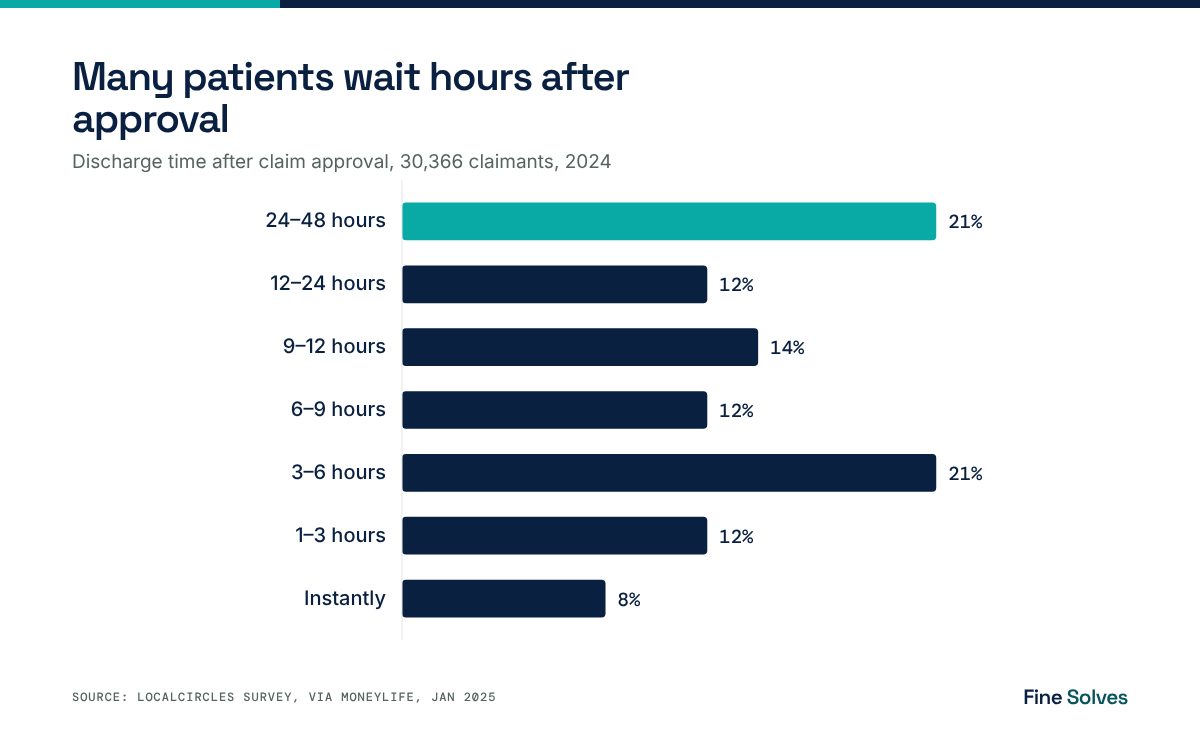
| Discharge wait after claim approval | Share of claimants |
|---|---|
| 24–48 hours | 21% |
| 12–24 hours | 12% |
| 9–12 hours | 14% |
| 6–9 hours | 12% |
| 3–6 hours | 21% |
| 1–3 hours | 12% |
| Instantly | 8% |
Source: LocalCircles survey of 30,366 respondents, via Moneylife, January 2025.
Who actually processes hospital claims in India?
Mostly third-party administrators. IRDAI data shows TPAs settled about 69% of FY25 health claims by number, with insurers handling 31% in-house.
That makes TPA performance a useful benchmark for what good looks like. Medi Assist, a listed TPA administering ₹8,975 crore of premiums, reports in its August 2026 investor presentation that about 64% of its inpatient claims are cashless by volume. It processed 88.3% of reimbursements within 1 day, and 51% of reimbursements now arrive electronically. Its payment turnaround improved to 6.76 days from 7.31 days.
The lesson for hospitals: TPAs are digitising fast. A hospital that still sends scanned bills by email becomes the slowest link in an otherwise quick chain.
Is government scheme billing (PM-JAY) a different problem?
Yes. PM-JAY claims follow fixed package rates and scheme rules, and the main risk shifts from documentation errors to fraud flags, audits and slow payment.
The scale is large. According to a Lok Sabha reply reported by Medical Dialogues, AB-PMJAY had enabled 8.99 crore hospital admissions worth ₹1.26 lakh crore by March 2025, across over 30,957 empanelled hospitals. Enforcement is serious too. A Rajya Sabha reply reported by PTI shows 3.56 lakh claims worth ₹643 crore were rejected for fraud, 1,114 hospitals were de-empanelled and 1,504 hospitals were penalised ₹122 crore. Clean, consistent records protect honest hospitals from being caught in the same net.
How can hospitals cut health insurance claim rejection? A 7-step playbook
Hospitals cut rejections by checking the claim before it leaves: eligibility at admission, complete documents at discharge, and a tracked queue for every query.
- Verify eligibility at admission. Check policy status, sum insured, waiting periods and exclusions before the patient reaches the ward, not at discharge.
- Use a pre-authorisation checklist per procedure. Map the documents each insurer and TPA asks for. Every missing item becomes a query and a delay.
- Code at the source. Doctors' notes, diagnosis codes and the final bill should come from one record, so dates and codes never disagree.
- Start the discharge file early. Draft the discharge summary and interim bill the day before planned discharge. The insurer's 3-hour clock only starts on a complete request.
- Track every query with an owner and a deadline. A shared queue beats an inbox. Measure time-to-respond per query.
- Analyse partial approvals monthly. Group deductions by reason, insurer and department. Fix the top three causes first.
- Submit electronically. Move to TPA portals and the National Health Claims Exchange (NHCX) as each payer goes live, so files arrive structured.
Where does AI fit in hospital claim denial management?
AI helps most before submission: reading clinical notes, checking documents against payer rules, and flagging likely deductions while there is still time to fix them.
From the way we build hospital software, the useful pattern is narrow and practical. An extraction model pulls diagnosis, dates and procedure details from discharge notes. A rules layer compares them with the policy and the payer's checklist. A billing executive reviews only the flagged items. Claim denial management then becomes a daily worklist instead of a month-end surprise. Keep a human on every submission, and log what the model flagged so auditors can see it.
What this means for Indian businesses
Hospital revenue cycle work is becoming a volume business. The NSS survey shows rural coverage rose to 47% in 2025 from 14% in 2017-18, and urban coverage to 44% from 19%. Yet the same survey puts average out-of-pocket spend per hospitalisation at ₹34,064, so patients feel every deduction. Hospitals that treat claims as a data process, with clean records, tracked queries and electronic submission, will collect faster and argue less at the discharge desk.
FineHealth by Fine Solves is a hospital management system built for this work: billing, insurance desk workflows, ABDM-ready records and WhatsApp report delivery for Indian hospitals and clinics. If your claim queue lives in spreadsheets and email, Talk to Fine Solves.
Frequently asked questions
What percentage of health insurance claims are rejected in India?
According to IRDAI's 2024-25 annual report, insurers repudiated about 8% of registered health claims in FY25, down from 11% in FY24. Around 87% were settled and about 5% were pending at year end. Survey data is harsher: many claimants report partial approvals that the official rejection figure does not count.
How long should cashless claim approval take?
IRDAI's 2024 master circular requires insurers to decide cashless pre-authorisation within 1 hour and final discharge authorisation within 3 hours of the hospital's request. If the 3-hour limit is missed, the insurer bears the extra cost. Official data shows 96.69% of final authorisations met that limit between August 2024 and May 2025.
What are the most common reasons hospital claims are rejected?
The most common reasons are documentation discrepancies such as wrong diagnosis codes or treatment dates, undisclosed pre-existing conditions, lapsed policies and waiting-period violations. For hospitals, missing or inconsistent documents in the pre-authorisation and discharge file are the causes they can control directly, with checklists and a single source of clinical and billing data.
What is NHCX and should hospitals join it?
The National Health Claims Exchange (NHCX) is the National Health Authority's digital platform for exchanging claim data between hospitals, insurers and TPAs in a standard format. It went live in June 2024. Hospitals should plan to integrate as their main payers connect, because structured electronic claims reduce re-keying, missing fields and query cycles.
Can AI reduce health insurance claim rejection?
AI can reduce avoidable rejections by checking claims before they are sent. Models can extract details from clinical notes, compare them with policy terms and payer checklists, and flag gaps for a billing executive to fix. It works best as a review aid with a human approving every submission, not as an automatic claims bot.
Sources
- Record health insurance claims settled in FY25; average payout per claim declines — IndiaMedToday (IRDAI annual report), 2026
- 1 in 12 health insurance claims rejected in FY25: IRDAI — NewsBytes, 2026
- Health insurance claims rejection up 19.10% in FY24: Irdai report — Business Standard, 2024
- 6 in 10 health insurance claimants waited 6-48 hours for claim approval and discharge: LocalCircles — Moneylife, 2025
- Nearly half of health insurance claims rejected in India: survey — NewsBytes, 2025
- Cashless health insurance claim authorisation in 2025: IRDAI's new rules and data — Angel One, 2025
- Medi Assist Healthcare Services investor presentation, August 2026 — NSE filing, 2026
- 8.99 crore hospital admissions worth Rs 1.26 lakh crore authorised under PMJAY — Medical Dialogues, 2025
- 3.56 lakh claims worth Rs 643 cr rejected for frauds under Ayushman Bharat scheme — PTI via The Week, 2025
- More Indians have health cover, but hospital bills still burn a hole (MoSPI NSS 2025) — Business Today, 2026
- National Health Claims Exchange — Wikipedia, 2025
Last updated: 3 November 2026. Published by Fine Solves — an AI software development company in Ahmedabad building custom software and AI systems for Indian businesses. finesolves.com