Global AI Sell-off: Why FPIs Put ₹38,971 Crore in India
The global AI sell-off of 5–6 November 2026 pushed foreign money into India rather than out of it. Foreign portfolio investors (FPIs) put ₹38,971 crore into Indian equities in the week, according to NSDL data reported by ANI, and the Nifty rose 7.58%. Investors sold AI hardware and bought markets with little AI exposure. For Indian operators, the message is about AI spending discipline, not about stock tips.
This matters beyond the stock market. The sell-off was driven by doubts about whether the huge data centre spending behind AI will pay back. Those same doubts will reach every boardroom that is approving AI budgets in 2027: if the companies building AI infrastructure are being asked to prove returns, buyers of AI software will be asked the same question. This post sets out what happened, why money moved to India, and what Indian business leaders in manufacturing, logistics, healthcare, retail and BFSI should do with their own AI plans.
TL;DR
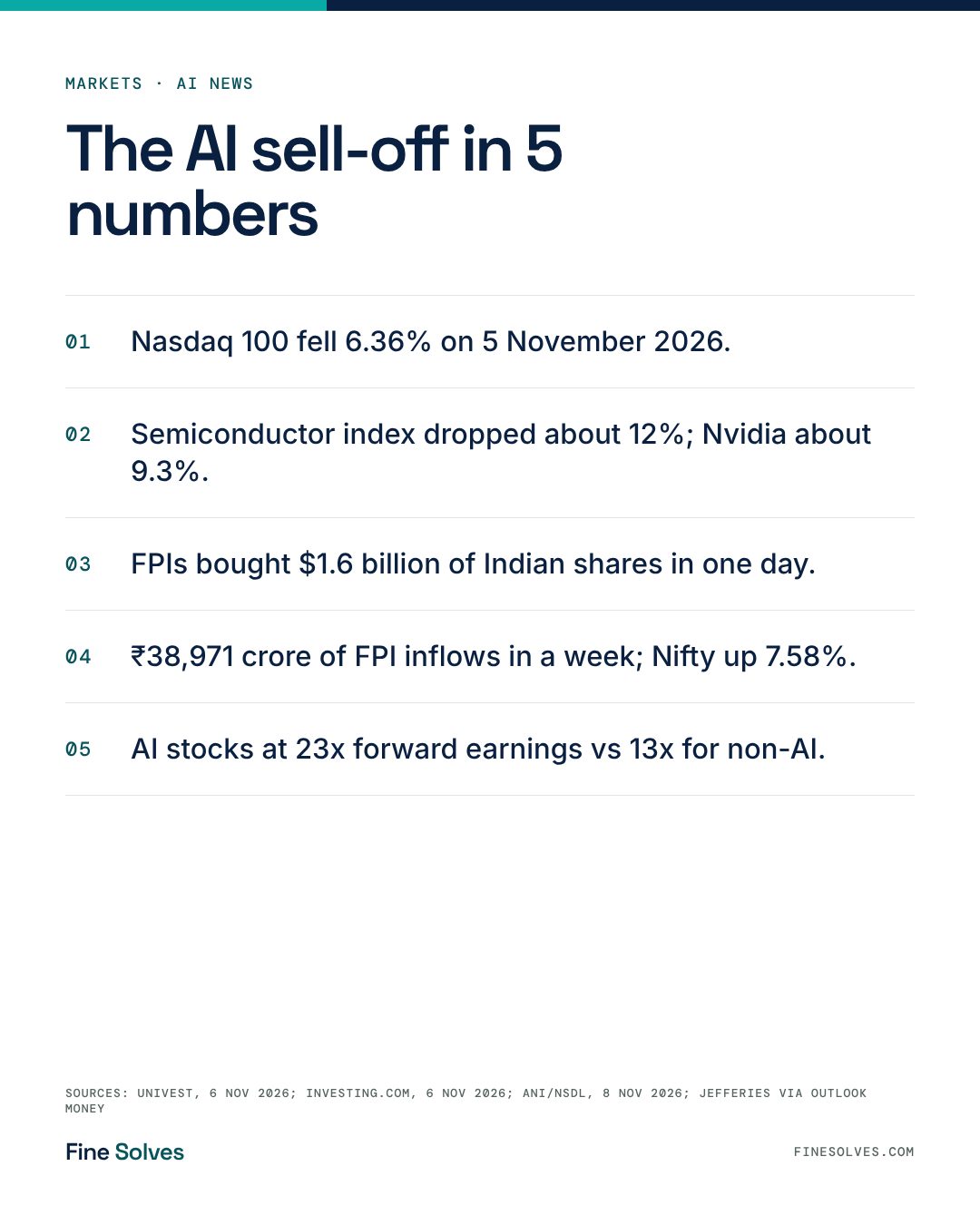
- The Nasdaq 100 fell 6.36% and the S&P 500 fell 4.36% on 5 November, the S&P's largest one-day fall since April 2025, Univest reported.
- Chip stocks took the worst of it: the Philadelphia Semiconductor Index fell about 12% and Nvidia about 9.3%.
- FPIs bought about $1.6 billion of Indian shares on 5 November alone, the biggest single-day purchase in nearly six years, Investing.com reported.
- FPI net inflows reached ₹45,970 crore in November so far, after a record $30 billion of selling through October.
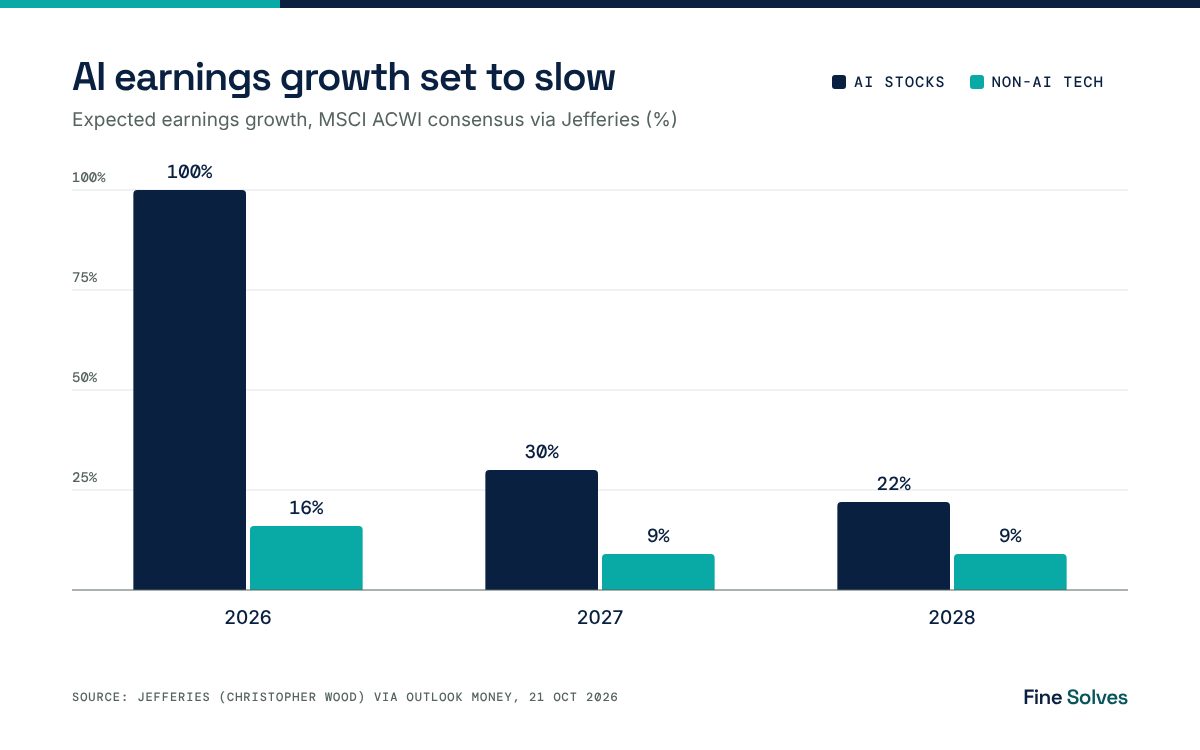
- Jefferies data show global AI stocks at 23x forward earnings against 13x for non-AI stocks, with AI earnings growth expected to slow from about 100% in 2026 to 30% in 2027.
What happened in the global AI sell-off?
On 5 November 2026, US technology stocks fell sharply on fears that AI data centre spending will slow, and Asian AI-heavy markets followed the next day.
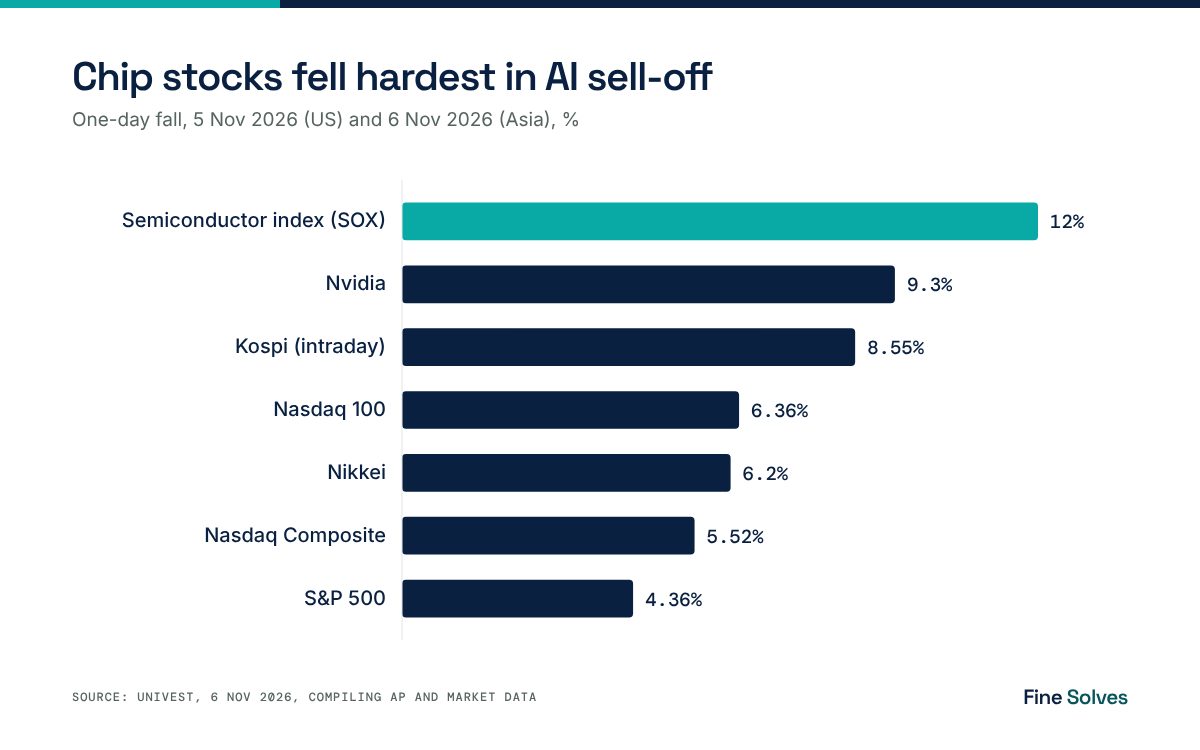
According to figures compiled by Univest from AP and market data, the S&P 500 fell 4.36%, the Nasdaq Composite 5.52% and the Nasdaq 100 6.36%. Memory and storage makers were hit hardest: Micron and Western Digital each fell more than 17% and SanDisk more than 22%. Mint estimated that about $2.3 trillion of market value was wiped out. The Nasdaq closed 11.9% below the all-time high it had set only the month before. The next morning, Korea's Kospi fell as much as 8.55% and Japan's Nikkei about 6.2%, Univest reported. The US 10-year Treasury yield dropped to about 4.82% as money moved to safety.
Why did AI stocks fall?
Investors started to doubt that the money being spent on AI data centres will earn an adequate return, and US election results raised the risk of tighter rules on that spending.
Geojit's V K Vijayakumar told ANI that concerns over AI-related data centre investment, and a possible slowdown in data centre spending, triggered the sell-off. He added that the Democrats, who won both chambers of Congress in the midterm elections, oppose indiscriminate data centre spending and are expected to demand AI safeguards. Univest also cited higher borrowing costs that could slow data centre construction.
The scale of the bet explains the nervousness. Jefferies estimated hyperscaler capital spending at around $620 billion, Republic World reported in March, and in July Jefferies noted that hyperscalers had issued $144 billion of bonds in 2026 so far against $83 billion in all of 2025. More and more of the AI build-out is being paid for with debt.
Why did foreign investors buy India during the AI sell-off?
India has almost no AI hardware stocks, so funds selling AI exposure in the US, Korea, Taiwan and Japan used India as the place to park money.
Investing.com reported that foreign institutional investors put a net $1.6 billion into Indian equities on 5 November, the biggest single-day net purchase in nearly six years. Univest put that day's buying at about ₹14,975 crore, and the Nifty 50 closed up 2.4%. Over the week, FPIs invested ₹38,971 crore, ANI reported from NSDL data, and IANS put net inflows for November so far at ₹45,970 crore. That is a sharp turn: foreign investors had sold a record $30 billion of Indian equities through October 2026, according to Investing.com.
The rally spread beyond large caps, with the Nifty Midcap 100 up 5.8% and the Nifty Smallcap 100 up 2.8% for the week, IANS reported.
| Measure | Move | Period | Reported by |
|---|---|---|---|
| Philadelphia Semiconductor Index | Down about 12% | 5 Nov | Univest |
| Nvidia | Down about 9.3% | 5 Nov | Univest |
| Kospi (intraday) | Down as much as 8.55% | 6 Nov | Univest |
| Nasdaq 100 | Down 6.36% | 5 Nov | Univest |
| Nikkei | Down about 6.2% | 6 Nov | Univest |
| Nasdaq Composite | Down 5.52% | 5 Nov | Univest |
| S&P 500 | Down 4.36% | 5 Nov | Univest |
| Nifty 50 | Up 7.58% | Week to 8 Nov | ANI |
| FPI net buying, India | ₹38,971 crore | Week to 8 Nov | ANI (NSDL data) |
Source: Univest (6 Nov 2026), compiling AP and market data; ANI (8 Nov 2026), citing NSDL data.
Are AI stocks overvalued compared with the rest of the market?
On Jefferies' numbers, global AI stocks trade at 23x forward earnings, against 13x for non-AI stocks, while AI earnings growth is expected to slow sharply.
Outlook Money reported in October that Jefferies' Christopher Wood cited MSCI ACWI consensus estimates showing AI stock earnings growth falling from about 100% in 2026 to 30% in 2027 and 22% in 2028. Non-AI tech earnings growth is forecast to slow from 16% this year to 9% in 2027 and 2028. Jefferies also flagged rising credit default swap spreads on AI infrastructure borrowers such as Oracle and CoreWeave as an early sign that lenders are getting nervous. India sits on the other side of that trade. Goldman Sachs Research, cited by Investing.com, put the Nifty 50 at roughly 19x forward earnings, below its five-year average of about 21x.
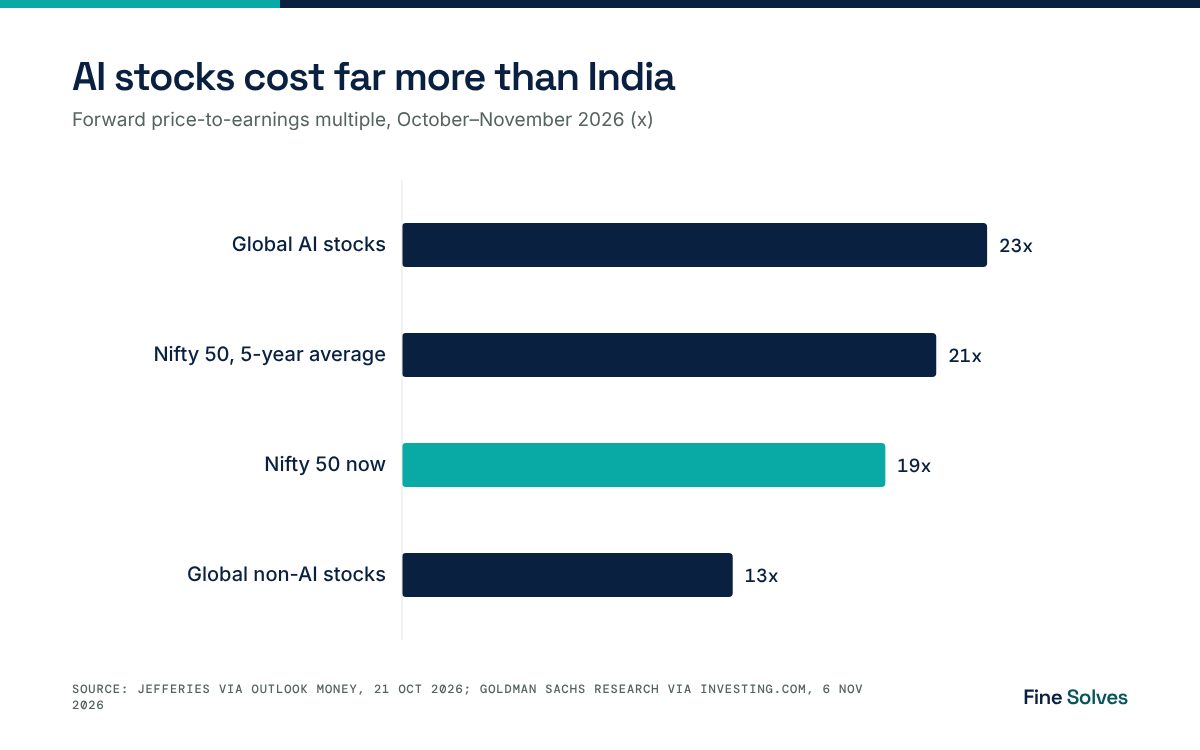
The earnings path is the real story. Valuations at 23x only hold if AI earnings keep compounding, and the consensus already expects that growth to drop from about 100% to 22% within two years.
Does the AI sell-off mean the AI boom is over?
No. The sell-off questions the price of AI infrastructure stocks and the speed of data centre spending, not whether businesses can get value from using AI.
Two different things are being priced here. One is the infrastructure trade: chips, memory, data centres and the debt that funds them. The four big hyperscalers were up 180% from the start of 2023 to mid-2026, Jefferies noted in July, so there was a lot of optimism to unwind.
The other is AI adoption inside ordinary companies: forecasting demand, reading invoices, scheduling plants, answering customer queries. Jefferies' own view, reported by The Tribune, is that the AI capex cycle is more likely to end through market pushback than through hyperscalers cutting spending. For a buyer of AI software, a slower and more disciplined build-out is not bad news. It means more scrutiny of returns, which well-scoped projects already pass.
How should Indian businesses respond to the AI sell-off?
Keep AI projects that have a measured payback, cut the ones that don't, and reduce dependence on any single AI vendor whose funding looks stretched.
- Re-test every AI project against one operating number. Forecast error, days of inventory, claim processing time, cost per invoice. If a project cannot name its number and its baseline, pause it before your CFO does.
- Prefer usage-based pricing over long prepaid commitments. When the market is asking whether AI capacity will be fully used, avoid locking in multi-year volume you have not yet proven you need.
- Check vendor concentration. Jefferies' warning about widening credit spreads on AI infrastructure borrowers is a reminder to ask your AI and cloud vendors about continuity, data export and exit terms.
- Keep models swappable. Build integrations so the model behind a workflow can be changed without rewriting the workflow. Price and supply shocks then become a configuration change, not a project.
- Put your own data in order first. Clean master data, reliable ERP feeds and clear process ownership deliver returns whatever happens to AI share prices.
- Watch the cost line, not the headlines. Track AI spend per transaction monthly. A sell-off is noise; a rising cost per processed order is a signal.
What this means for Indian businesses
For Indian companies, the AI sell-off is mostly good news. Foreign money came back after months of selling, Jefferies keeps India overweight at 12% against a 10.90% MSCI benchmark weight, and India's lack of AI hardware exposure has turned from a weakness into a cushion.
In BFSI, the immediate effect is market volatility and capital flows; for manufacturers, logistics firms, hospitals and retailers, it is a sharper question from the board about AI returns. From the way we build systems at Fine Solves, the projects that survive that question are small, tied to one process, and measured from week one. If you want a second view on which of your AI plans pass that test, Talk to Fine Solves.
Frequently asked questions
What caused the November 2026 AI sell-off?
The sell-off on 5 November 2026 was driven by fears that AI data centre spending will slow and fail to earn adequate returns. Analysts quoted by ANI also pointed to the US midterm results, which gave Democrats both chambers of Congress; they are expected to push for AI safeguards and oppose indiscriminate data centre spending. Higher borrowing costs added to the pressure.
How much did foreign investors put into India after the AI sell-off?
FPIs invested ₹38,971 crore in Indian equities in the week to 8 November 2026, according to NSDL data reported by ANI. On 5 November alone they bought about $1.6 billion, the largest single-day net purchase in nearly six years. IANS put November inflows so far at ₹45,970 crore.
Why is India seen as a hedge against AI stocks?
India's stock market has very few AI hardware or semiconductor companies, so it moves differently from AI-heavy markets such as the US, Korea and Taiwan. When funds cut AI exposure, India is an easy place to redeploy money. Goldman Sachs Research also put the Nifty 50 at about 19x forward earnings, below its five-year average.
Should Indian companies cut AI budgets after the sell-off?
Not across the board. The sell-off is about the valuations of AI infrastructure companies, not about whether AI improves operations. Companies should cut AI projects without a measured payback, keep those tied to clear operating metrics, avoid long prepaid commitments and make sure they can switch models or vendors if prices or supply change.
Which stocks fell most in the AI sell-off?
Chip and memory stocks fell hardest. On 5 November the Philadelphia Semiconductor Index dropped about 12%, Nvidia about 9.3%, Micron and Western Digital more than 17% each and SanDisk more than 22%, according to figures compiled by Univest. Korea's Kospi fell as much as 8.55% the next morning.
Sources
- Global AI sell-off triggers FPI return to Indian markets; Rs 38,971 crore equity inflows this week — ANI, 2026
- Global AI sell-off makes India attractive for foreign portfolio investors — IANS via The Hans India, 2026
- AI Bubble Fears Spark Wall Street Selloff: India Impact — Univest, 2026
- India draws $1.6 billion in foreign inflows in one day as AI stocks rout — Investing.com, 2026
- Jefferies' Christopher Wood flags AI credit strains and US consumer debt stress, keeps India overweight — Outlook Money, 2026
- AI capex cycle likely to end with market pushback, not spending cuts: Jefferies — ANI via The Tribune, 2026
- India could emerge as 'reverse AI trade' as global AI boom nears inflection point: Jefferies' Chris Wood — Republic World, 2026
Last updated: 9 November 2026. Published by Fine Solves — an AI software development company in Ahmedabad building custom software and AI systems for Indian businesses. finesolves.com