
E-Way Bill Generation Hits 156.21 Million: Oct 2026
E-way bill generation in India hit a record 156.21 million in October 2026, according to GSTN data reported by Business Standard on 6 November. That is 23.14% more than October 2025 and 10.37% more than September, the previous record month. For operators, it means goods moved at peak volume through the festive season.
An e-way bill is the digital permit needed to move goods worth more than ₹50,000, so the monthly count is one of the closest real-time reads of physical freight in India. October's jump did not arrive alone. Gross GST collections rose to ₹2,31,290 crore, and import GST grew faster than any other component. For a plant head, a logistics manager or a CFO planning the January–March quarter, the question is simple: was this a one-month festive spike, or a new baseline that your network now has to carry?
TL;DR
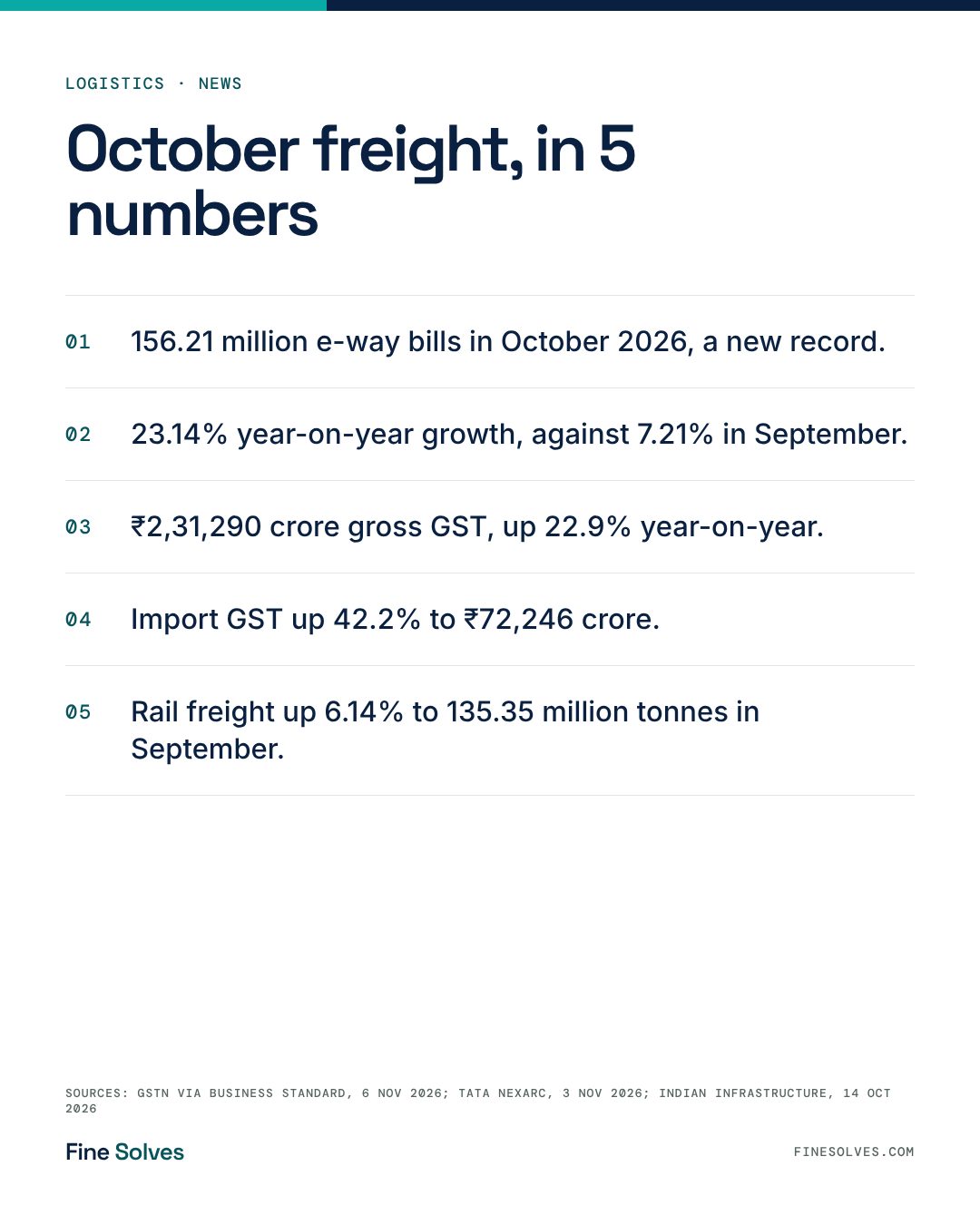
- 156.21 million e-way bills were generated in October 2026, a record, up 23.14% year-on-year (GSTN via Business Standard).
- The previous record was 141.53 million in September 2026, so October added 10.37% month-on-month.
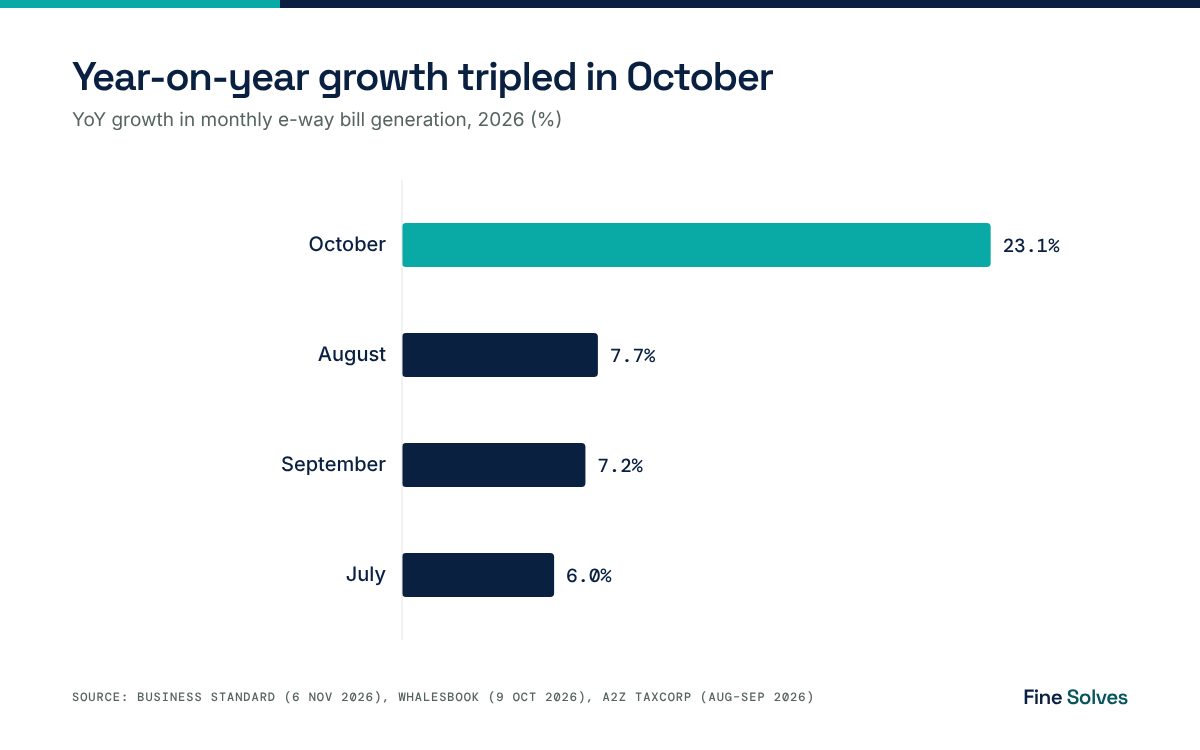
- Year-on-year growth in July, August and September sat between 5.98% and 7.7%, which makes October's 23.14% an outlier.
- Gross GST rose 22.9% to ₹2,31,290 crore; import GST rose 42.2% to ₹72,246 crore (Tata nexarc).
- Rail freight loading rose 6.14% to 135.35 million tonnes in September 2026 (Indian Infrastructure).
What happened to e-way bill generation in October 2026?
E-way bill generation rose to a record 156.21 million in October 2026, up 23.14% year-on-year and 10.37% over September, according to GSTN data reported by Business Standard. October 2025 had 126.86 million.
The new figure beats September 2026's 141.53 million, which itself had beaten the March 2026 high of 140.6 million, Whalesbook reported. Two records in two months is unusual for a series that, through mid-2026, mostly moved sideways. A2Z Taxcorp's tracking shows 136.77 million in June, 139.79 million in July and 139.08 million in August, a 0.51% dip from July. Then September rose 1.75%, and October broke away.
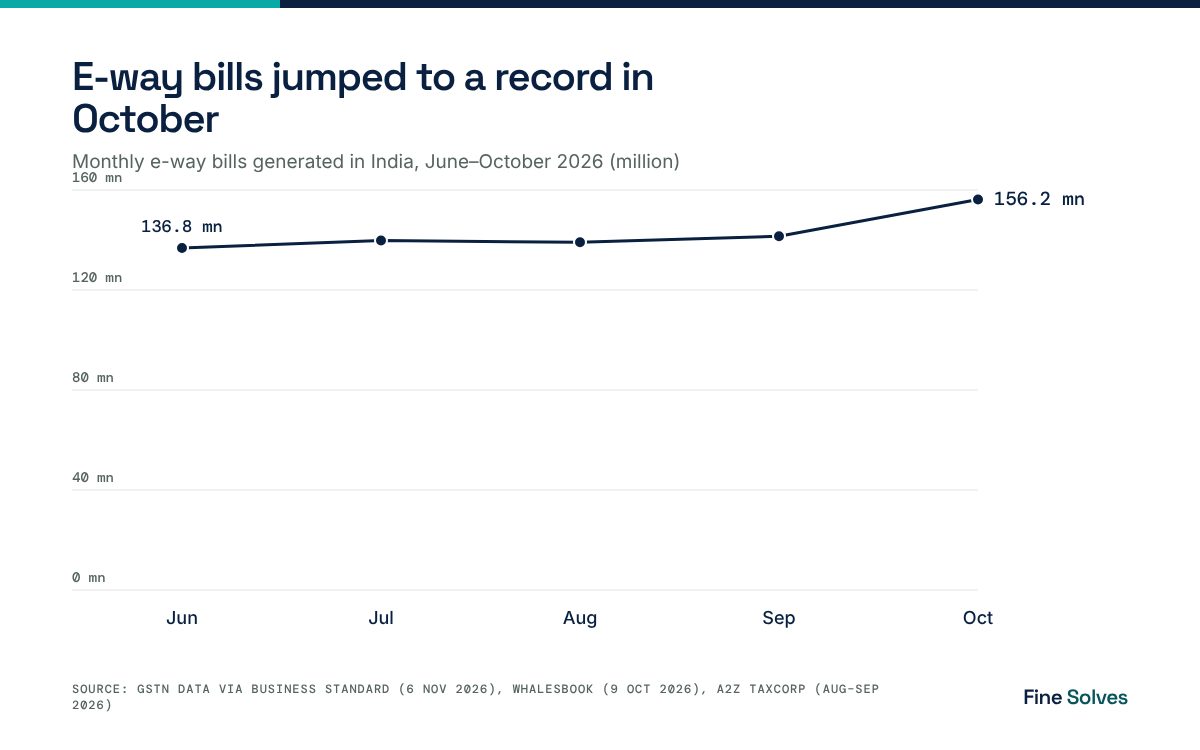
| Month (2026) | E-way bills generated | Year-on-year growth | Month-on-month change |
|---|---|---|---|
| June | 136.77 million | Not reported | Not reported |
| July | 139.79 million | 5.98% | +2.21% |
| August | 139.08 million | 7.7% | −0.51% |
| September | 141.53 million | 7.21% | +1.75% |
| October | 156.21 million | 23.14% | +10.37% |
Source: GSTN data as reported by Business Standard (6 Nov 2026), Whalesbook (9 Oct 2026) and A2Z Taxcorp (11 Aug and 7 Sep 2026).
Why did e-way bills jump 23.14% in October?
E-way bills jumped because festive demand peaked in October and last year's base was soft, tax experts told Business Standard. Both effects push the year-on-year number up at the same time.
The base effect matters. In 2025, e-way bills peaked in September at 132 million and then fell almost 4% in October, Business Standard reported a year ago, with year-on-year growth of only 8.2% that month. Lawyers quoted at the time linked that pattern to the GST rate changes that took effect on 22 September 2025. So October 2025 was a weak comparison month, and October 2026 is being measured against it.
The demand effect is real too. Tax experts quoted this week linked the surge to strong festive demand and lower rates after GST rate rationalisation. A2Z Taxcorp's August report noted private final consumption expenditure grew 7.1% in Q1 FY27, so the consumer side was already firm before the festive season started.
Is the October surge a one-month spike or a new baseline?
It is probably part spike, part baseline: festive timing and a weak 2025 base inflate October, but September also set a record before the festive peak. Plan for some easing, not a full reversal.
The evidence for a spike: from July to September, year-on-year growth stayed in a narrow 5.98% to 7.7% band. A single month at 23.14% after that run looks like timing. The evidence for a higher baseline: September's 141.53 million was already a record, up 7.21% year-on-year, before Diwali-season dispatches peaked. GSTN data via Tata nexarc also shows the system had processed 833.82 crore e-way bills cumulatively by 30 September 2026, and the registered taxpayer base has grown to 1.70 crore. More businesses in the net means more documented movement each month, independent of festivals.
The November and December prints will settle it. If they hold well above the 140.6 million level of March 2026, treat the higher volume as structural.
What do October GST collections say about freight?
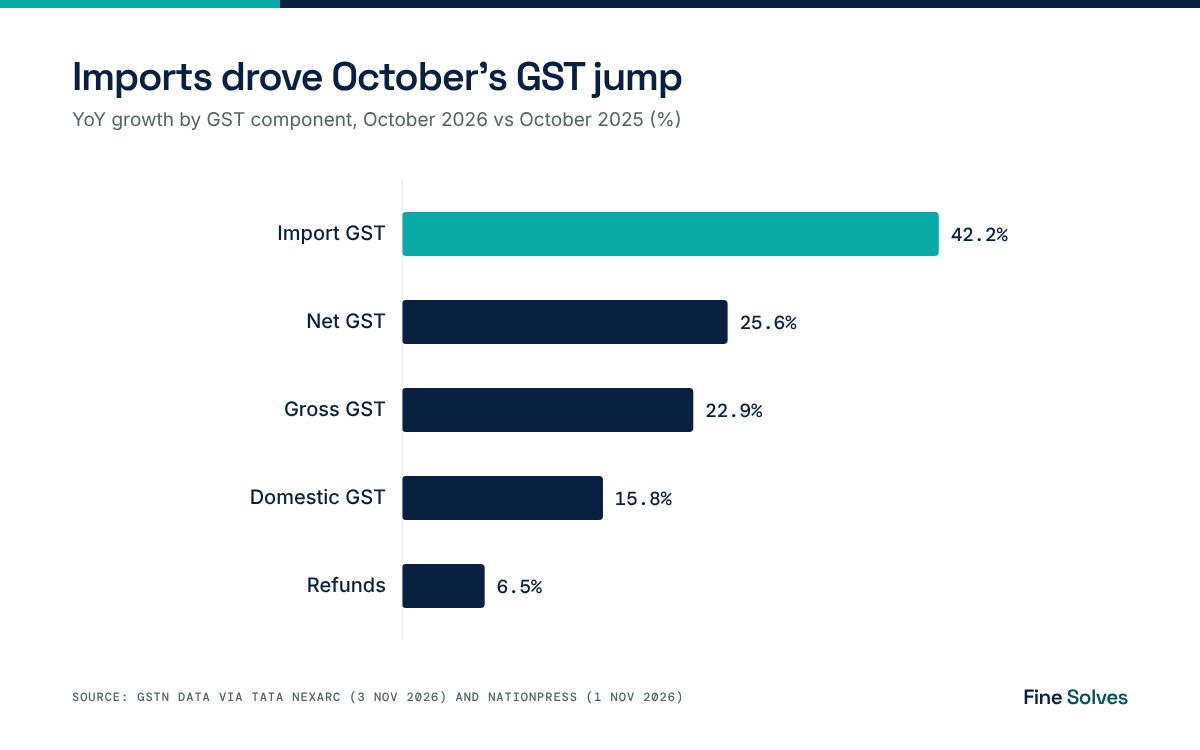
October GST collections confirm the freight signal: gross GST rose 22.9% to ₹2,31,290 crore, with imports growing nearly three times faster than domestic revenue, according to GSTN data reported by Tata nexarc.
The split matters for supply chains. Domestic gross GST grew 15.8% to ₹1,59,044 crore. Import GST grew 42.2% to ₹72,246 crore, up from ₹50,796 crore in October 2025, NationPress reported. Net GST after refunds was ₹2,03,356 crore, up 25.6%, while refunds rose a slower 6.5% to ₹27,934 crore. For the year so far, gross collections from April to October reached ₹14.77 lakh crore, up 13.2%.
Fast import growth usually means more inbound containers, more port-to-warehouse movement and more inventory in transit. If you import components or finished goods, October's numbers suggest your port and customs lead times were under more pressure than usual.
How is rail freight keeping up?
Rail freight is growing, but slower than road documentation: Indian Railways loaded 135.35 million tonnes in September 2026, up 6.14% year-on-year, according to Indian Infrastructure.
Swarajya reported the September 2025 base at 127.52 million tonnes. Growth was led by foodgrain at 25%, clinker at 20% and domestic containers at 10%, with coal up 9%, mineral oil 6%, finished steel 5.5% and iron ore 5.2%. Freight revenue rose 9.3%, and coal rakes supplied per day rose 11.6%. Cumulative loading from April to September reached 833.7 million tonnes, up 4.1%.
The 10% rise in domestic container loading is the figure to watch for manufacturers and distributors, because containers carry the mixed, finished goods that also generate e-way bills. Still, road dominates. A 2026 study in Transportation Research Interdisciplinary Perspectives by researchers at Nirma University puts road's share of freight at about 71% and rail's at 17.5%. When volumes spike, it is truck capacity that tightens first.
Where does the extra freight volume hurt operations?
Extra volume hurts most where trucking is already inefficient: empty return trips, low daily running and broker-heavy booking. The Nirma University study quantifies each of these for India.
The same study reports that nearly 40% of trucks in India run without return loads, and that trucks average about 300 km a day, well below global averages. It also found, from primary data on 500 transport providers, a 30.5% reduction in average transit time after National Logistics Policy measures. Those two findings point in the same direction: the gains come from better planning and visibility, not only from more trucks or roads. During a record month, a shipper with poor visibility pays twice, once in spot rates and again in missed delivery windows.
How should ops and supply chain teams respond?
Use the e-way bill and GST prints as an early warning system and plan the next quarter's capacity, inventory and cash around them. Five practical steps:
- Add public freight indicators to your S&OP pack. Monthly e-way bills, GST collections and rail loading come out within the first two weeks of each month. Put them next to your own dispatch numbers.
- Compare your dispatch growth with the national number. If your October dispatches grew well below 23.14%, check whether you lost share or simply had a different festive calendar.
- Lock lane capacity before the next peak. With road carrying about 71% of freight, tight months show up as spot-rate jumps. Sign contract rates on your top lanes early.
- Attack empty running. If about 40% of trucks return empty, a backhaul or shared-load arrangement on your regular lanes is often the cheapest capacity you can find.
- Use your own e-way bill data. Every e-way bill you generate is a structured record of origin, destination, value and vehicle. Pulled into a simple dashboard or demand-sensing model, it shows lane volumes and seasonality faster than most ERP reports.
What this means for Indian businesses
October showed how quickly freight demand can move in India: e-way bill growth went from 7.21% in September to 23.14% a month later. Businesses that saw it coming had capacity booked and stock positioned. The rest paid spot rates. Most mid-market firms already hold the data needed to see these swings early, in GST filings, e-way bill records and dispatch logs, but it sits in separate systems that nobody joins up.
From the way we build supply chain software, the fix is usually modest: connect e-way bill and dispatch data, add a few external indicators, and run a forecasting model on top that planners trust. If you want help scoping that, Talk to Fine Solves.
Frequently asked questions
What is an e-way bill?
An e-way bill is an electronic permit generated on the GST portal before moving goods. It is needed when the consignment is worth more than ₹50,000, subject to specified conditions and exemptions. Because nearly every documented B2B shipment needs one, the monthly e-way bill count is widely used as a near real-time indicator of goods movement in India.
How many e-way bills were generated in October 2026?
India generated 156.21 million e-way bills in October 2026, a record, according to GSTN data reported by Business Standard. That was 23.14% higher than the 126.86 million generated in October 2025 and 10.37% higher than September 2026, which had itself set a record at 141.53 million.
What was India's GST collection in October 2026?
Gross GST collection in October 2026 was ₹2,31,290 crore, up 22.9% year-on-year, according to GSTN data reported by Tata nexarc. Net collection after refunds was ₹2,03,356 crore, up 25.6%. Import GST grew fastest, by 42.2% to ₹72,246 crore, while domestic GST grew 15.8%.
Does a rise in e-way bills mean sales have grown?
Not exactly. E-way bills track documented movement of goods above the ₹50,000 threshold, not sales. Tax experts quoted by Business Standard have noted that shipments below the threshold or by non-motorised transport are excluded, and that timing shifts, such as buyers waiting for GST rate changes, can move volumes between months.
How can a company use e-way bill data for logistics planning?
Treat your own e-way bills as a clean shipment log: origin, destination, value, vehicle and date. Aggregated by lane and week, they show volume trends and seasonality. Compared with national monthly totals, they show whether your growth is tracking the market, which helps book truck capacity and position inventory before peaks.
Sources
- E-way bill generation hits fresh record of 156.2 million in October — Business Standard, 2026
- India Records 141.53 Million E-Way Bills in September — Whalesbook, 2026
- E-way bill generation rises 7.7 per cent to 139.08 million in August 2026 — A2Z Taxcorp, 2026
- E-way bill generation rises 5.98% to second-highest level in July 2026 — A2Z Taxcorp, 2026
- After September high, e-way bills soften 4% to 126.85 million in October — Business Standard, 2025
- October 2026 GST collection in India: ₹2.31 lakh crore, up 22.9% YoY — Tata nexarc, 2026
- GST collections surge 22.9% to ₹2.31 lakh crore in October 2026 — NationPress, 2026
- IR achieves freight loading of 135.35 mt in September 2026 — Indian Infrastructure, 2026
- Indian Railways freight loading rises 6.14 per cent to 135.35 million tonnes in September — Swarajya, 2026
- AI's role in efficient logistics management: shaping the future of supply chain in India — Transportation Research Interdisciplinary Perspectives (Elsevier), 2026
Last updated: 7 November 2026. Published by Fine Solves — an AI software development company in Ahmedabad building custom software and AI systems for Indian businesses. finesolves.com