DEPA for AI Training: What MeitY's 2026 Draft Means
DEPA for AI training is MeitY's draft framework that lets companies train AI models on hospital, bank and public-agency data without ever seeing the raw records. The model travels into a "sealed room", trains under a machine-readable contract, and leaves with the result. According to the draft report, the approach could add $500 billion in AI-driven value to India's GDP by 2030.
MeitY Secretary S Krishnan unveiled the handbook at a roundtable in Bengaluru on 30 October, built with support from the iSPIRT Foundation. It lands while most Indian firms still struggle with the basics: a World Bank survey found that only 23% of surveyed formal firms in India use AI. For anyone running operations in banking, healthcare or MSME lending, this is the first official blueprint for getting AI training data out of silos without breaking privacy law.
TL;DR
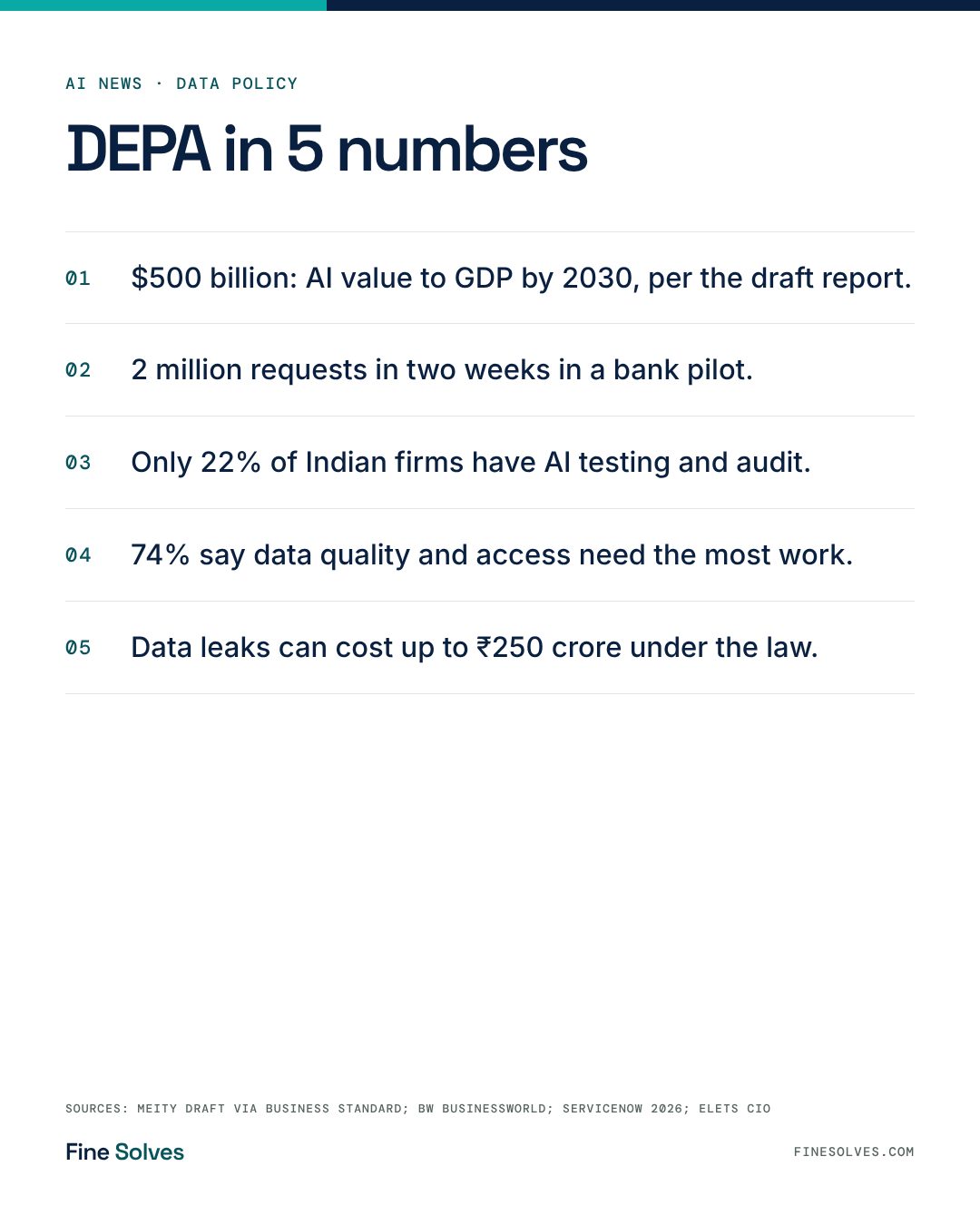
- The draft report estimates $500 billion of AI-driven GDP value by 2030 if sensitive data can be used safely.
- A bank pilot processed more than 2 million requests in two weeks, according to BW Businessworld.
- Only 22% of Indian enterprises have AI testing, auditing and risk-assessment processes, ServiceNow found.
- 74% of Indian organisations say data accuracy, access and management need the most work before AI.
- Leaks under the data protection law can cost up to ₹250 crore, which is why data owners hold back.
- The framework is a draft with 4 technical pillars; consultations are expected in the coming weeks.
What is DEPA for AI training?
DEPA for AI training is a techno-legal framework where data stays with its owner and the AI model is sent to the data for training. MeitY calls it purpose-bound data collaboration with traceable provenance.
DEPA stands for Data Empowerment and Protection Architecture. NITI Aayog introduced the original DEPA model in 2020, and it already powers consented sharing of individual financial data through the Account Aggregator system. That version is now labelled DEPA Inference. The new piece, DEPA Training, handles bulk, de-identified data used to build models, according to Business Standard's reading of the draft report.
Principal Scientific Adviser Ajay Kumar Sood summed it up at the launch: "the model travels to the data, rather than the data travelling to the model." The PIB release frames the goal as letting institutions share AI training data while keeping control over privacy, confidentiality and intellectual property.
How does the DEPA sealed room work?
Training runs inside a secure "sealed room" that only executes what an authorised electronic contract permits. The developer gets back a trained model, or sometimes only a decision, never the raw records.
The draft report rests on four technical pillars, as Business Standard and Elets CIO both report:
| Pillar | What it does | Who it protects |
|---|---|---|
| Data Exchange Platform | Providers register datasets; consumers request access for a stated purpose | Data owners (hospitals, banks, agencies) |
| Electronic contracts | Machine-readable permissions that the system enforces | Both sides of the deal |
| Secure Data Environment | The "sealed room" where training runs; raw data never leaves | Individuals in the dataset |
| Differential privacy | Adds statistical noise so no single record can be re-identified | Individuals in the dataset |
Source: Business Standard and Elets CIO coverage of the draft DEPA for AI Training report, October 2026.
Intermediaries called "Data Collabs" pool and standardise data from several providers. Trained models must pass bias, security and explainability checks before deployment, and a government authority would certify models and could suspend non-compliant activity. The evidence base for the idea is real: the report cites a Penn Medicine and Intel project across 71 institutions that reached over 99% of the accuracy of a model trained on centralised data.
Why did MeitY launch DEPA now?
Because Indian AI ambition is outrunning Indian data readiness. Firms are spending on AI fast, but the data and governance underneath are not keeping up.
ServiceNow's Enterprise AI Maturity Index found that Indian enterprise AI investment grew 119% in a year, above the global average of 110%. AI now takes 16.6% of the average Indian IT budget, projected to reach 21.3% by 2027. Private AI investment in India rose from $1.2 billion in 2024 to $4.1 billion in 2025, according to the World Bank's India Development Update.
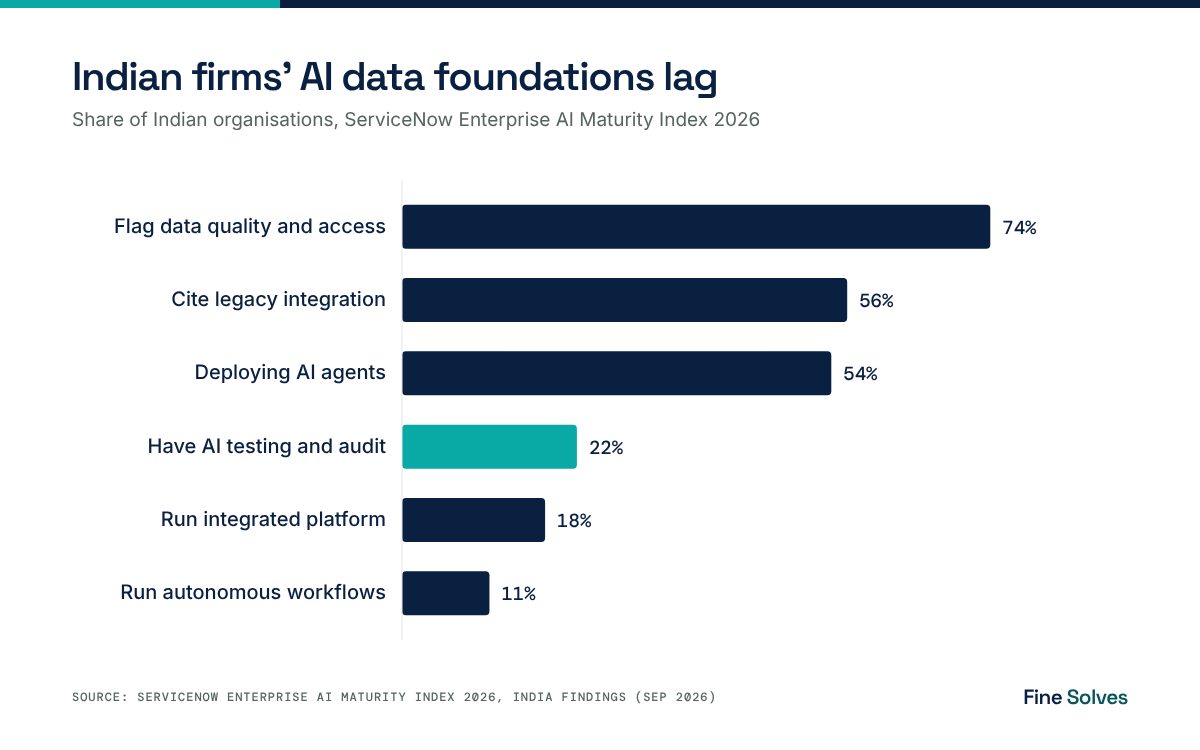
The foundations lag. The same ServiceNow survey shows 74% of Indian organisations flag data accuracy, access and management as their weakest area, 56% point to legacy system integration, and 50% cite data privacy and security. Only 18% have replaced fragmented legacy systems with an integrated platform. While 54% are deploying AI agents, just 11% have moved to autonomous workflows.
The draft report calls this the "Data Deadlock". Hospitals and banks hold the most useful data, but the downside of sharing is large: Elets CIO notes the data protection law allows penalties of up to ₹250 crore for a leak, and the DPDP Act's main rules take effect in May 2027. Simple anonymisation does not fix it, the report argues, because records can be re-identified.
Which sectors does DEPA target first?
Finance and healthcare come first, with pilots and regulatory sandboxes, followed later by education, cross-border agreements and incentive models.
| Sector | Size cited in the draft | Gap DEPA aims at | Pilot status |
|---|---|---|---|
| Financial services | $550 billion | 400 million underserved people and MSMEs; MSME credit gap of ₹20 trillion to ₹25 trillion | Bank pilot live since March; 2 million requests in two weeks |
| Healthcare | $600 billion-plus | Clinical data locked inside individual hospitals | Tumour-detection model training on MRI scans |
| Education | $29 billion EdTech sector | 250 million students | Later phase; no pilot named |
Source: Business Standard and Elets CIO on the draft DEPA for AI Training report; BW Businessworld on the bank pilot (October 2026).
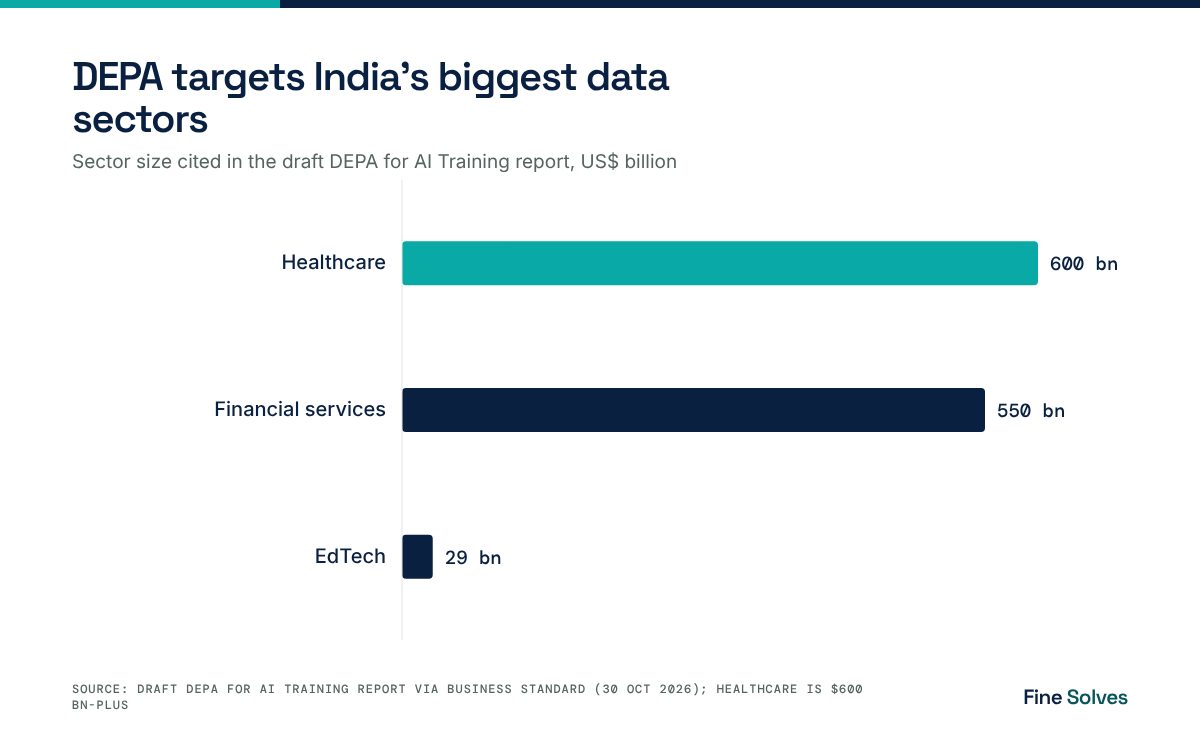
The bank pilot shows the commercial logic. Working with a fintech partner, a bank identified which of the partner's customers qualified for its credit cards, then sought consent and contacted only those with a genuine offer, BW Businessworld reports. In healthcare, hospitals and a health-tech startup are training a tumour-detection model on MRI scans that the startup never sees.
What is still unresolved in the DEPA draft?
Liability, payment and legal force are all open. The handbook is a non-binding draft, and consultations are expected in the coming weeks.
- Liability: the handbook does not say who pays if data leaks from a sealed room, both Elets CIO and BW Businessworld note.
- Payment: how data owners get compensated "will be explored", with no detail yet.
- Legal route: observers expect sectoral regulators to make it binding, as with Account Aggregators, rather than a new law.
- Trust: institutions still have to believe that contracts, certification and secure environments are enough to cover a ₹250 crore exposure.
How should Indian firms prepare for DEPA?
Start by knowing which of your datasets are valuable and clean, and who can approve their use. That work pays off whether DEPA becomes binding or not.
- Map high-value datasets. List what you hold (claims, lab reports, loan books, sensor logs), where it lives and its quality. With 74% of firms naming data quality as the weak spot, this is the real bottleneck.
- Classify by sensitivity. Tag personal, health and financial fields now; the DPDP Act rules apply from May 2027 either way.
- Decide your role. Are you a data provider (hospital, NBFC, distributor), a consumer (startup, analytics team) or both? Contracts look very different for each.
- Write purpose-bound access rules. Draft who may train what, for which purpose, and what leaves the room. This is the electronic-contract layer in plain English.
- Run one sandboxed pilot. Pick one partner and one narrow model, such as credit pre-qualification or report triage, and measure accuracy against your current process.
- Put governance in place. Only 22% of Indian firms have AI testing and audit processes; DEPA models will need bias, security and explainability checks before deployment.
What this means for Indian businesses
For banks, NBFCs and lenders, DEPA points to better credit models without bulk data transfers, aimed at a market of 400 million underserved borrowers. For hospitals and diagnostic chains, it offers a route to co-develop clinical AI without handing over patient records, though payment terms for data owners are still undefined. For manufacturers and logistics firms, the near-term lesson is the same: clean, well-governed data is what lets you join any of these collaborations.
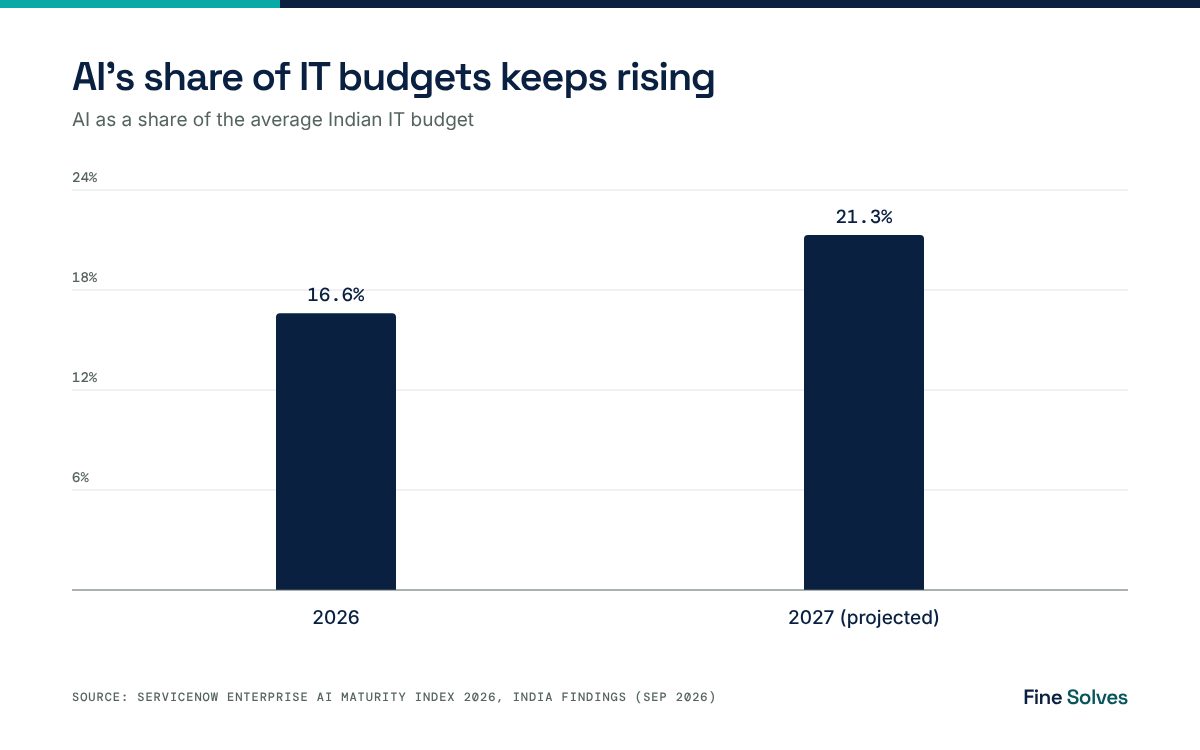
Budgets are moving regardless: AI's share of Indian IT spend is heading from 16.6% to 21.3%. The firms that get value from it will be the ones whose data pipelines, access controls and audit trails are ready before the rules harden. From the way we build data and AI systems for Indian clients, that groundwork usually takes longer than the model itself. If you want to scope a DEPA-ready data layer or a first sandboxed pilot, Talk to Fine Solves.
Frequently asked questions
Is DEPA for AI training mandatory?
No. The DEPA for AI Training handbook MeitY released on 30 October 2026 is a draft and is not legally binding. Consultations are expected in the coming weeks, and observers expect sectoral regulators such as banking and health authorities to make parts of it binding later, the way the Account Aggregator framework was rolled out.
How is DEPA Training different from the Account Aggregator system?
Account Aggregators run on DEPA Inference, which moves one person's data with their consent for a specific transaction. DEPA Training is about bulk, de-identified data used to build AI models. The data stays with its owner, and the model is trained inside a secure environment under an electronic contract.
Can a startup see the raw data in a DEPA sealed room?
No. Training happens inside a secure data environment that only runs what the authorised contract allows. The startup gets back a trained model or, in some cases, only a decision. In the healthcare pilot, a health-tech startup is training a tumour-detection model on hospital MRI scans it never sees.
Does DEPA replace compliance with the DPDP Act?
No. DEPA is a technical and contractual architecture, while the Digital Personal Data Protection Act is law, with penalties of up to ₹250 crore for data leaks and main rules taking effect in May 2027. DEPA is designed to help organisations share data for AI training in a way that respects that law.
Which Indian sectors benefit first from DEPA?
Financial services and healthcare. The draft report sizes financial services at $550 billion and healthcare at over $600 billion, and its roadmap starts with pilots and regulatory sandboxes in these two sectors. Education, with 250 million students, comes in a later phase alongside cross-border data agreements.
Sources
- MeitY launches DEPA for AI Training handbook — Press Information Bureau, 2026
- India proposes framework for AI training data and privacy — Business Standard, 2026
- DEPA for AI Training: MeitY's sealed-room plan for sensitive data — Elets CIO, 2026
- DEPA pilots process 2 million banking requests in AI data-sharing trial — BW Businessworld, 2026
- Enterprise AI Maturity Index 2026: India findings — ServiceNow, 2026
- World Bank India Development Update: AI use by Indian firms — MediaNama, 2026
Last updated: 2 November 2026. Published by Fine Solves — an AI software development company in Ahmedabad building custom software and AI systems for Indian businesses. finesolves.com