Build vs Buy Software in 2026: Data for Indian Firms
The build vs buy software decision comes down to one question: which option gets a working process live faster, at a total cost you can predict? Buying wins for standard workflows. Building wins where your process is the differentiator or off-the-shelf tools need heavy integration. Either way, plan for overruns: a Zoho–IDC study found 75% of Indian enterprises faced SaaS implementation delays.
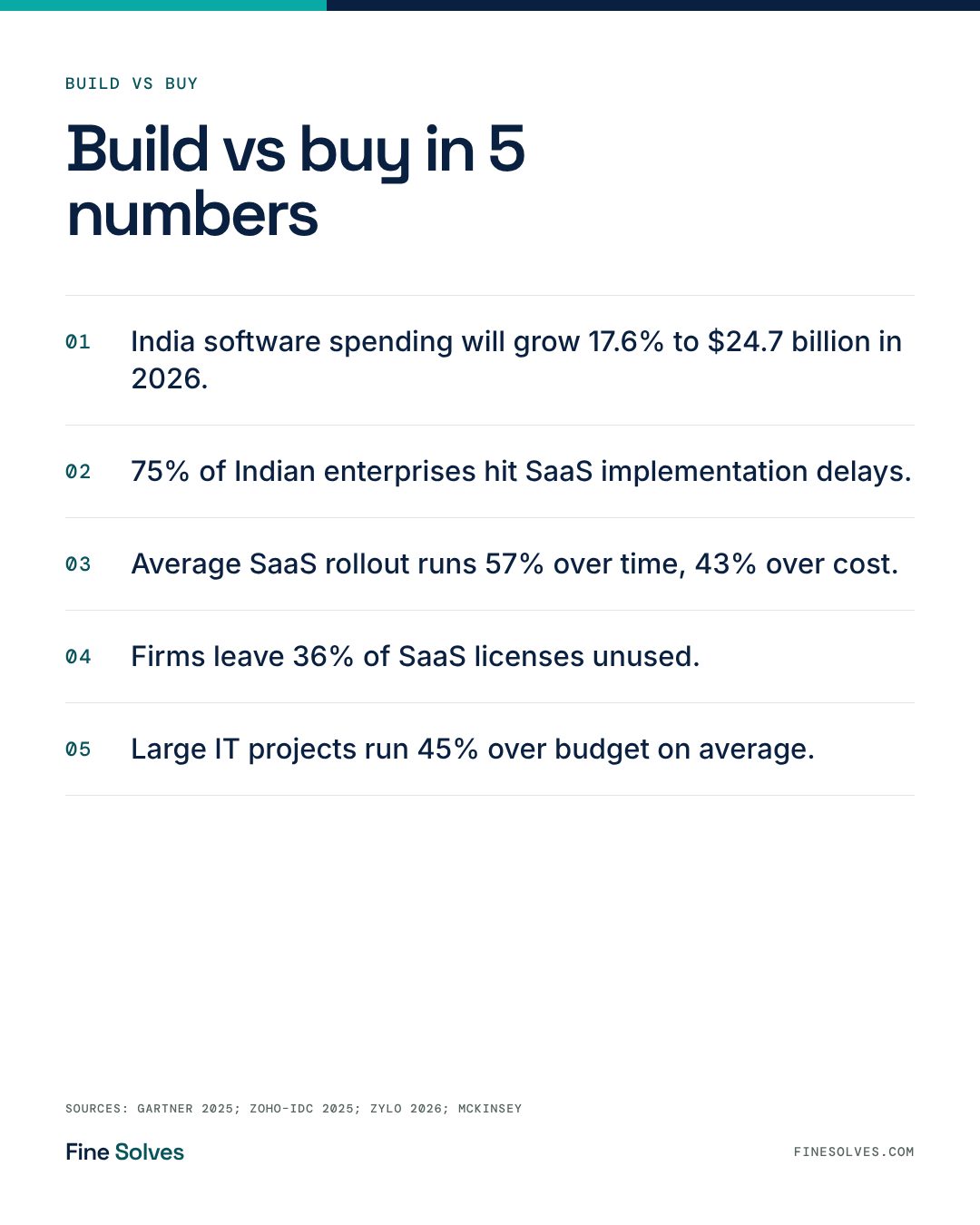
This matters now because Indian companies are spending more on software than ever. Gartner forecasts India's software spending will grow 17.6% to $24.7 billion in 2026, faster than total IT spending, which is set to rise 10.6% to $176.3 billion. More money is going into licences, subscriptions and custom builds at the same time. The firms that choose well on each workflow will spend less and get live sooner. The ones that default to "buy another tool" or "build everything" will pay for it in overruns, unused licences and integration work.
TL;DR
- India's software spending is forecast to grow 17.6% in 2026, according to Gartner.
- Indian SaaS rollouts run an average 57% over time and 43% over cost, Zoho and IDC found.
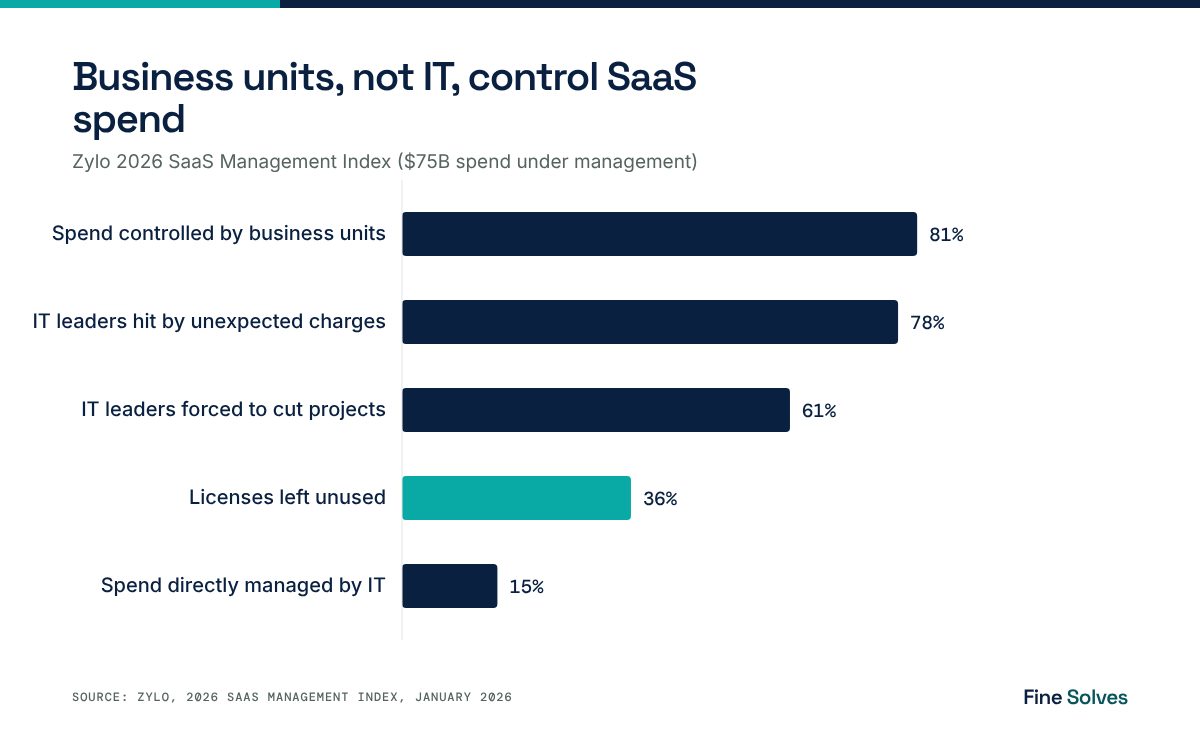
- Organisations leave 36% of SaaS licences unused, and business units control 81% of SaaS spend, per Zylo.
- Large IT projects run 45% over budget and deliver 56% less value than predicted, McKinsey and Oxford found.
- Indian mid-market firms lose 27% of AI budgets to complexity, roughly ₹33,000 crore a year, Freshworks estimates.
What does build vs buy software actually mean in 2026?
Build vs buy software is the choice between licensing an existing product (SaaS or packaged software) and commissioning custom software development for a specific workflow. In 2026 most firms do both, so the real decision is per workflow.
The old framing treated it as a one-time platform choice: buy an ERP or build one. Today a mid-sized manufacturer might run a bought ERP, a bought CRM, three AI tools and a custom dispatch app that stitches them together. Freshworks' survey found the average company runs 15 different software solutions. The question is no longer "which platform?" but "for this process, does a product fit well enough, or does the fit gap cost more than building?"
That fit gap is where most of the money goes. A tool that matches most of a process sounds cheap until the remaining work becomes manual workarounds, spreadsheets and integrations.
Why do software projects overrun so often?
Software projects overrun because scope, integration and ownership are underestimated at the start. The data is consistent across bought and built software, and across India and global samples.
On the buy side, the Zoho–IDC report on Indian enterprises shows 75% faced SaaS implementation delays, with an average 57% time overrun and 43% cost overrun. The study puts typical losses at about ₹6 crore in missed opportunities, productivity and customer experience. Respondents blamed project management inefficiencies (47%) and unexpected integration and security challenges (38%).
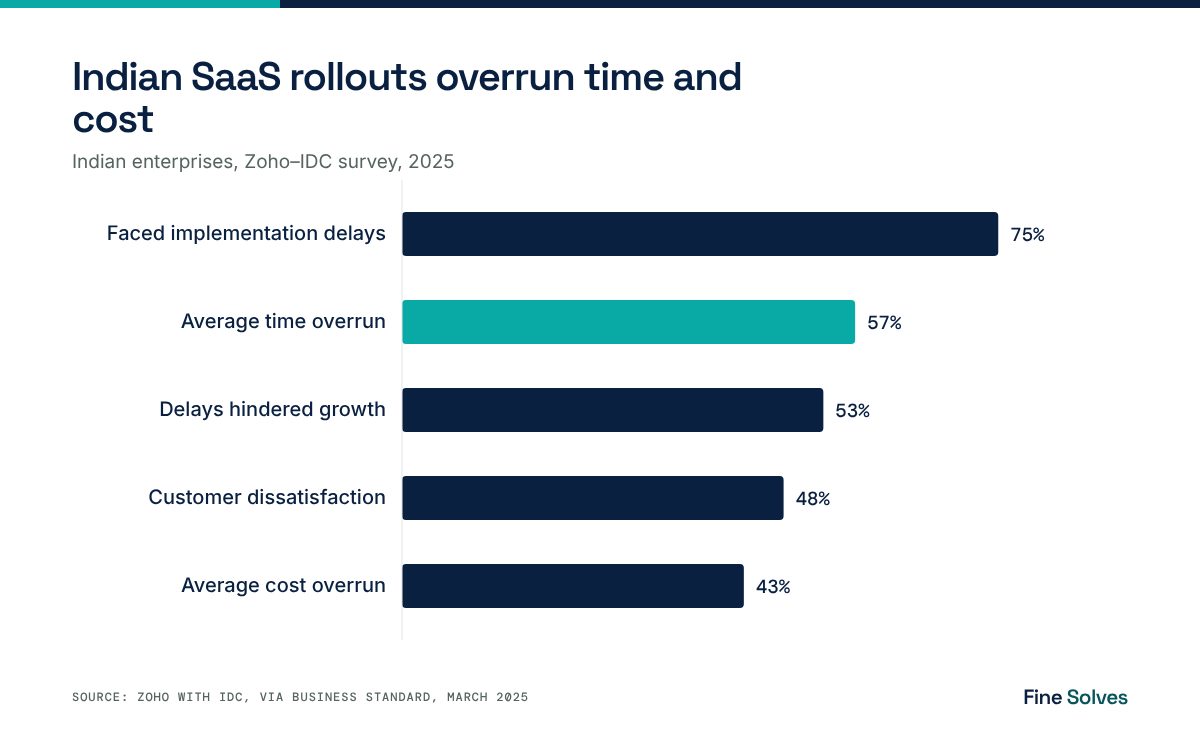
Delays are not just an IT problem. In the same survey, 53% said delays hindered digital transformation and growth, and 48% reported customer dissatisfaction. Freshworks' global survey found a similar pattern: 43% said implementations went over budget in the last 12 months, and 53% of companies have not received the ROI they planned from their software.
On the build side, the benchmark is McKinsey's study with the University of Oxford of more than 5,400 IT projects. Large projects, those above $15 million, ran an average 45% over budget and 7% over time, and delivered 56% less value than predicted. About 17% went so badly they threatened the company's existence, with budget overruns above 200%. Each extra year of scheduled length raised cost overruns by 15%.
| Risk | Buy (SaaS / packaged) | Build (custom) |
|---|---|---|
| Time overrun | 57% average (India, Zoho–IDC) | 7% average on large projects (McKinsey) |
| Cost overrun | 43% average (India, Zoho–IDC) | 45% average on large projects (McKinsey) |
| Value shortfall | 53% missed planned ROI (Freshworks) | 56% less value than predicted (McKinsey) |
| Ongoing waste | 36% of licences unused (Zylo) | Maintenance and team cost you own |
Source: Zoho–IDC via Business Standard (2025); McKinsey and University of Oxford; Freshworks (2025); Zylo 2026 SaaS Management Index. Samples differ, so compare direction, not decimals.
Read the table with care. The McKinsey figures cover very large projects, while the Zoho–IDC figures cover Indian SaaS rollouts of all sizes. The point is not that one route is safe. Both fail in the same places: unclear scope, late integration work and weak ownership.
How much does SaaS sprawl cost after go-live?
SaaS sprawl costs most through unused licences, surprise usage charges and spend nobody owns. Zylo's 2026 index shows organisations leave 36% of SaaS licences unused.
Zylo's data, built on more than $75 billion of spend under management, shows median SaaS spend of $9,455 per employee. Business units now control 81% of SaaS spend, while IT directly manages just 15%. In a survey of IT leaders, 78% reported unexpected consumption-based or AI pricing charges in the last 12 months, and 61% were forced to cut projects because of unplanned SaaS cost increases. Spend on AI-native apps rose 108% year over year.
Indian firms feel this sharply with AI tools. Freshworks' Global Cost of Complexity Report found Indian mid-market companies lose 27% of their AI budgets to complexity overheads, against 25% globally, which it estimates at ₹33,000 crore a year. 88% of Indian IT leaders said AI complexity has increased their workloads. Globally, Freshworks estimates 20% of software spending is wasted on failed implementations, underused tools and unexpected costs, and complexity drains 7% of annual revenue.
Is custom software development worth it for Indian SMBs?
Custom software development is worth it when the workflow is specific to your business, touches several systems, or is where you compete. It is rarely worth it for commodity functions like payroll, email or accounting.
Notice what the buyers themselves say. In the Freshworks India data, 93% of Indian respondents prefer AI products with built-in workflows over heavy customisation. That is a sensible default: if a product already fits, configuring it beats building. The trouble starts when "configure" turns into months of custom scripts on a tool you do not control. At that point you are building anyway, on someone else's platform, and paying a licence on top.
For Indian SMB and mid-market firms, custom builds tend to pay off in a handful of areas: dispatch and logistics flows tied to local carriers, plant-floor data capture, distributor and dealer portals, hospital billing linked to insurers and government schemes, and the integration layer that connects bought systems.
Where is Indian software spending heading?
Indian software spending is heading up fast: Gartner forecasts 17.6% growth in 2026, up from 12.1% in 2025. IT services spending, which includes custom development, should grow 11.1%.
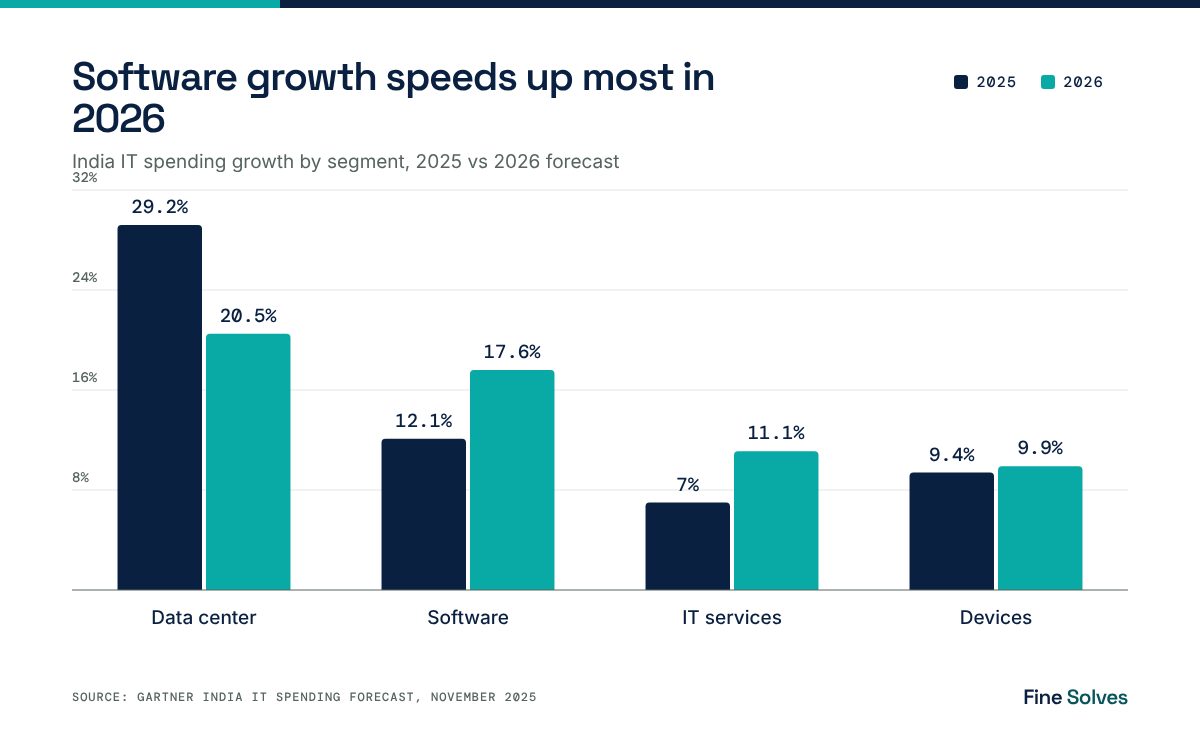
| Segment | 2025 growth | 2026 growth (forecast) |
|---|---|---|
| Data center systems | 29.2% | 20.5% |
| Software | 12.1% | 17.6% |
| IT services | 7.0% | 11.1% |
| Devices | 9.4% | 9.9% |
Source: Gartner, India IT spending forecast, November 2025.
Data center spending grows fastest, driven by AI infrastructure, but software shows the biggest jump in growth rate of any segment. For buyers, that means more vendors pitching more tools, and more pressure to rationalise what is already installed before adding the next subscription.
How should you decide: build or buy? A 7-step framework
Decide per workflow, not per company. Score each process on fit, differentiation and integration load, then pick the cheaper route to a live, owned process.
- Map the process first. Write the steps, the people and the systems involved before looking at any product.
- Measure the fit gap. Demo two or three products against your real process. List every step that needs a workaround.
- Ask if it is a differentiator. If customers choose you because of how this process runs, lean towards building.
- Count the integrations. Integration and security issues caused delays for 38% of Indian enterprises in the Zoho–IDC data. Every integration is real build work, whichever route you choose.
- Price the full life, not the licence. Include implementation, unused seats, usage charges and internal team time for both options.
- Keep scope small and phased. McKinsey found every extra year of schedule adds 15% to overruns. Ship a first version in weeks, then extend.
- Name one owner. With business units controlling 81% of SaaS spend, decide who owns each tool's cost, usage and renewal.
What this means for Indian businesses
For most Indian SMB and mid-market firms, the right answer is a mix: buy for standard functions, build the thin layer that is specific to how you operate, and integrate the two properly. The data says the biggest losses come from poor scoping and integration, not from the build-or-buy label itself. A ₹6 crore loss from a delayed SaaS rollout and a 45% overrun on a custom build have the same root causes.
From the way we build custom software at Fine Solves, the projects that land on time start with a mapped process, a short first release and one accountable owner on the client side. If you are weighing a build vs buy software decision for a specific workflow, Talk to Fine Solves.
Frequently asked questions
When should a company build software instead of buying it?
Build when the workflow is a competitive differentiator, when no product fits without heavy customisation, or when the main job is connecting several existing systems. Buy for commodity functions such as payroll, accounting and email, where products are mature and your process is not what customers pay for. Decide workflow by workflow rather than for the whole company.
How often do SaaS implementations get delayed in India?
Very often. A Zoho and IDC study of Indian enterprises found 75% faced SaaS implementation delays, with an average time overrun of 57% and an average cost overrun of 43%. Respondents linked the delays to project management gaps, integration and security issues, talent shortages and technical complexity in new solutions.
What is SaaS sprawl?
SaaS sprawl is the build-up of overlapping software subscriptions bought by different teams, often without central tracking. It shows up as unused licences, duplicate tools and surprise charges. Zylo's 2026 index found organisations leave 36% of SaaS licences unused, and business units, not IT, control 81% of SaaS spend.
Is custom software more likely to go over budget than SaaS?
Both go over budget often. McKinsey and Oxford found large IT projects run 45% over budget on average, while Indian SaaS rollouts in the Zoho–IDC study ran 43% over cost. The samples differ, but the lesson is the same: overruns come from scope, integration and ownership gaps, whichever route you take.
How much is India spending on software in 2026?
Gartner forecasts India's software spending at $24.7 billion in 2026, growth of 17.6%. Total IT spending in India is forecast at $176.3 billion, up 10.6%, with IT services, which include custom development work, growing 11.1%. Data center systems are the fastest-growing segment, driven by AI infrastructure.
Sources
- Gartner Forecasts India IT Spending to Exceed $176 Billion in 2026 — Gartner, 2025
- SaaS implementation delays result in business losses: Zoho, IDC report — Business Standard, 2025
- 2026 SaaS Management Index — Zylo, 2026
- Delivering large-scale IT projects on time, on budget, and on value — McKinsey & Company with University of Oxford
- India's mid-market firms lead in AI adoption but face rising complexity costs: Freshworks report — YourStory, 2026
- 20% of software budgets wasted on unnecessary business complexity — Freshworks, 2025
Last updated: 2 November 2026. Published by Fine Solves — an AI software development company in Ahmedabad building custom software and AI systems for Indian businesses. finesolves.com