AI Revenue at Indian IT Firms Tops 10%: Q2 FY27 Data
Indian IT AI revenue crossed a visible threshold in the Q2 FY27 results. TCS put its annualised AI revenue at $3.1 billion, more than 10% of its business, and Infosys reported AI at 10.5% of quarterly revenue. For Indian companies buying software and AI work, the message is simple: AI is now mainstream services work, and it is being priced under pressure.
The results season for the big five IT firms ended in the third week of October, and the analysis landed this week. On 27 October, Elets CIO and Analytics India Magazine both published breakdowns showing AI growing fast while overall revenue barely moved. On 28 October, a report from brokerage Anand Rathi argued that Indian IT firms are positioned as the integration layer for enterprise AI, while warning about AI-led pricing deflation. If you run operations or IT at an Indian firm, this matters because it changes what vendors will pitch you, and what you should pay.
TL;DR
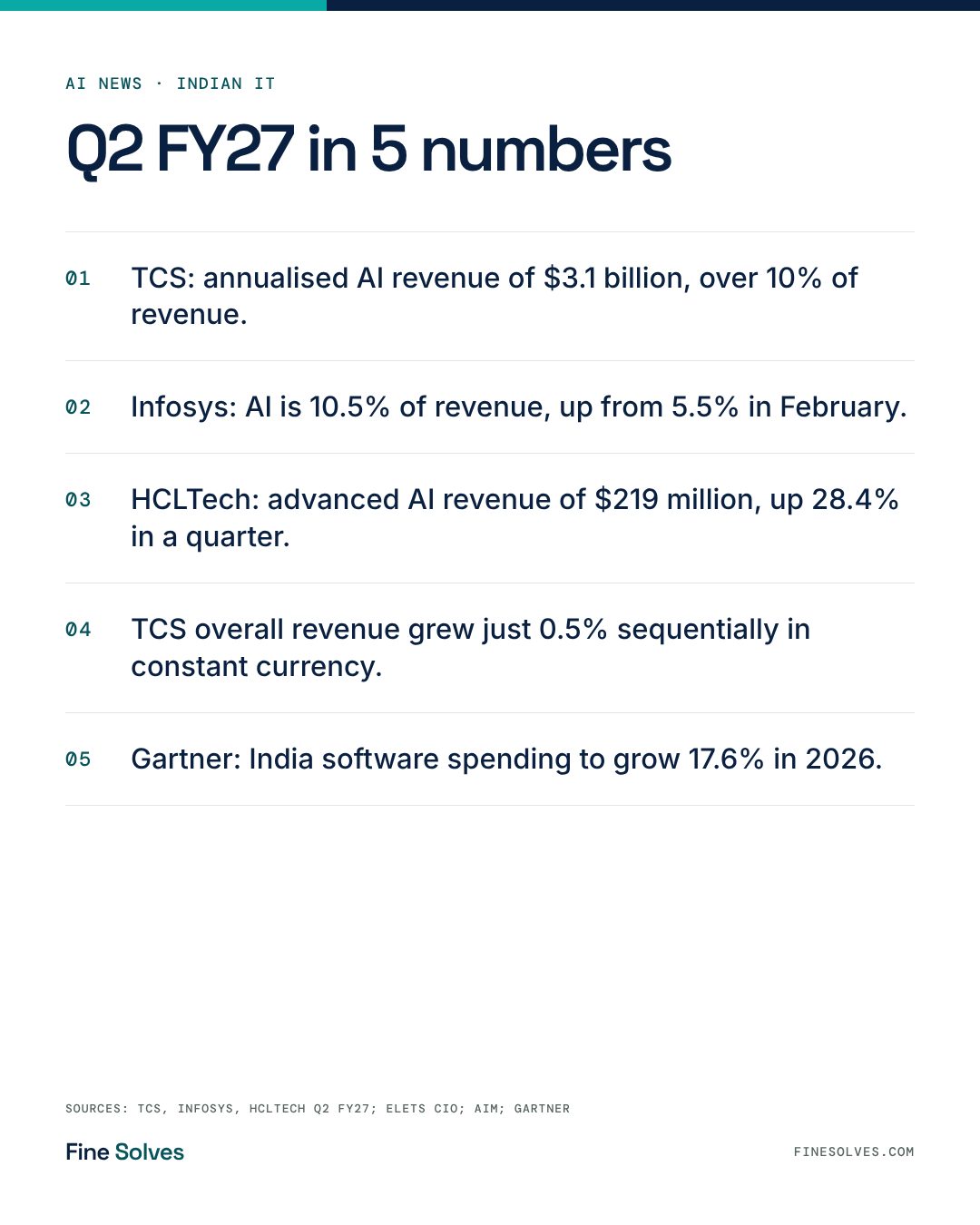
- TCS reported annualised AI revenue of $3.1 billion, crossing 10% of total revenue for the first time.
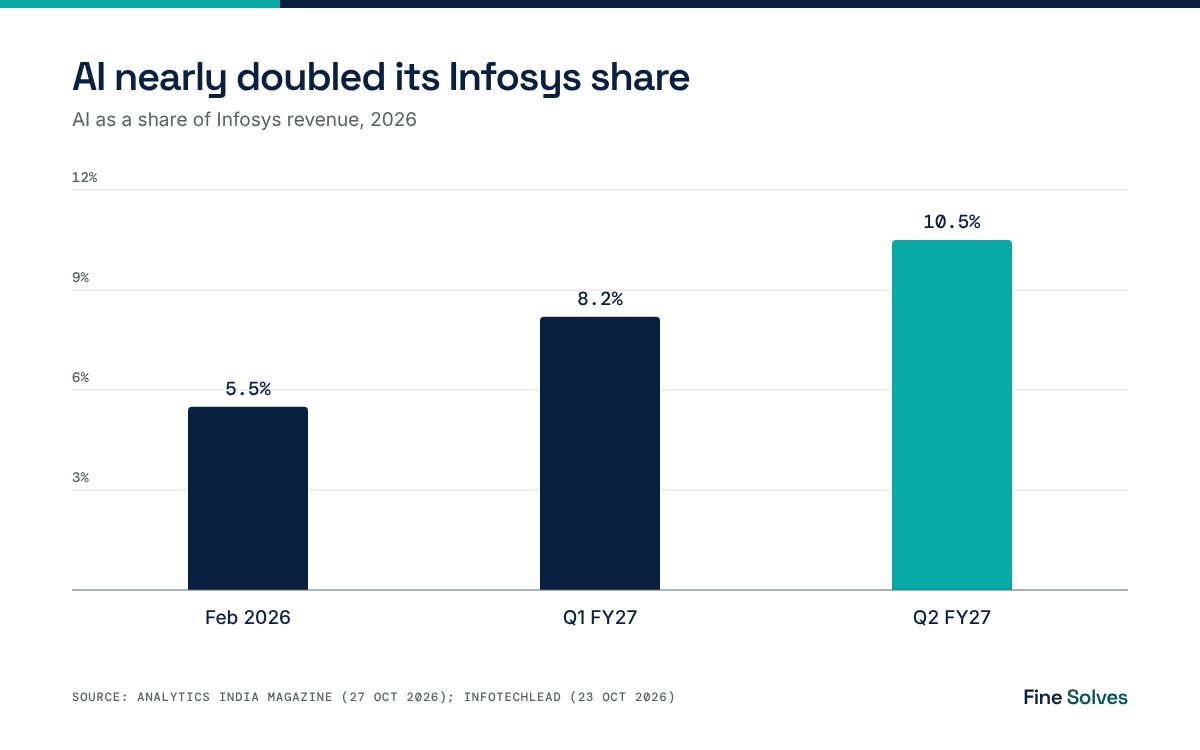
- Infosys said AI was 10.5% of Q2 revenue, up from 8.2% in Q1 and 5.5% in February.
- HCLTech's advanced AI revenue reached $219 million in the quarter, up 28.4% sequentially.
- Overall growth stayed weak: TCS grew 0.5% sequentially in constant currency and Infosys cut its FY27 guidance to 1% to 2%.
- Gartner forecasts India's own IT spending at $176.3 billion in 2026, with software growing 17.6%.
How much AI revenue are Indian IT firms reporting?
TCS and Infosys now report AI at 10% or more of revenue, and HCLTech discloses a separate advanced AI line. Each company defines "AI revenue" its own way, so treat the figures as directional rather than strictly comparable, a caveat Elets CIO also makes.
TCS said annualised AI revenue reached $3.1 billion in the July–September quarter, exceeding 10% of revenue for the first time, according to its Q2 FY27 results as reported by Pulse 2.0. Total revenue was $7.56 billion (₹73,188 crore), up 11.2% year on year. Infosys reported quarterly revenue of ₹49,244 crore, up 10.7% year on year in rupee terms, with AI at 10.5% of the total, InfotechLead reported. HCLTech's press release put advanced AI revenue at $219 million for the quarter, or $876 million annualised, up 78% year on year in constant currency.
| Company | AI metric disclosed (Q2 FY27) | AI growth, quarter on quarter | Headline deal wins |
|---|---|---|---|
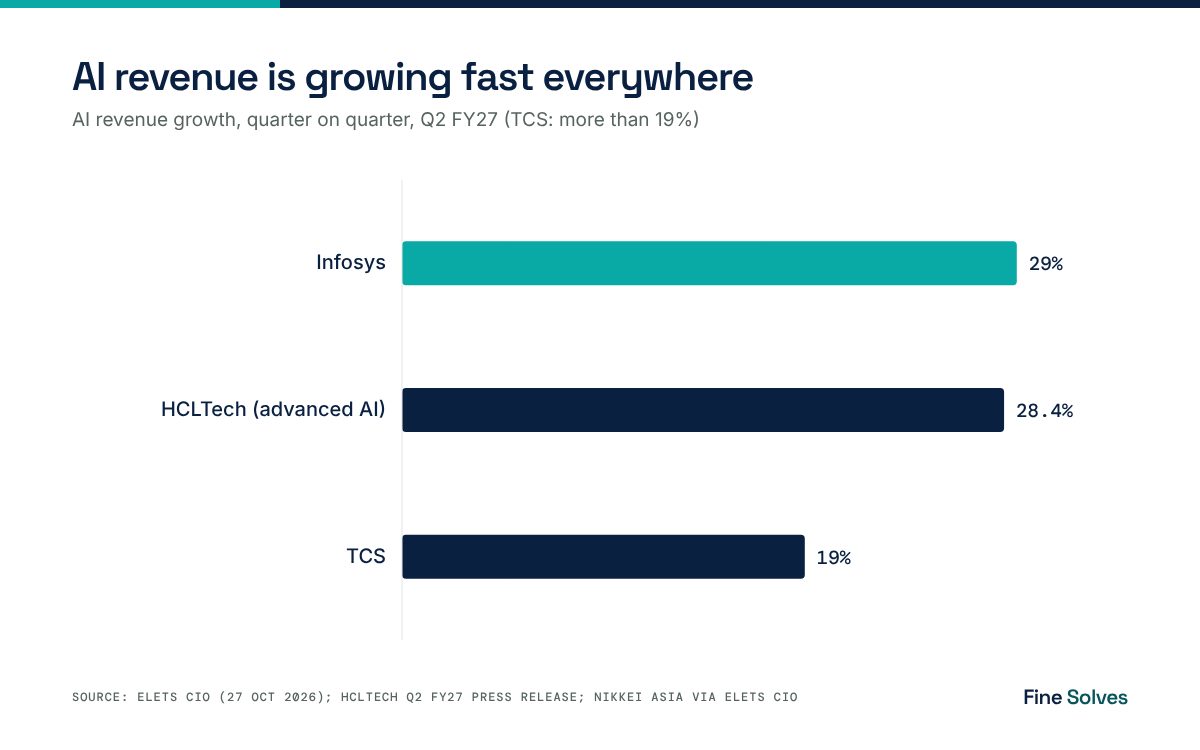
| TCS | $3.1 billion annualised AI revenue | More than 19% | $9.6 billion TCV |
| Infosys | 10.5% of quarterly revenue | 29% | $5.2 billion large-deal TCV |
| HCLTech | $219 million advanced AI revenue | 28.4% | $3.3 billion new bookings |
| Wipro | Not quantified | Not disclosed | $2,595 million total bookings |
Source: TCS Q2 FY27 results via Pulse 2.0; Infosys via InfotechLead and Elets CIO; HCLTech press release; Wipro results via CXOToday. TCS AI growth figure is Nikkei Asia's, as cited by Elets CIO.
Why is AI growing while overall IT revenue stalls?
AI work is growing partly by replacing older services work, so the total barely moves. Analytics India Magazine's breakdown of Infosys shows the pattern most clearly.
Infosys added roughly $120 million of AI revenue in the quarter, while total revenue rose only about $63 million, which implies the rest of the business shrank by about 1%, by the magazine's estimate. Infosys still cut its FY27 constant-currency guidance to 1% to 2%, moving the midpoint from 2.5% in April to 1.5%. Its large deals totalled $5.2 billion, of which 62% was net new, including one mega deal of over $2 billion.
The picture at the others is similar. TCS grew just 0.5% sequentially in constant currency. Wipro's total bookings were $2,595 million, down 22.9% sequentially, and its large-deal bookings fell 58.6% to $674 million, according to its results release. HCLTech was the exception on bookings, reporting $3.3 billion, up 27% year on year.
Is AI making IT services cheaper for buyers?
Possibly, but not evenly: analysts expect AI to push some service prices down while vendors try to earn more on AI-specific work. Both forces will show up in the quotes you receive.
The Anand Rathi report flagged AI-led pricing deflation as a key risk for Indian IT, and Analytics India Magazine noted continued pricing pressure as a headwind for Infosys in the second half. At the same time, HCLTech claims its advanced AI services earn 7% to 10% higher margins, the magazine reported, while Infosys does not disclose AI margins. Gartner, quoted by InfotechLead, expects worldwide application services spending to grow 4.7% in 2026, a modest pace that leaves vendors competing hard on price for routine work.
For a buyer, that combination is useful. Routine build, testing and support should get cheaper as vendors automate it. Work that is clearly AI-specific (model integration, agents, data pipelines) is where vendors will try to hold or raise rates, so that is where you need line-item clarity.
What is driving demand: AI models or integration?
Integration. The money for services firms sits in connecting AI models to the systems, data and workflows a business already runs, not in building models.
The Anand Rathi report describes Indian IT as offering "asset-light exposure" to the enterprise deployment cycle, with model-agnostic systems integrators helping firms select, integrate and deploy models. The same report notes that around 80% of Anthropic's first-half 2026 revenue was consumption-based, meaning spend scales with usage once AI is wired into operations. That is the part integrators help create.
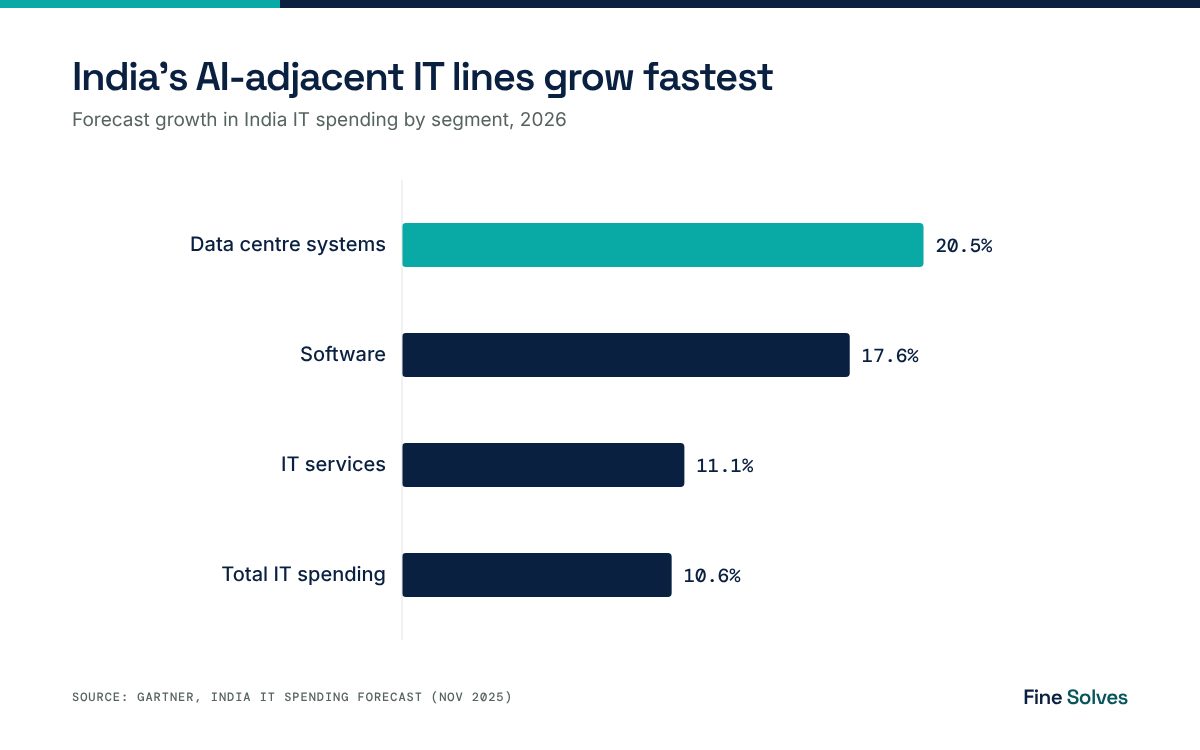
Gartner's India forecast points the same way. It expects Indian IT spending to reach $176.3 billion in 2026, up 10.6%, with software spending up 17.6% to $24.7 billion and IT services up 11.1%. Data centre systems are forecast to grow fastest, at 20.5%.
How did the India market itself fare for these firms?
Mixed: TCS's India revenue fell sharply quarter on quarter, while HCLTech's India business was its fastest-growing geography. Domestic revenue remains a small slice for all of them.
TCS's India revenue fell 10.3% sequentially, though it was still 6% higher than a year earlier, Pulse 2.0 reported. India was just 2.8% of Infosys revenue in the quarter, according to InfotechLead. HCLTech reported India growth of 21.8% year on year in constant currency, its fastest among geographies. For a mid-market Indian firm, the practical point is that the largest vendors are built around overseas clients. Their AI practices, pricing models and contract terms are designed for global enterprise budgets, not for a ₹ crore-scale project with a 12-week timeline.
| India 2026 IT segment | Forecast growth | What it signals for buyers |
|---|---|---|
| Data centre systems | 20.5% | Compute capacity for AI workloads is expanding |
| Software | 17.6% | More subscriptions and AI features to integrate |
| IT services | 11.1% | Demand for build and integration work rising |
| Total IT spending | 10.6% | Budgets growing, but faster in AI-adjacent lines |
Source: Gartner, India IT spending forecast for 2026 (November 2025).
How should Indian buyers evaluate an AI services proposal now?
Ask vendors to separate AI work from routine work, and price each on outcomes you can measure. These five steps make that concrete.
- Split the quote. Ask for separate line items for integration, data preparation, model usage and ongoing support. If a vendor bundles "AI" into one number, you cannot compare it.
- Ask what AI changed in the delivery cost. If vendors automate testing and boilerplate code, the effort estimate for routine work should fall. Ask where that saving shows up.
- Model the run cost, not just the build cost. Usage-based AI pricing means spend rises with adoption. Get a monthly cost estimate at expected volume, and at three times that volume.
- Insist on model-agnostic design. The Anand Rathi report's point about model-agnostic integrators applies to you too: avoid architectures locked to one model provider.
- Define a measurable pilot. Pick one workflow (invoice matching, demand forecasting, patient discharge summaries) with a baseline metric, and fund the next phase only if the metric moves.
What this means for Indian businesses
Three things follow from this quarter. First, AI services are no longer experimental for vendors: they are 10% or more of revenue at the biggest firms and growing at double-digit rates quarter on quarter. Expect every proposal you receive to include an AI component, whether you need one or not.
Second, pricing pressure on routine IT work is real, and you should benefit from it. Third, the hard part of AI is integration with your existing ERP, WMS, HMS or billing systems, which is exactly the work that suits a focused team that knows your stack. From the way we build at Fine Solves, the projects that pay back start with one workflow and a clear metric, not a platform.
If you are scoping an AI or custom software project and want a second opinion on a proposal, Talk to Fine Solves.
Frequently asked questions
How much of TCS revenue comes from AI?
TCS reported annualised AI revenue of $3.1 billion in its Q2 FY27 results for the July–September 2026 quarter. The company said this exceeded 10% of its total revenue for the first time. TCS's total quarterly revenue was $7.56 billion. The AI figure is company-defined, so it is not directly comparable with other firms' disclosures.
What share of Infosys revenue is AI?
Infosys said AI accounted for 10.5% of its revenue in Q2 FY27, up from 8.2% in the previous quarter. AI revenue grew 29% quarter on quarter. Despite this, Infosys cut its full-year FY27 constant-currency growth guidance to 1% to 2%, and the rest of the business shrank slightly, by Analytics India Magazine's estimate.
Will AI make IT services cheaper in India?
Routine services such as testing, maintenance and standard development are likely to face price pressure. Brokerage Anand Rathi flagged AI-led pricing deflation as a key risk for Indian IT in an October 2026 report. AI-specific work such as model integration and agents may be priced higher, so buyers should ask for itemised quotes.
Why does integration matter more than the AI model?
A model on its own does nothing for a business until it is connected to real data, systems and workflows. The Anand Rathi report argues that model-agnostic systems integrators capture this value. For Indian firms, the cost and risk of an AI project usually sit in integrating with ERP, billing or warehouse systems, not in the model.
How fast is IT spending growing in India?
Gartner forecasts Indian IT spending will reach $176.3 billion in 2026, up 10.6% from 2025. Software is expected to grow 17.6% and IT services 11.1%, while data centre systems lead at 20.5%. The forecast reflects faster adoption of cloud and AI infrastructure by Indian enterprises.
Sources
- AI Now Brings in Over 10% of Revenue at TCS and Infosys as Enterprise AI Moves Beyond Pilots — Elets CIO, 2026
- Infosys's $5.2 Billion Deal Wins Fail to Lift FY27 Outlook — Analytics India Magazine, 2026
- Indian IT Firms Set to Benefit From Rising Enterprise AI Adoption (Anand Rathi report, via ANI) — Asianet Newsable, 2026
- TCS Q2 FY27 results and annualised AI revenue — Pulse 2.0, 2026
- Infosys Q2 FY27 Results — InfotechLead, 2026
- HCLTech delivers strong Q2 led by record deal bookings — HCLTech, 2026
- Wipro announces results for the quarter ended September 30, 2026 — CXOToday, 2026
- Gartner forecasts India IT spending for 2026 — Gartner, 2025
Last updated: 1 November 2026. Published by Fine Solves — an AI software development company in Ahmedabad building custom software and AI systems for Indian businesses. finesolves.com