AI-Powered Cyberattacks: I4C's 6-Hour Alert for Banks
AI-powered cyberattacks are now hitting Indian banks, NBFCs and fintechs through their payment and disbursement APIs, according to an advisory from the Indian Cyber Crime Coordination Centre (I4C) made public on 4 November 2026. Attackers use AI agents to move money at machine speed. Firms must report incidents to CERT-In within six hours, while bank fraud value already rose 46% in FY26.
This matters now because the threat has moved from the customer's phone to the institution's own plumbing. Earlier fraud waves tricked people into sending money. The pattern I4C describes skips the customer entirely: an AI agent finds an unpatched server or a forgotten test API, calls the disbursement system directly, and spreads the money across mule accounts before a human analyst has opened a ticket. Any Indian business that pays out money through an API, from lenders to insurers to marketplaces, should read this advisory as if it were addressed to them.
TL;DR
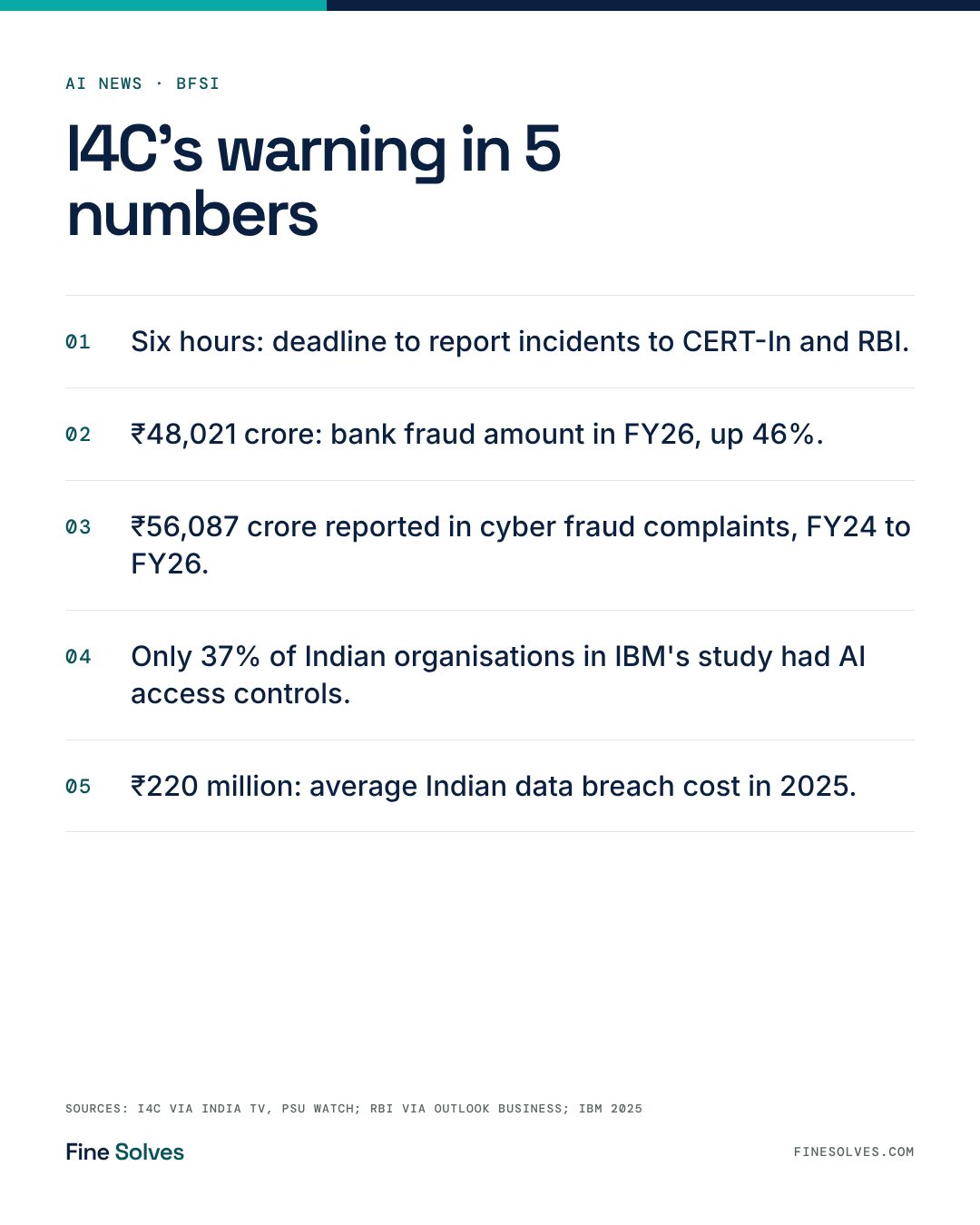
- I4C's National Cybercrime Threat Analysis Unit issued the advisory on November 3; incidents must reach CERT-In within six hours of detection.
- RBI data shows bank fraud value rose 46% to ₹48,021 crore in FY26, even as case counts fell 57%.
- Cyber fraud complaints worth ₹56,087 crore were reported between FY2023-24 and FY2025-26; only ₹206 crore was refunded.
- IBM found just 37% of Indian organisations it studied had AI access controls in place.
- The average Indian data breach cost a record ₹220 million in 2025, up 13% in a year, per IBM.
What did I4C warn banks and fintechs about?
I4C warned that financially motivated attackers are using AI agents to break into banks, NBFCs and fintechs and push unauthorised transfers through payment and disbursement APIs. Inc42 reports that the advisory was issued on November 3 by I4C's National Cybercrime Threat Analysis Unit, and it points to what the agency called machine-speed compromise.
The entry points are ordinary: unpatched software, misconfigured internet-facing servers and customer-facing complaint systems. Once inside, the attackers target automated fund disbursement systems. According to PSU Watch, the advisory says multi-crore unauthorised transactions are being found in individual cases. Money is routed to mule accounts across banks, pulled out through IMPS and NEFT, and logs are deleted to hide the trail.
The advisory does not name the affected institutions or put a rupee figure on total AI-led losses. It does tell every financial entity, including payment aggregators, to implement two critical CERT-In advisories issued in October: one on payment and disbursement API abuse dated October 9, and one on AI agents as attack vectors dated October 15. Reuters reported the warning alongside a separate leak of data on 3,900 State Bank of India customers.
How big is the fraud problem behind AI-powered cyberattacks?
The rupee value of bank fraud is rising fast even though the number of cases is falling. RBI data, reported by Outlook Business, shows banks and financial institutions reported 10,114 fraud cases involving ₹48,021 crore in FY26, against 23,722 cases worth ₹32,803 crore a year earlier.
That is a 57% fall in cases and a 46% rise in value. One caveat matters: the FY26 total includes 314 older cases worth ₹30,199 crore that were reclassified after re-examination, as Free Press Journal notes. Even so, the direction is clear. Fewer, larger frauds are the pattern, and that is exactly what an API-level attack produces.
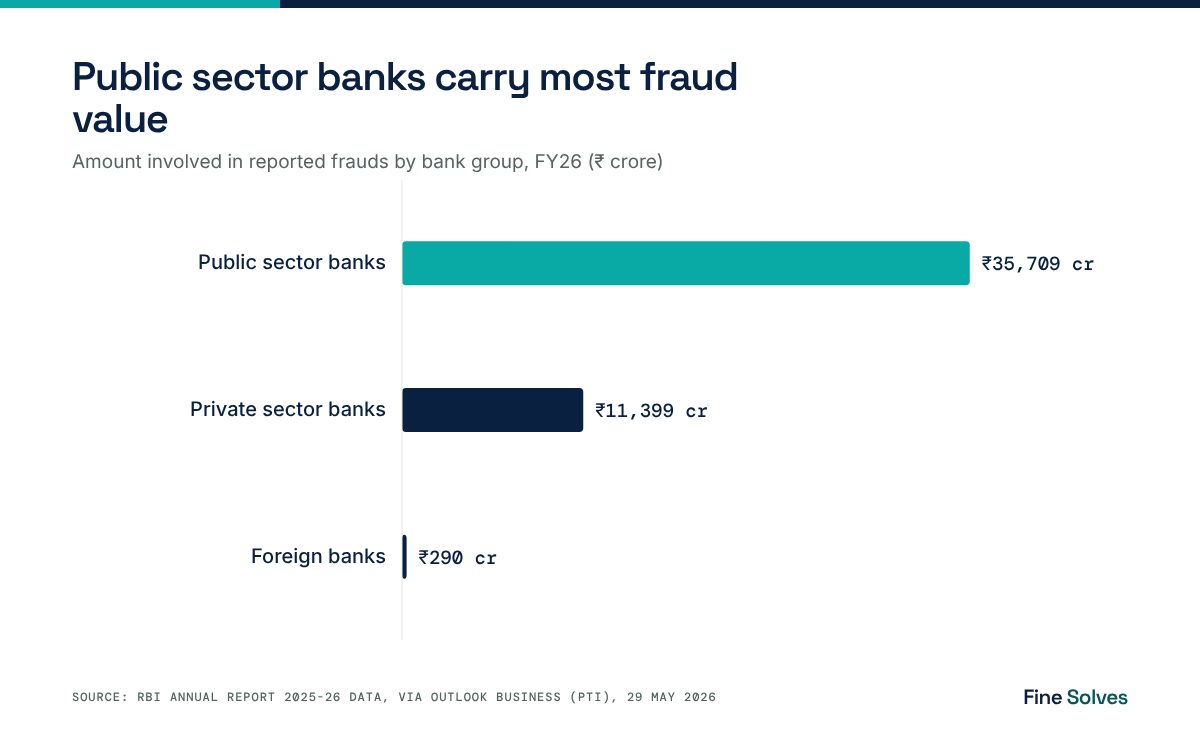
| Bank group | FY26 cases | FY26 amount | FY25 cases | FY25 amount |
|---|---|---|---|---|
| Public sector banks | 5,418 | ₹35,709 crore | 6,916 | ₹23,617 crore |
| Private sector banks | 3,956 | ₹11,399 crore | 14,024 | ₹8,927 crore |
| Foreign banks | 210 | ₹290 crore | 1,447 | ₹181 crore |
| All banks and FIs | 10,114 | ₹48,021 crore | 23,722 | ₹32,803 crore |
Source: RBI Annual Report 2025-26 data, via Outlook Business (PTI), 29 May 2026. Totals include small finance banks and payments banks.
On the public side, the cyber fraud numbers are larger still. PSU Watch, citing official data, reports more than 53.87 lakh cyber fraud complaints and over 1.81 lakh FIRs between FY2023-24 and FY2025-26, with ₹56,087 crore reported in those complaints. Of that, ₹9,079 crore was marked as lien and just ₹206 crore was refunded to victims. PSU Watch is careful to say these figures cover all cyber fraud, not only AI-led attacks.
Why are payment APIs the new target?
Payment APIs are the target because they move real money automatically, and an AI agent can probe and call them far faster than a human attacker. Weak spots are old, test or undocumented interfaces that nobody monitors.
RBI's own split of fraud categories shows the shift. Card, internet and digital payment frauds fell to 293 cases worth ₹29 crore in FY26, from ₹517 crore in FY25 and ₹1,452 crore in FY24. Losses at the customer end are shrinking. Meanwhile, advances-related frauds rose to ₹40,774 crore in FY26, from ₹30,367 crore in FY25 and ₹8,917 crore in FY24. Large-ticket fraud now sits inside institutional processes, not at the customer's fingertip.
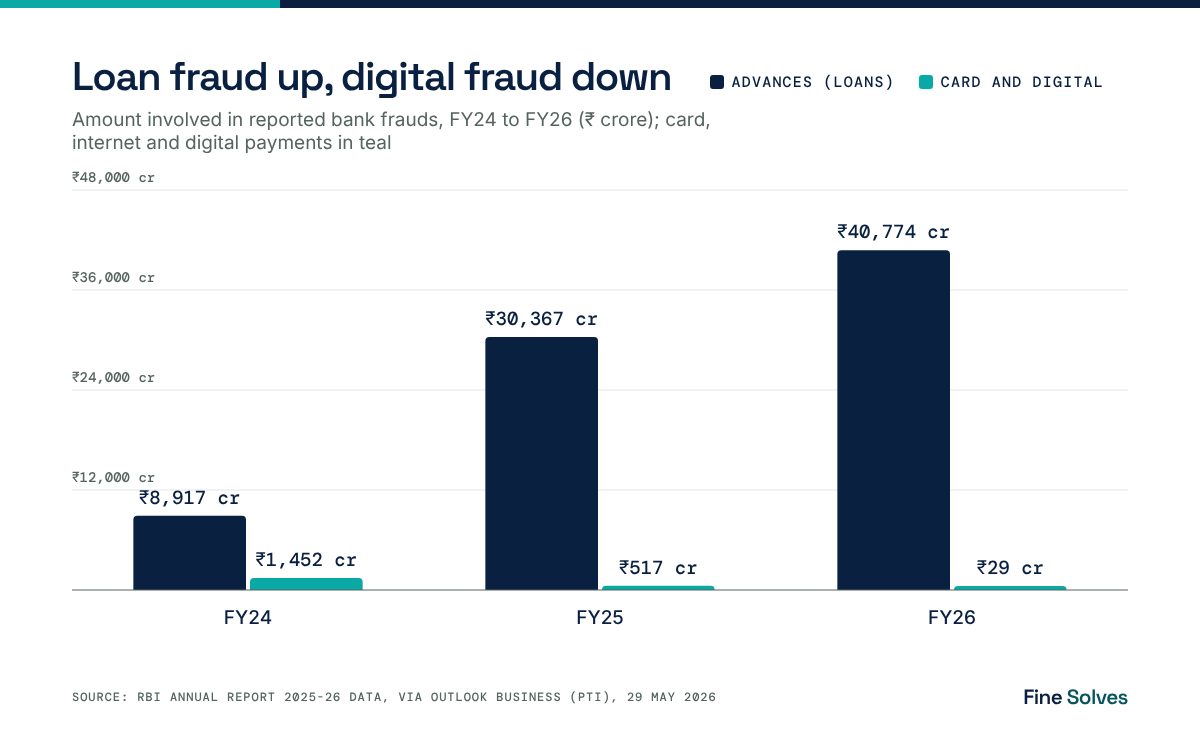
An agentic attacker suits that environment. It can enumerate endpoints, test token handling, and repeat small calls until it finds a disbursement path with no per-transaction limit. That is why the advisory focuses on API inventories, beneficiary-name checks and transaction-speed monitoring rather than on customer awareness.
What does the six-hour reporting rule require?
Banks, NBFCs and fintechs must report any cyber incident to CERT-In within six hours of detection; banks and NBFCs must also report to RBI through its DAKSH portal within the same window.
India TV reports that NBFCs and fintechs can also use I4C's NCRP-CFCFRMS portal to bulk-report fraudulent transactions so that defrauded money can be frozen faster. The practical point is simple. Six hours is not enough time to discover an attack by reading logs the next morning. If detection depends on a weekly report or a reconciliation that runs overnight, the deadline is already missed.
Are Indian firms ready for AI-led attacks?
Mostly not. IBM's 2025 data shows most Indian organisations lack basic controls over AI systems, and breaches involving unmanaged AI tools cost more.
The IBM Cost of a Data Breach Report 2025 found the average Indian breach cost ₹220 million, up 13% from ₹195 million in 2024. Only 37% of Indian organisations reported AI access controls. Nearly 60% of breached organisations had no AI governance policy or were still drafting one. Shadow AI, meaning staff using unapproved AI tools, added ₹17.9 million to the average breach, and only 42% had policies to manage AI or detect shadow AI.
IBM also reports that phishing caused 18% of Indian breaches, third-party and supply chain compromise 17%, and vulnerability exploitation 13%. The last two are exactly the doors I4C describes. Worse, 73% of organisations surveyed said they made limited or no use of AI and security automation — the tools IBM links to lower breach costs.
Is this only a bank problem?
No. Any business that disburses money through an API, or whose customers lose money through scams, carries the same exposure.
I4C and NCRP data, reported by BrokersView, show Indians lost over ₹198 billion to financial fraud in 2025. Investment schemes accounted for 77% of those losses, digital arrest scams 8%, credit card fraud 7%, sextortion 4%, e-commerce fraud 3% and app or malware scams 1%.
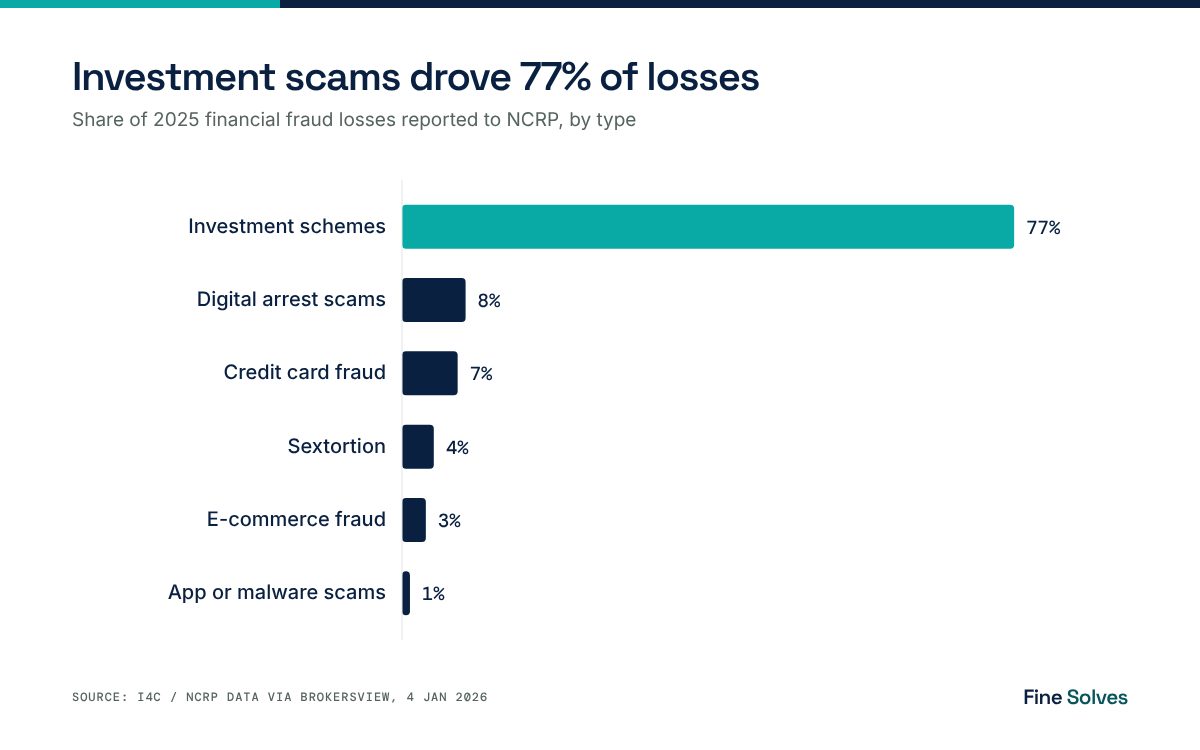
Insurers paying claims, lenders disbursing loans, marketplaces settling sellers, and hospitals processing refunds all run payout flows that look like the ones I4C flagged. Mule accounts do not care whether the money left a bank or an NBFC's lending stack.
How should firms defend payment APIs against AI agents?
Start with an inventory, then add limits and monitoring that work at machine speed. The I4C and CERT-In measures translate into a practical checklist:
- List every payment and disbursement API. Include partner, legacy and test endpoints. Disable anything old, unused or undocumented.
- Set daily and per-transaction limits at the API layer, not only in the core system.
- Verify beneficiary names and accounts before funds move, and confirm KYC and approvals are complete.
- Monitor speed and volume. Alert on unusual call rates, changes in narration or beneficiary, and access-token failures from non-whitelisted IPs.
- Patch and lock down internet-facing systems, including complaint and grievance portals.
- Review architecture for lateral movement so one compromised server cannot reach the disbursement engine.
- Run authorised red-team drills that simulate machine-speed attacks, and measure how long your SOC and payment controls take to respond.
- Rehearse the six-hour report: who detects, who decides, who files with CERT-In and RBI DAKSH.
The advisory also asks for tighter coordination between the CISO, transaction monitoring and IT teams. In many mid-sized lenders these three groups use separate tools and meet only after an incident.
What this means for Indian businesses
For an ops or IT head at an NBFC, insurer, fintech or any firm with a payout flow, the message is that the weakest link is now software, not the customer. Three decisions follow. First, treat the API inventory as a board-level control, not a developer document. Second, build real-time monitoring on payout flows before adding new AI features. Third, put AI agents your own teams deploy under the same access controls as human users, since IBM's data shows that is where most Indian firms are behind.
From the way we build payment and operations software, the cheapest moment to add limits, beneficiary checks and audit trails is before go-live, not after an incident report. If you want a second pair of eyes on a disbursement flow or an internal AI agent, Talk to Fine Solves.
Frequently asked questions
What is an AI-powered cyberattack on a bank?
It is an attack where AI agents automate the steps a human hacker would take: scanning for unpatched servers, probing APIs, and triggering transfers. I4C says such attacks on Indian banks, NBFCs and fintechs target payment and disbursement APIs, move money to mule accounts across banks, and delete records, producing what it calls machine-speed compromise.
Who issued the November 2026 advisory?
The National Cybercrime Threat Analysis Unit of the Indian Cyber Crime Coordination Centre (I4C) issued it on November 3, 2026. It asks all financial entities, including banks, fintechs and payment aggregators, to urgently implement CERT-In's October advisories on payment API abuse and on AI agents as attack vectors.
How quickly must a cyber incident be reported in India?
Financial entities must report cyber incidents to CERT-In within six hours of detection. Banks and NBFCs must also report to the Reserve Bank of India through its DAKSH portal within six hours. NBFCs and fintechs can use I4C's NCRP-CFCFRMS portal for bulk reporting of fraudulent transactions to help freeze stolen funds.
How much did bank fraud cost India in FY26?
According to RBI data, banks and financial institutions reported 10,114 fraud cases involving ₹48,021 crore in FY26, up 46% in value from ₹32,803 crore in FY25, while case numbers fell 57%. The FY26 figure includes 314 older cases worth ₹30,199 crore reclassified during the year.
What is the first step to secure payment APIs?
Build a complete inventory of every payment and disbursement API, including partner, legacy and test endpoints, and switch off any that are unused. Then add per-transaction and daily limits, beneficiary-name checks and real-time monitoring of call speed and volume, so an automated attack is stopped within minutes rather than found the next day.
Sources
- Cybersecurity Agency I4C Warns Banks & Fintechs Against AI-Led Cyberattacks — Inc42, 2026
- AI-driven cyberattacks could put banks at risk of multi-crore fraud, Indian agencies warn — India TV News, 2026
- I4C warns banks, NBFCs of AI-powered cyberattacks, flags multi-crore fraudulent transactions — PSU Watch, 2026
- India cybercrime agency warns financial firms of AI-driven cyberattacks — Reuters, 2026
- Financial Institutions Report Over 10,000 Fraud Cases in FY26: RBI Data — Outlook Business (PTI), 2026
- Bank Fraud Amount Jumps 46% In FY26, RBI Weighs 'Kill Switch' — Free Press Journal, 2026
- India Records Highest Average Cost of a Data Breach: IBM Cost of a Data Breach Report — IBM, 2025
- Indians Lost Over ₹198 Billion to Financial Fraud in 2025, I4C & NCRP Data Show — BrokersView, 2026
Last updated: 5 November 2026. Published by Fine Solves — an AI software development company in Ahmedabad building custom software and AI systems for Indian businesses. finesolves.com