AI Pilot to Production: A 2026 Playbook for India
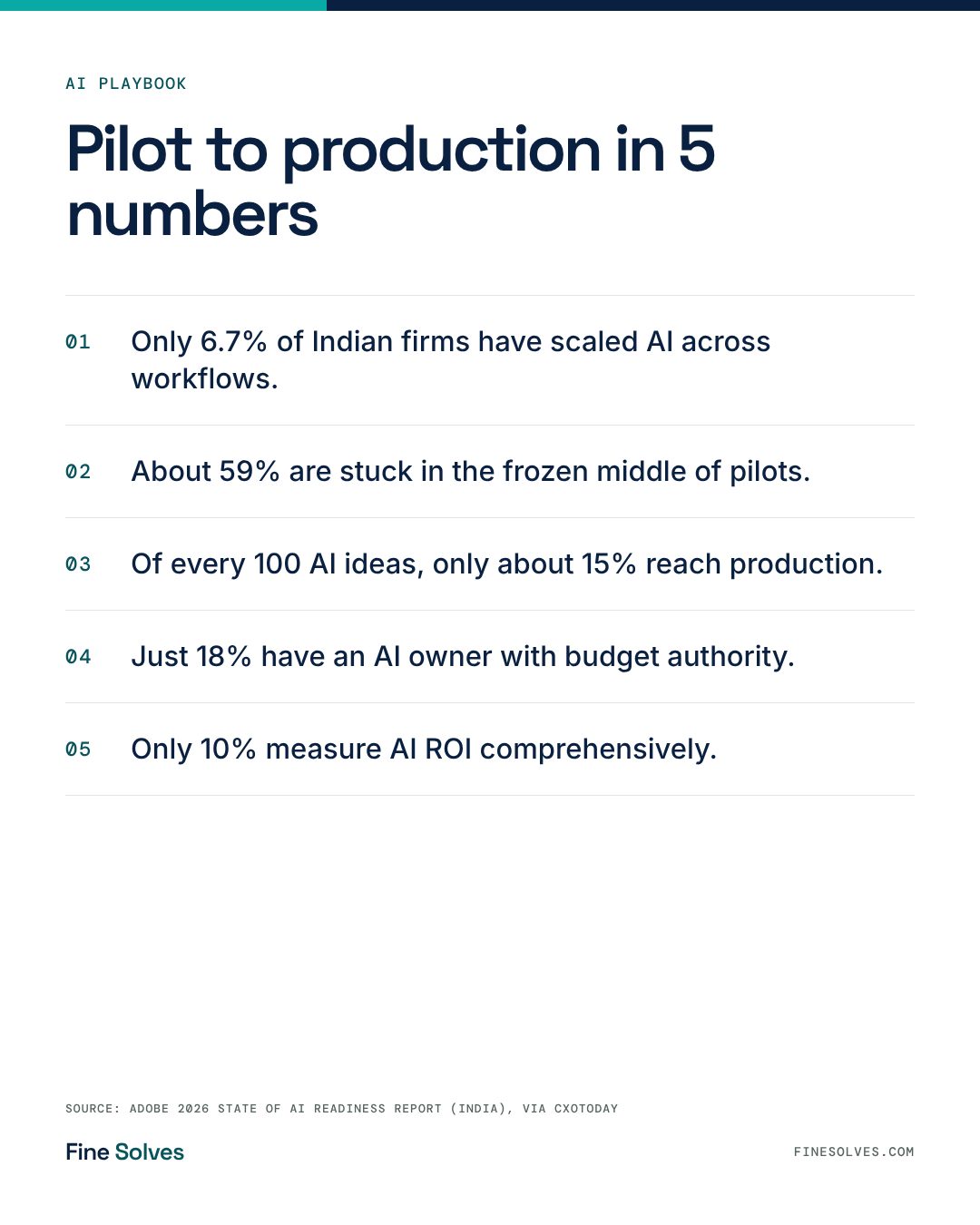
Moving an AI pilot to production is where most Indian AI programmes stall. Adobe's 2026 State of AI Readiness study of 475 Indian executives found only 6.7% of companies have scaled AI across multiple workflows, while about 59% sit in a "frozen middle" of pilots. The gap is rarely the model. It is ownership, data readiness, security review and how ROI is measured.
This matters now because the money has already moved. Adobe's study reports that 77% of Indian companies are raising AI investment year-on-year, and EY-CII found 47% of Indian enterprises already run multiple GenAI use cases live. Budgets are going up. The share of pilots that become dependable, measured production systems is not keeping pace. This playbook pulls together four studies on why that happens and what the companies that do scale AI do differently.
TL;DR
- Only 6.7% of Indian companies have scaled AI across workflows; about 59% are stuck in the frozen middle (Adobe, 2026).
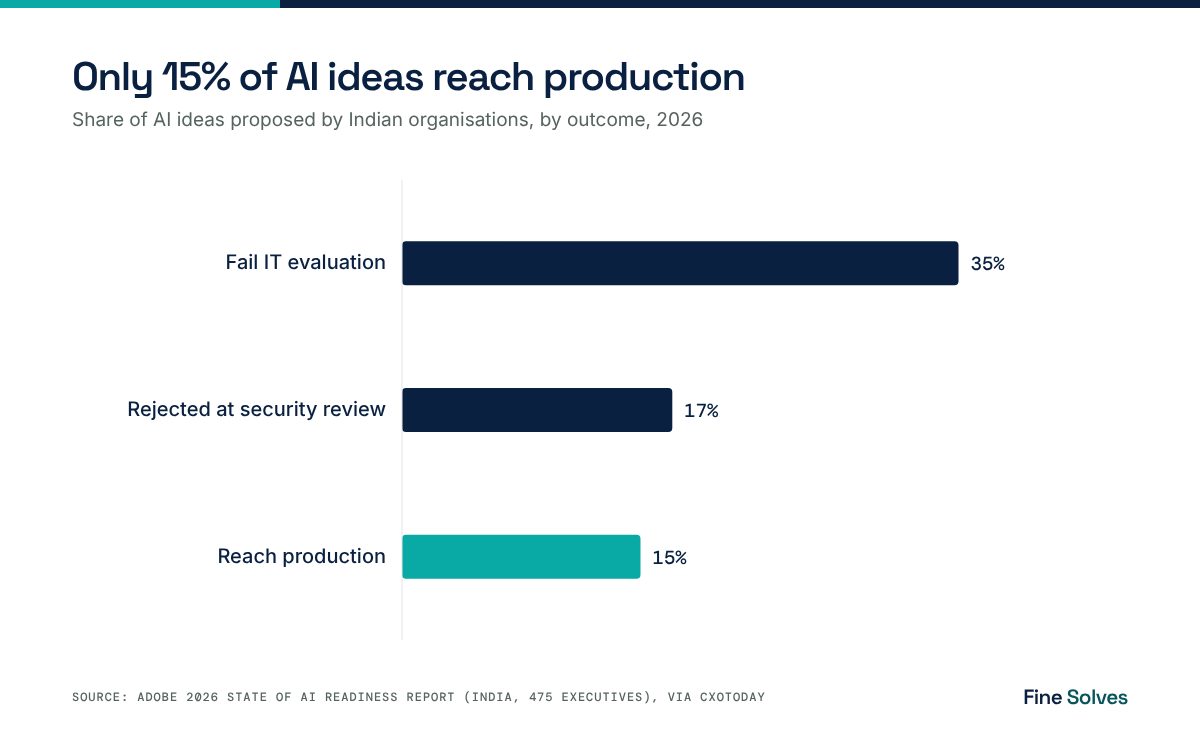
- Of every 100 AI ideas Indian firms propose, only about 15% reach production; about 35% fail IT evaluation and a further 17% fail security review.
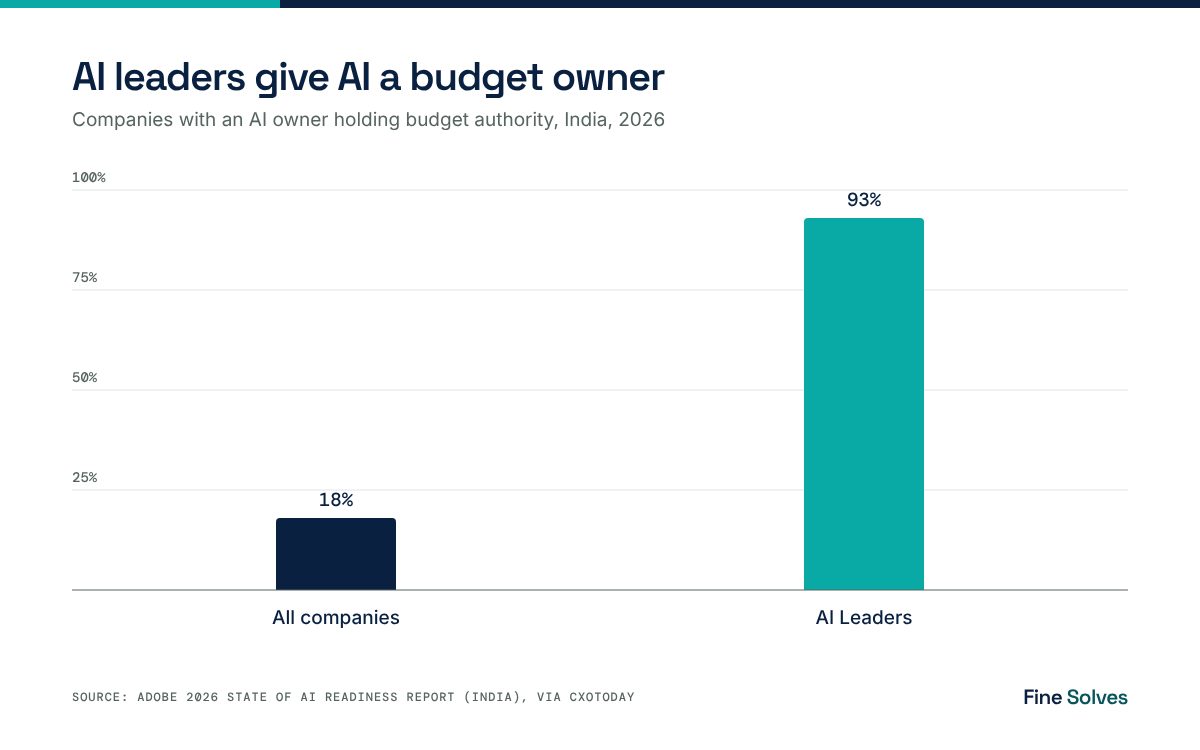
- Just 18% of companies have an AI owner with budget authority, against 93% of the firms that scale.
- Globally, only 38% of AI projects reach production, and 43% of data leaders name data quality as the top blocker (Informatica).
- Gartner predicted at least 30% of GenAI projects would be abandoned after the AI proof of concept stage by the end of 2025.
Why do most AI pilots never reach production?
Most AI pilots stall because nobody owns the outcome, the data is not production-grade, and security and IT reviews arrive late instead of being designed in from day one.
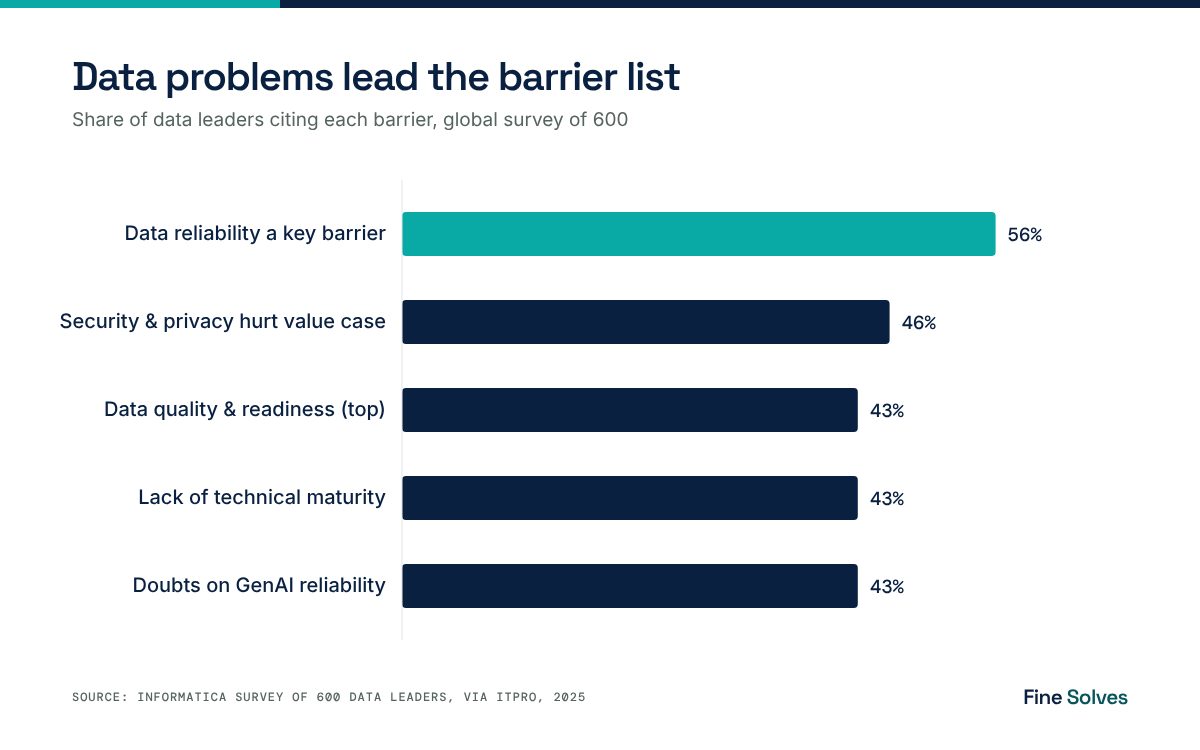
The pattern shows up in every study we reviewed. Informatica surveyed 600 data leaders and found 43% cited a lack of data quality and readiness as the biggest obstacle to production, while another 43% blamed a lack of technical maturity. According to the same survey, 41% slowed, paused or halted GenAI initiatives over the past year. Gartner's earlier forecast pointed at the same causes: poor data quality, inadequate risk controls, escalating costs and unclear business value.
A pilot is built to prove something can work. Production has to work every day, on messy data, inside existing systems, with someone accountable when it breaks. Those are different projects with different budgets, and most organisations fund only the first one.
How big is the pilot-to-production gap in India?
The gap is large: Adobe found only 6.7% of Indian companies have scaled AI across multiple workflows, while about 59% are still piloting or deploying without the coordination to scale.
For agentic AI the frozen-middle figure is 40%, according to Adobe's study. EY-CII's survey of 200 organisations paints a busier picture on the surface: 47% have multiple GenAI use cases live and 23% are in pilot. Read together, the two studies say that many Indian firms have something live, but very few have AI running across workflows with an operating model behind it.
Spending is also thin. EY-CII reports that more than 95% of organisations allocate less than 20% of their IT budgets to AI, and only 4% have crossed that 20% threshold. Thin budgets spread across many pilots are a reliable way to end up in the frozen middle.
| Benchmark | Figure | Scope |
|---|---|---|
| Companies that scaled AI across multiple workflows | 6.7% | India, 475 executives (Adobe, 2026) |
| Companies stuck in the frozen middle | 59% | India (Adobe, 2026) |
| AI ideas that reach production | 15% | India (Adobe, 2026) |
| Enterprises with multiple GenAI use cases live | 47% | India, 200 organisations (EY-CII) |
| AI projects that transitioned into production | 38% | Global, 600 data leaders (Informatica) |
| GenAI projects forecast to be abandoned after proof of concept | 30% | Global forecast for 2025 (Gartner) |
Source: Adobe 2026 State of AI Readiness Report (India) via CXOToday; EY-CII AIdea of India: Outlook 2026; Informatica via ITPro; Gartner via Intelligent CIO.
Where do AI ideas drop out of the funnel?
Most AI ideas in India die at review gates, not in the lab: about 35% fail IT evaluation and a further 17% are rejected at security review.
Adobe's India data puts it plainly. Of every 100 AI ideas proposed, only about 15% make it to production. The study adds that the security-review rejection rate nearly doubles in highly regulated industries, which covers most BFSI and healthcare teams. Time is the other cost. Around two-thirds of organisations need at least six months to move from experimentation to first deployment, and almost one in four take 12 months or more.
The lesson for a CIO is simple. If IT and security see a pilot for the first time when it asks to go live, the pilot was designed for a demo, not for your environment. Bring both reviews to the scoping meeting.
What separates the companies that scale AI?
Companies that scale AI give it a single owner with budget authority, measure value beyond usage, and treat failure as something to contain and learn from.
Adobe found only 18% of companies have an AI owner with budget authority, compared with 93% of the Leaders who scale. Those Leaders convert pilots to production at nearly four times the rate of other companies. Measurement is the second gap: only 10% of companies measure AI ROI comprehensively, and most track usage rather than quality, rework or the cost of reviewing AI output.
Skills are the third. The Adobe study reports that 82% of businesses say their AI skills shortfall stayed the same or got worse over the past year, and EY-CII lists a shortage of skilled AI talent, cited by 59%, as a persistent barrier. Leaders keep destructive-failure rates below 1%, and 53% of them say identifying and empowering internal champions is the single most effective and least expensive move.
Is data quality the real blocker?
Yes, data quality is the most-cited blocker: 43% of data leaders in Informatica's survey named data quality and readiness as the biggest obstacle to reaching production.
The same survey shows the issue runs deeper than clean tables. 56% described data reliability as one of a few key barriers, 46% said cybersecurity and privacy issues made it hard to demonstrate GenAI value, and 43% expressed concern about the reliability of GenAI results. Only 38% of AI projects had transitioned into production, and 67% of firms saw less than half of their GenAI pilots get there.
For Indian manufacturers, distributors and hospitals, the usual culprits are familiar: item masters with duplicates, ERP fields used differently across plants, scanned documents with no structure. A pilot can hand-clean a sample. Production needs the pipeline that keeps it clean.
How much does a GenAI deployment cost, and is it worth it?
Gartner put the cost of GenAI deployment approaches at $5 million to $20 million for business-model-level programmes, but surveyed adopters reported measurable revenue, cost and productivity gains.
In the Gartner survey of 822 business leaders, respondents reported a 15.8% revenue increase, 15.2% cost savings and 22.6% productivity improvement on average. Those figures come from firms that got to deployment. The 30% abandonment forecast is the other side of the same coin: projects that never reached the stage where benefits could be measured.
Most Indian mid-market use cases sit far below Gartner's top cost band. A document-extraction workflow, a demand-forecast assistant or a claims-scrubbing agent is a scoped engineering project, not a business-model rebuild. The cost question that matters is whether you have funded the production work, such as integration, monitoring and review, and not just the pilot.
A 7-step playbook to take an AI pilot to production
These steps follow directly from the gaps the four studies identify. Use them as a checklist before you approve the next pilot.
- Name one owner with budget authority. Only 18% of companies have one; 93% of Leaders do. No owner, no pilot.
- Pick a workflow, not a demo. Choose a process with a clear before-and-after metric: hours per invoice, forecast error, claim rejection rate, ticket handling time.
- Put IT and security in the scoping meeting. With about 35% of proposals failing IT evaluation and 17% failing security review, design for both gates on day one.
- Fix the data path before the model. Map source systems, owners and refresh cycles. Budget for the pipeline, not a one-time clean-up.
- Define ROI beyond usage. Track quality, rework and review cost. Only 10% of companies measure ROI comprehensively today.
- Set a production date and a kill date. Two-thirds of firms take at least six months to reach first deployment. Agree upfront what result earns a go-live and what ends the project.
- Plan the run phase. Monitoring, fallbacks, human review, retraining and a support owner. This is what separates a scaled system from a pilot that quietly decays.
What this means for Indian businesses
Indian enterprises are not short of AI ideas or intent. EY-CII found 76% of leaders expect a significant business impact from GenAI, and 63% feel ready to use it. The bottleneck is converting that intent into fewer, better-run production systems. EY-CII also found 91% of leaders named speed of deployment as the biggest factor in buy-versus-build decisions, so the pressure to ship fast is real.
Shipping fast and shipping to production are compatible if the pilot is scoped as the first release of a production system. From the way we build at Fine Solves, the projects that go live are the ones where integration, data and review were scoped in week one, not bolted on after the demo. If you have a pilot stuck in the frozen middle, Talk to Fine Solves.
Frequently asked questions
What is the "frozen middle" in AI adoption?
The frozen middle is Adobe's term for organisations that are piloting or deploying AI but lack the coordination needed to scale it across the business. In Adobe's 2026 India study, about 59% of organisations fell into this group, compared with only 6.7% that had scaled AI across multiple workflows.
What percentage of AI pilots reach production?
It depends on the study. Informatica's survey of 600 data leaders found only 38% of AI projects had moved into production. Adobe's India data says that of every 100 AI ideas proposed, only about 15% make it to production, with most lost at IT evaluation and security review.
Why do AI proof of concept projects fail?
The most common reasons are poor data quality, weak risk controls, rising costs and unclear business value, according to Gartner. Informatica's survey adds that 43% of data leaders see data quality and readiness as the biggest obstacle, and another 43% point to a lack of technical maturity.
How long does it take to move an AI pilot to production?
Adobe's India study found that around two-thirds of organisations need at least six months to move from experimentation to first deployment, and almost one in four take 12 months or more. Involving IT and security early and fixing the data path first are the main ways to shorten that.
Should Indian companies build or buy AI solutions?
Either can work; the deciding factor is fit with your workflow and data. EY-CII found 91% of Indian leaders treat speed of deployment as the biggest factor in buy-versus-build decisions. Buy where a product fits your process; build where the workflow, integrations or data are specific to your business.
Sources
- Adobe 2026 State of AI Readiness Report, India findings — CXOToday, 2026
- Is India ready for Agentic AI? The AIdea of India: Outlook 2026 (EY-CII) — EY India, 2025
- Only a handful of generative AI projects make it into production (Informatica survey) — ITPro, 2025
- Gartner predicts 30% of generative AI projects will be abandoned after proof of concept by end of 2025 — Intelligent CIO, 2024
Last updated: 8 November 2026. Published by Fine Solves — an AI software development company in Ahmedabad building custom software and AI systems for Indian businesses. finesolves.com