AI in Indian Banks Delivers 10–50% Gains: 2026 Data
AI in Indian banks has moved from pilots to measurable operations. In results-season disclosures this week, lenders reported 10% to 50% gains in productivity, turnaround time and operating costs from AI projects, according to Elets BFSI. Axis Bank's AI bots now handle about 60% of its collection calls. The catch: RBI survey data shows only a minority of institutions run basic AI safeguards.
The numbers surfaced on 1 November, when Kotak Mahindra Bank, HDFC Bank, Axis Bank and AU Small Finance Bank shared AI results with The Economic Times after their September-quarter (Q2 FY27) earnings. It is rare for several large Indian lenders to put hard operational numbers on AI in the same week. For anyone running operations in a bank, NBFC, insurer or any business with high-volume customer calls and documents, these are the most concrete Indian benchmarks available today.
TL;DR
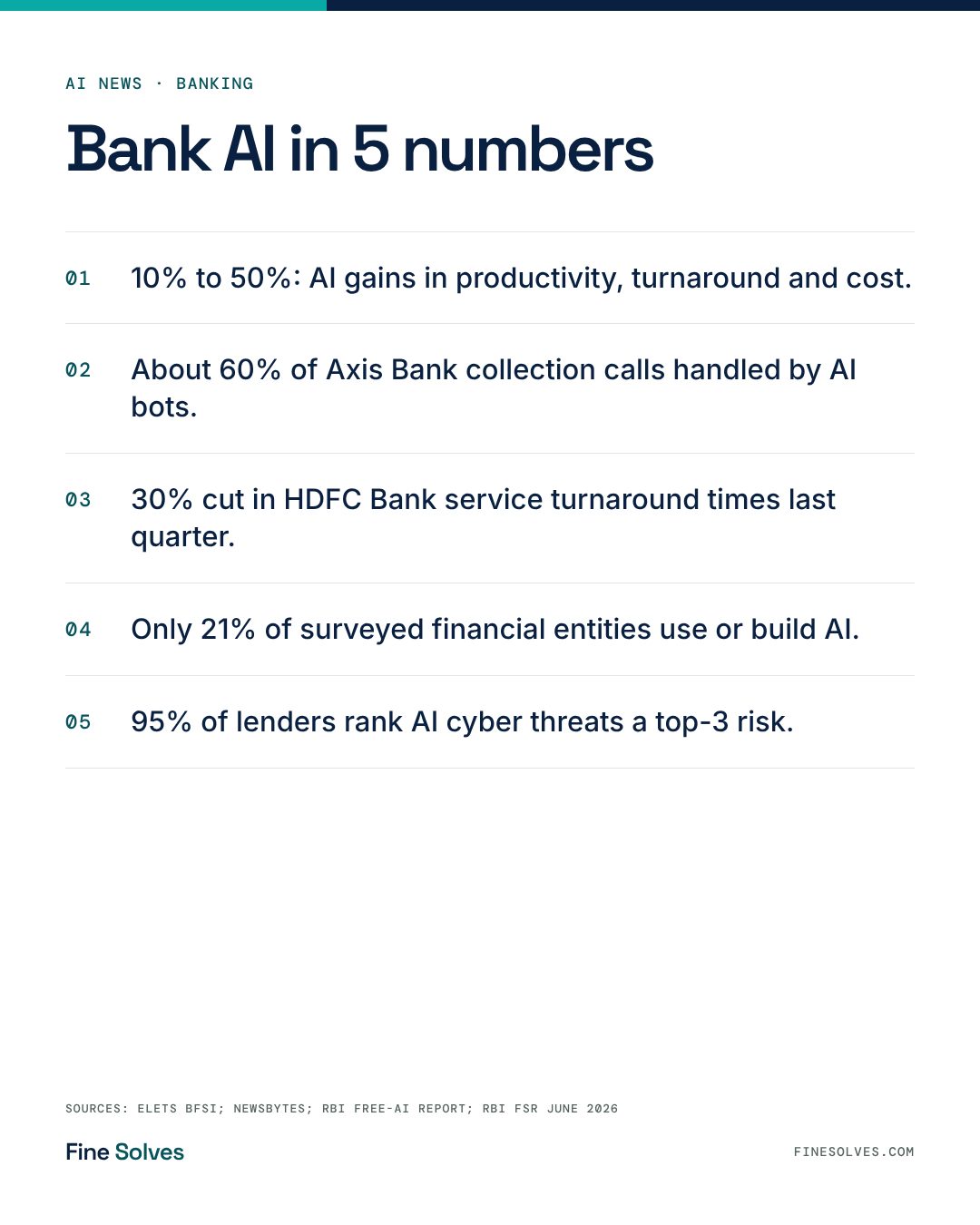
- Indian lenders report 10% to 50% gains in productivity, turnaround time and operating costs from AI, Elets BFSI reports.
- HDFC Bank cut service-delivery turnaround times by 30% in the September quarter, according to NewsBytes.
- Axis Bank's AXIOM bots handle about 60% of collection calls and read about 34 million documents.
- Only 21% of entities in the RBI's FREE-AI survey were using or developing AI systems.
- 95% of surveyed banks and NBFCs rank AI-enabled cyber threats among their top three risks, per the RBI's June 2026 Financial Stability Report.
What did Indian banks report about AI this week?
Four lenders disclosed specific AI results: faster turnaround, higher capacity per employee, lower call-centre costs, and bots handling most collection calls. The gains sit in operations, not in new products.
According to Elets BFSI, which summarised the banks' statements to The Economic Times, the improvements range from 10% to 50% across productivity, turnaround time and operating costs. Whalesbook reports that similar figures were discussed at industry forums including the FIBAC 2026 banking summit. The range is wide because each bank measured something different, so treat it as a spread of outcomes, not a single benchmark.
The table below puts the bank-by-bank numbers side by side.
| Bank | AI programme / area | Reported result |
|---|---|---|
| Kotak Mahindra Bank | Project ACE, corporate banking | 20% to 30% more corporate volume with the same team |
| HDFC Bank | Digitised frontline interactions | Turnaround times down 30%; frontline staff serving about 50% more customers |
| Axis Bank | AXIOM (collections, sales, documents) | About 60% of collection calls handled by bots; more than 2.5 million AI-led sales calls; about 9.5 million calls transcribed |
| AU Small Finance Bank | AI-led voice operations | Operating cost of voice operations halved |
Source: Elets BFSI and NewsBytes, reporting bank statements to The Economic Times, 1–2 November 2026.
Where is AI in Indian banks actually saving money?
The savings come from three high-volume jobs: phone calls, documents, and repeat service requests. Each is rule-heavy, measured daily, and expensive to staff.
Axis Bank is the clearest example. Its AXIOM programme handles about 60% of collection calls, and those calls resolve at about 50%, Elets BFSI reports. The same programme has led more than 2.5 million sales calls, read about 34 million documents with AI assistance, and transcribed about 9.5 million calls. Axis says AXIOM is certified to ISO 42001, the international standard for AI management systems.
AU Small Finance Bank halved the operating cost of its AI-led voice operations. HDFC Bank says its frontline staff now serve nearly 50% more customers each, and NewsBytes reports a 30% cut in service-delivery turnaround in the September quarter. Kotak's corporate banking team can absorb 20% to 30% more volume without adding people, according to Anu Aggarwal, its head of corporate and transaction banking.
How widespread is AI adoption across Indian financial institutions?
Not very. Only about 21% of entities surveyed by the RBI's FREE-AI committee were using or developing AI systems, and adoption is concentrated in larger banks.
The Economic Survey 2025-26 repeated the same 21% figure, citing the RBI's surveys, and called adoption still early, according to Business Standard. So the Q2 FY27 disclosures come from the front of the queue, not the median lender.
The survey also shows the main banking AI use cases among institutions that have started. Customer support leads at 15.6% of use cases, followed by credit underwriting at 13.7%, sales and marketing at 11.8%, and cybersecurity at 10.6%, as summarised by Dvara Research.
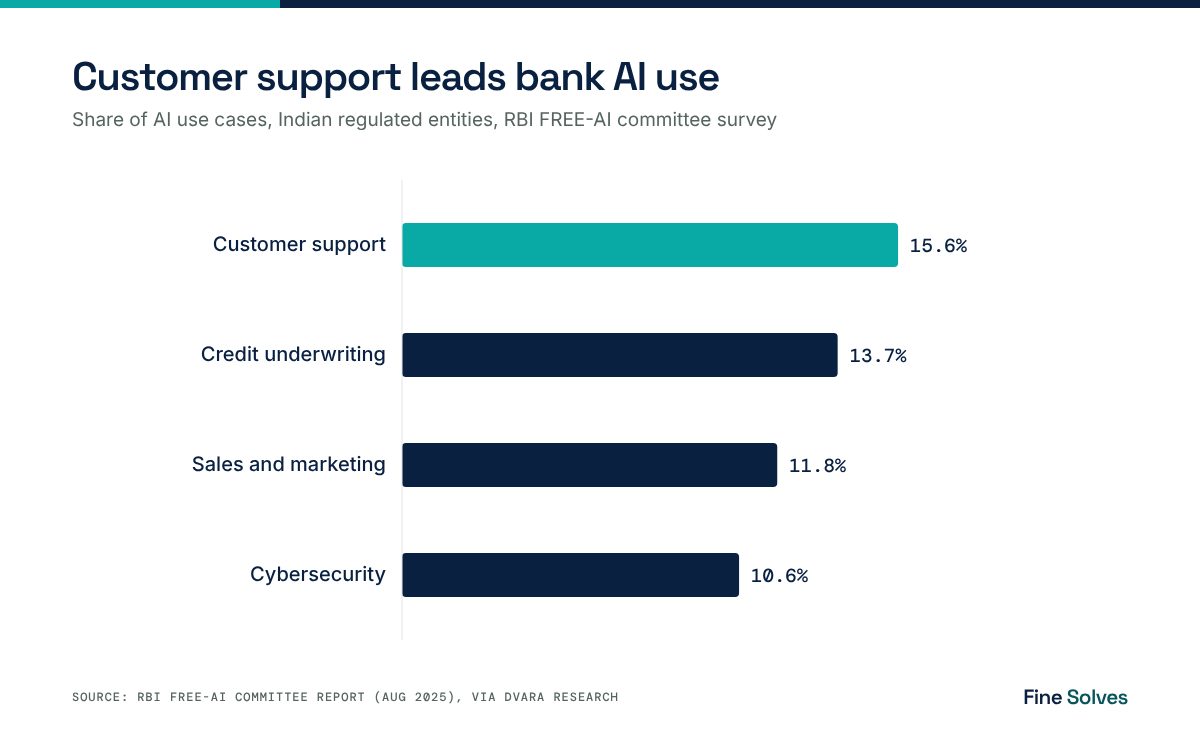
That ordering matches what the banks disclosed this week. Collections, service turnaround and voice operations are all customer-support work. Underwriting, where errors carry credit risk, is moving more slowly.
Why are banks still cautious about scaling AI?
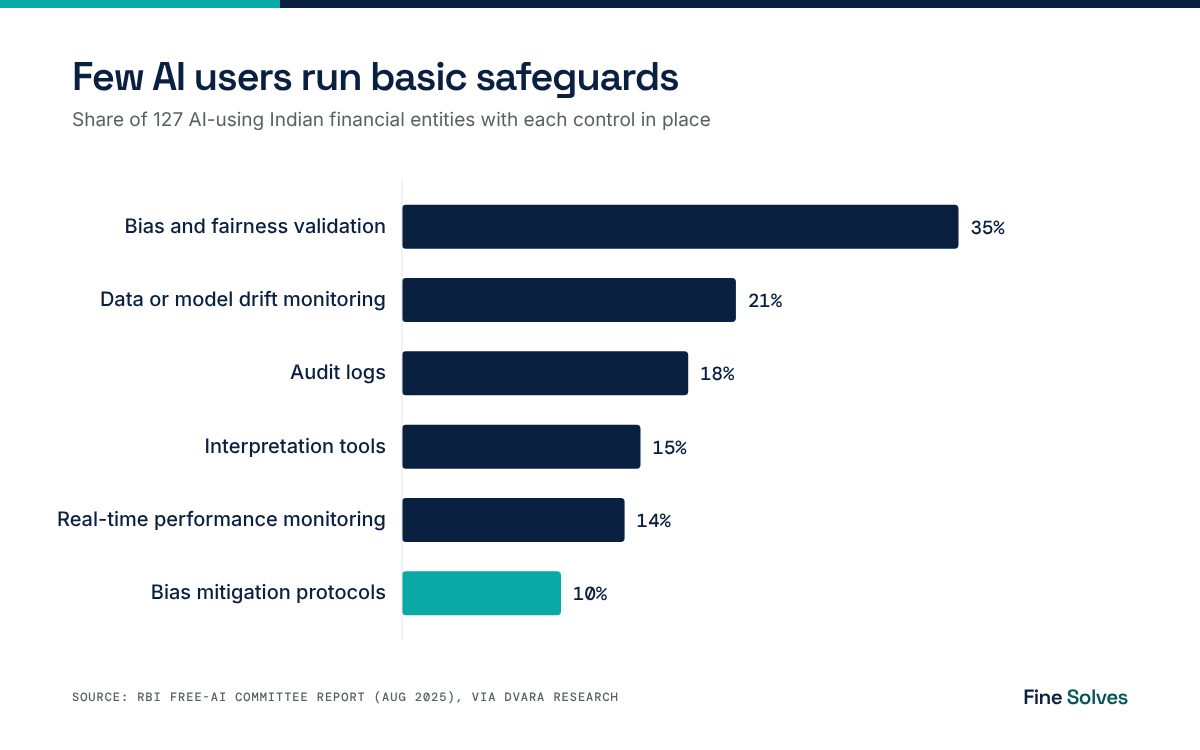
Because governance has not kept pace with deployment. Among the 127 entities reporting AI use, most lacked basic monitoring, testing and audit controls.
The FREE-AI committee survey found that 35% of AI users ran bias and fairness validation, 21% monitored data or model drift, 18% kept audit logs, 15% used interpretation tools, 14% ran real-time performance monitoring, and just 10% had bias mitigation protocols. Only about one-third of respondents reported board-level oversight of AI. Most relied on existing IT, cybersecurity and privacy policies instead of AI-specific ones.
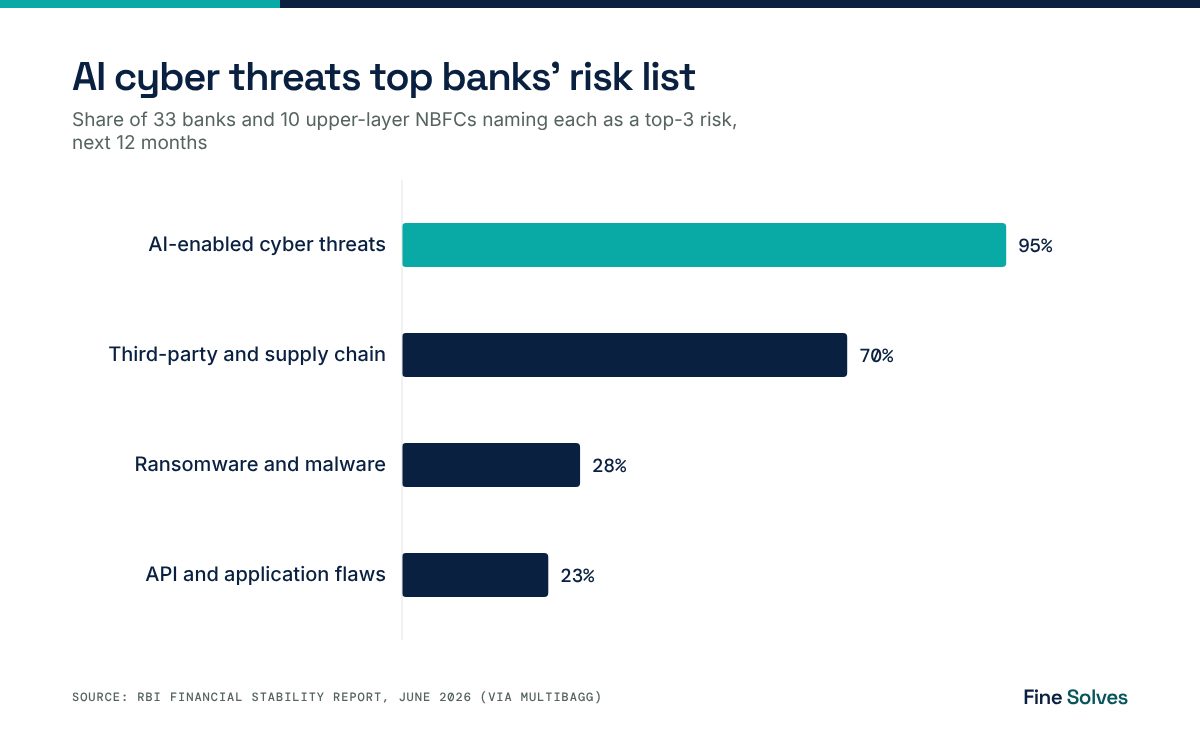
Risk perception has also shifted. In the RBI's June 2026 Financial Stability Report, 95% of surveyed banks and upper-layer NBFCs named AI-enabled cyber threats among their top three risks for the next 12 months, Multibagg reports. Third-party and supply chain risk came second at 70%, far ahead of ransomware at 28% and API vulnerabilities at 23%. The survey covered 33 scheduled commercial banks and 10 upper-layer NBFCs.
Banks are spending to respond. About 67% of surveyed institutions grew their IT and cybersecurity workforce between March 2025 and March 2026, and 71% raised cybersecurity spending as a share of IT budgets over three years, News Karnataka reports from the same FSR.
What does the RBI's FREE-AI framework ask banks to do?
The FREE-AI framework sets out 7 Sutras and 26 recommendations for responsible AI in regulated entities. It is the RBI's main reference point for how regulated entities should govern AI.
The committee, set up in December 2024, published its report in August 2025. In August 2026, RBI Governor Sanjay Malhotra used his FIBAC address to urge banks to treat an inventory of AI systems and meaningful human oversight as immediate priorities. For lenders, that turns AI governance from a nice-to-have into something supervisors will ask about.
The practical reading: a bank that cannot list its models, show who approved them, and prove they are monitored will struggle to scale AI beyond a few pilots, whatever the productivity gains.
How should a bank or NBFC start with AI in 2026?
Start with one high-volume, measurable process, build governance alongside it, and scale only after the numbers hold for a full quarter. Each step below draws on what the banks and the RBI surveys reported.
- Pick a process with a daily metric. Collections calls, KYC document reading, or service-request routing. Each has a baseline you already track: calls per agent, turnaround time, cost per case.
- Record the baseline before you build. Kotak's 20% to 30% and HDFC's 30% only mean something because the banks knew their starting point.
- Keep a human on the exception path. Axis resolves about 50% of bot-handled collection calls; the rest still need people. Design the hand-off first.
- Build the governance pack in parallel. Model inventory, audit logs, drift monitoring and a bias check. These are the controls most institutions lack.
- Vet every AI vendor as a third-party risk. With 70% of lenders already worried about third-party risk, contracts need data-residency, logging and exit terms.
- Report results to the board quarterly. One page: volume handled, accuracy, cost per case, incidents.
What this means for Indian businesses
The lesson travels beyond banking. Any Indian firm with call centres, collections, claims, or document-heavy back offices, such as NBFCs, insurers, hospitals and logistics companies, can copy the pattern: narrow use case, hard baseline, human exception path, and governance from day one.
The gap is also an opening. If only about 21% of financial institutions use AI at all, the mid-sized NBFCs, co-operative banks and fintech lenders that move in the next 12 months can still get ahead of peers. Most will not need a large platform. They need one well-integrated workflow connected to their core banking system, CRM and telephony, with audit logs built in.
Fine Solves is an AI software development company in Ahmedabad that builds custom software and AI systems for Indian businesses. From the way we build, most of the effort in a first AI workflow goes into integration, logging and exception handling, not the model itself. If you are scoping a first AI workflow for collections, KYC or customer service, Talk to Fine Solves.
Frequently asked questions
How much are Indian banks saving with AI?
Indian lenders report 10% to 50% gains in productivity, turnaround time and operating costs from specific AI projects, according to statements shared with The Economic Times in November 2026. AU Small Finance Bank halved the cost of its voice operations, and HDFC Bank cut service turnaround by 30%. The gains apply to targeted processes, not to total operating costs.
What is Axis Bank's AXIOM?
AXIOM is Axis Bank's AI programme for collections, sales and document work. Its bots handle about 60% of collection calls with about a 50% resolution rate, have led more than 2.5 million sales calls, read about 34 million documents and transcribed about 9.5 million calls. Axis says AXIOM is certified to the ISO 42001 AI management standard.
What share of Indian financial institutions use AI?
About 21% of banks and financial institutions surveyed by the Reserve Bank of India were implementing or developing AI solutions, according to the RBI's FREE-AI committee and the Economic Survey 2025-26. Adoption is concentrated among larger banks. Customer support is the most common use case, followed by credit underwriting.
What is the RBI FREE-AI framework?
FREE-AI is the Reserve Bank of India's Framework for Responsible and Ethical Enablement of AI, published by an RBI committee in August 2025. It contains 7 Sutras, or guiding principles, and 26 recommendations for regulated entities such as banks and NBFCs. In August 2026 the RBI Governor asked banks to treat an inventory of AI systems and meaningful human oversight as immediate priorities.
What is the biggest AI risk for Indian banks?
AI-enabled cyber threats. In the RBI's June 2026 Financial Stability Report, 95% of surveyed banks and upper-layer NBFCs ranked them among their top three risks for the next year, ahead of third-party and supply chain risk at 70%. Weak internal AI controls are a second risk: only 18% of AI users keep audit logs.
Sources
- Indian Banks Report Up to 50% Gains From AI Deployments — Elets BFSI, 2026
- AI drives faster service and higher capacity at Indian banks — NewsBytes, 2026
- Indian Banks Deploy AI to Boost Efficiency by Up to 50% — Whalesbook, 2026
- RBI flags AI cyber threats as top bank risk in 2026 (Financial Stability Report, June 2026) — Multibagg, 2026
- RBI flags AI-powered cyber threats as biggest risk to financial sector — News Karnataka, 2026
- 21% of surveyed banks, institutions implementing or developing AI: Economic Survey — Business Standard, 2026
- Summary of the RBI FREE-AI Committee Report — Dvara Research, 2025
- Winning in the AI Era: The New Playbook for Indian Banks (Governor's FIBAC 2026 address) — Reserve Bank of India, 2026
Last updated: 3 November 2026. Published by Fine Solves — an AI software development company in Ahmedabad building custom software and AI systems for Indian businesses. finesolves.com