AI Demand Forecasting: 2026 Benchmarks for India
AI demand forecasting uses machine learning on sales history, prices, promotions, seasonality and outside signals to predict what customers will order, SKU by SKU and location by location. McKinsey research cited by Oracle found AI-powered forecasting can cut forecast errors by 20% to 50% and product unavailability by up to 65%. For Indian manufacturers, distributors and retailers, that gap shows up as cash tied in stock.
This matters now because the adoption curve is turning. Gartner predicts 70% of large organisations will adopt AI-based forecasting to predict future demand by 2030. India is already ahead on intent: a Honeywell survey found 96% of large Indian retail enterprises use AI somewhere in operations, against a global average of 85%, and demand planning is the single most common use. The question for an ops head is no longer whether to try it, but how to get a forecast that planners actually trust.
TL;DR
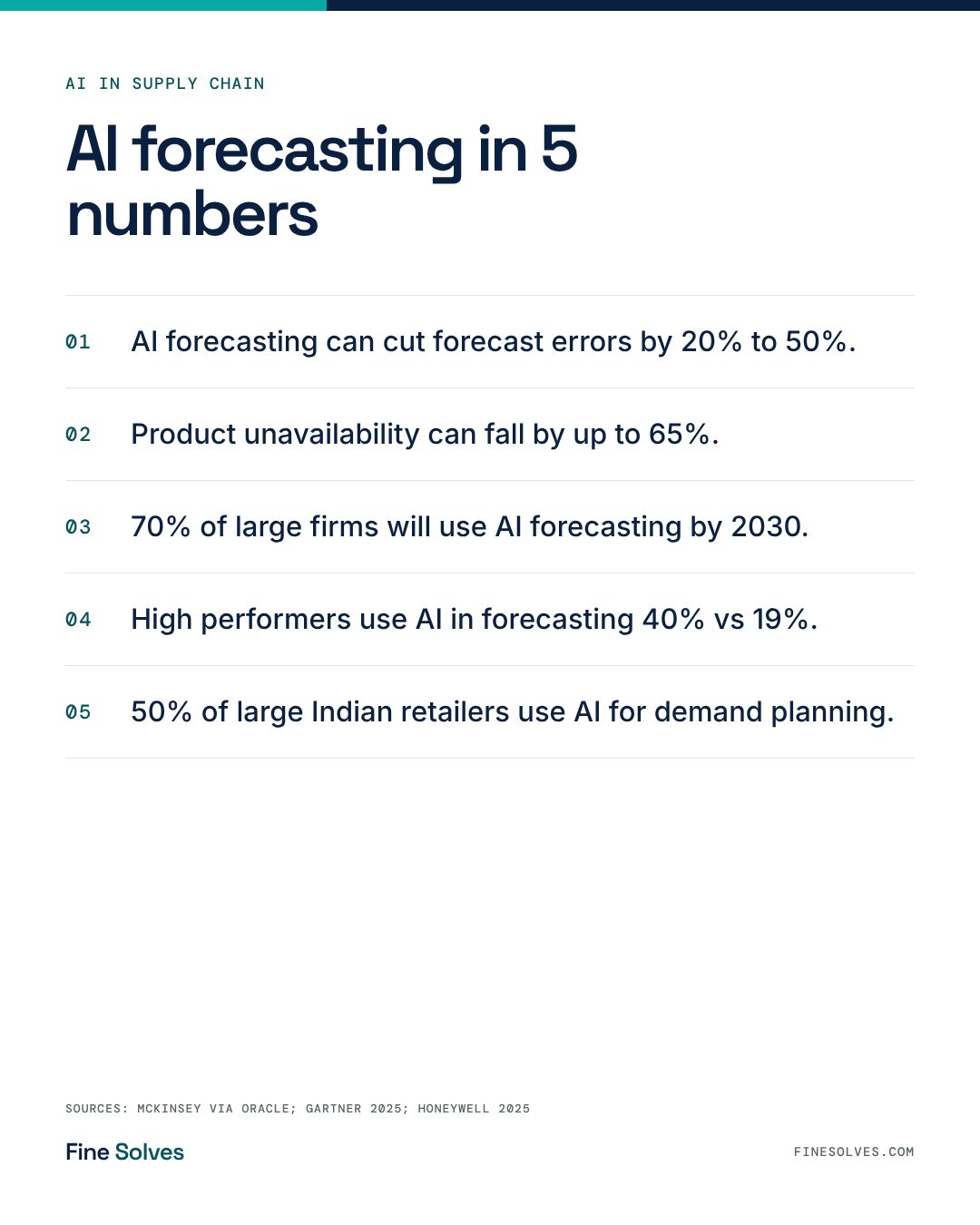
- AI-powered forecasting can reduce forecast errors by 20% to 50% and product unavailability by up to 65% (McKinsey, cited by Oracle).
- Gartner predicts 70% of large organisations will use AI-based demand forecasting by 2030.
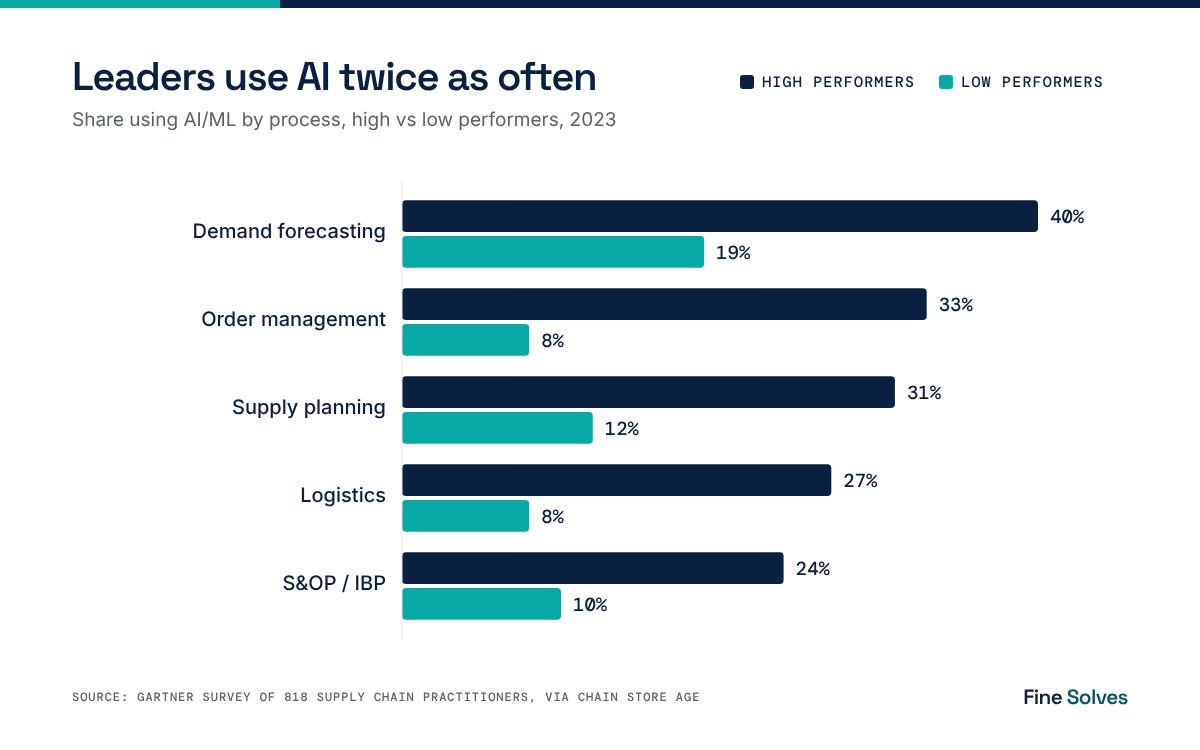
- High-performing supply chains use AI/ML in demand forecasting at roughly twice the rate of low performers: 40% vs 19% (Gartner survey of 818 practitioners).
- Inventory distortion, the cost of out-of-stocks plus overstocks, is a $1.7 trillion problem, equal to 6.2% of global retail sales in 2026 (IHL Group).
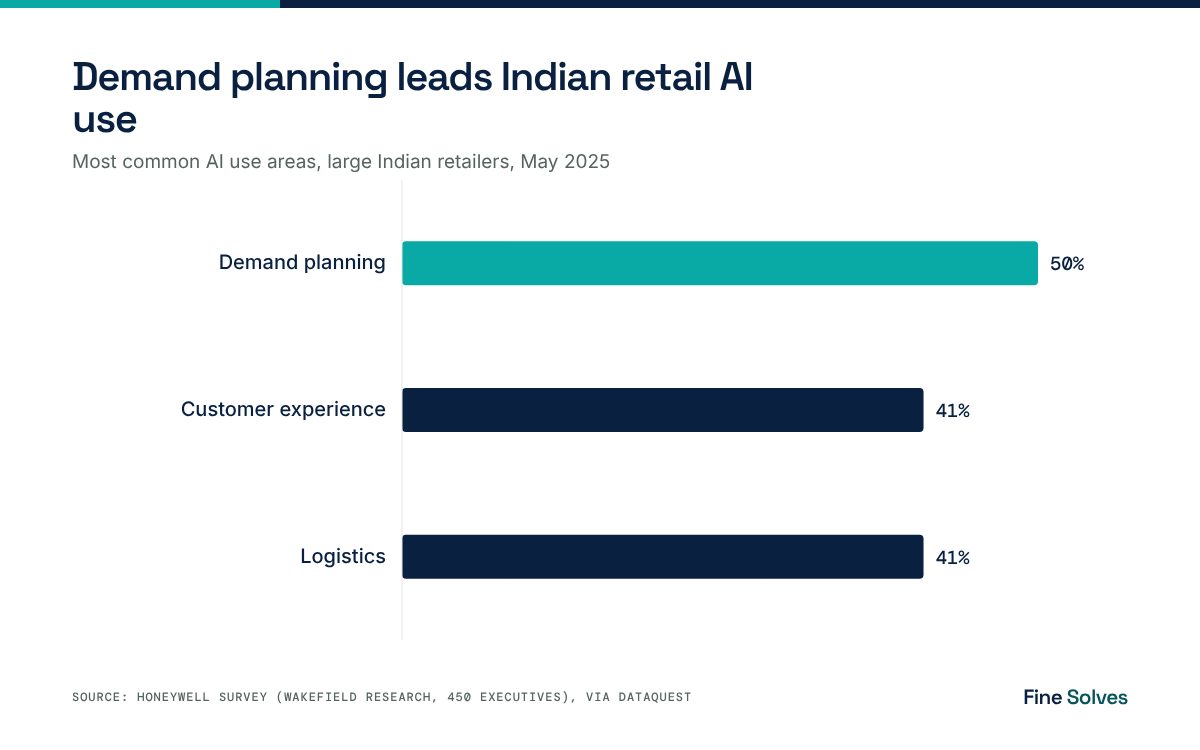
- 50% of large Indian retailers already use AI for demand planning, the top use case in Honeywell's survey.
What is AI demand forecasting?
AI demand forecasting is the use of machine learning models to predict future demand from many signals at once, instead of extrapolating last year's sales with a fixed formula.
Classical demand planning usually runs on moving averages or exponential smoothing in a spreadsheet or ERP module. That works for stable, high-volume items. It breaks on the things Indian businesses deal with every quarter: festive spikes, monsoon shifts, regional holidays, distributor schemes, price changes and new SKUs with no history. A machine learning model can learn how each of those drivers moves demand, and update the forecast as new orders arrive.
The output is not just a number. A good system gives a forecast per SKU per location per week, a range of likely outcomes, and a short list of exceptions for planners to review. That last part is where most of the time saving comes from.
How much does AI improve forecast accuracy?
Published benchmarks put the gain at a 20% to 50% reduction in forecast error, with product unavailability down by up to 65%, according to McKinsey research cited by Oracle.
Those are ranges, not promises. The low end is more likely when a company already has decent statistical forecasting and clean data. The high end is more likely where the baseline is manual, the catalogue is long, and demand is driven by promotions or weather. Forecast accuracy also compounds: a smaller error means lower safety stock for the same service level, which frees working capital without adding stock-outs.
Retail data points the same way. IHL Group research reported by Chain Store Age found AI/ML implementations show positive results for 76% of retailers using them for demand planning and forecasting. Retailers using AI/ML reported sales growth 2.3 times higher and profit growth 2.5 times higher than competitors. Treat that as correlation, not proof: firms that adopt AI early also tend to run tighter operations.
| Benchmark | Figure | Source |
|---|---|---|
| Forecast error reduction from AI-powered forecasting | 20% to 50% | McKinsey, cited by Oracle |
| Reduction in product unavailability | up to 65% | McKinsey, cited by Oracle |
| Retailers seeing positive results from AI/ML in demand planning | 76% | IHL Group, via Chain Store Age |
| Sales growth of AI/ML retailers vs competitors | 2.3 times | IHL Group, via Chain Store Age |
| Profit growth of AI/ML retailers vs competitors | 2.5 times | IHL Group, via Chain Store Age |
| Global inventory distortion, 2026 | 6.2% of retail sales ($1.7 trillion) | IHL Group, 2026 |
Source: McKinsey & Company research cited by Oracle (2025); IHL Group via Chain Store Age; IHL Group 2026 Inventory Distortion Study.
Why does inventory distortion make forecasting a board issue?
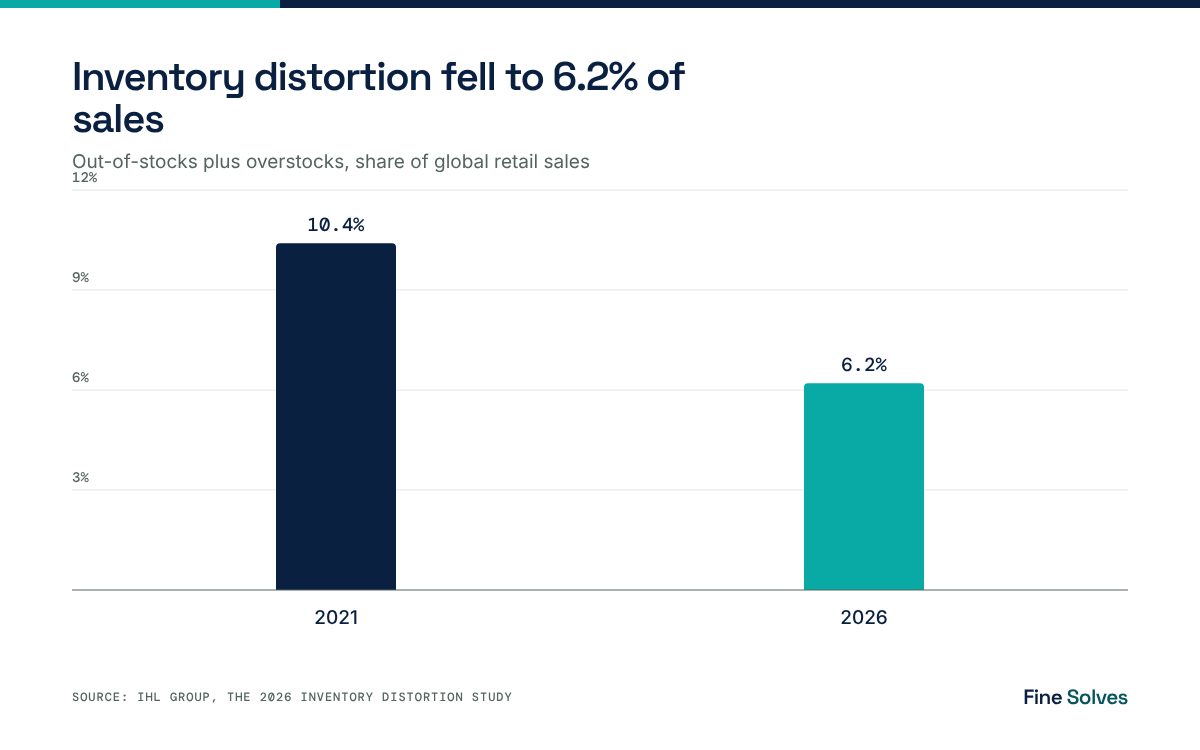
Because poor forecasts show up directly as lost sales and dead stock, which IHL Group sizes at $1.7 trillion a year worldwide, or 6.2% of global retail sales in 2026.
IHL calls this inventory distortion: the combined cost of out-of-stocks and overstocks. The good news is that it is falling. IHL's 2026 study shows distortion dropped from 10.4% of retail sales in 2021 to 6.2% in 2026, after five straight years of improvement.
The bad news is that 6.2% is still a large slice of revenue for any business running on thin margins. For an Indian distributor or FMCG brand, the money is visible in two places: slow-moving stock in the warehouse and empty shelves at the retailer during a scheme or festive peak.
Are high-performing supply chains using AI for demand planning?
Yes. Gartner found top-performing supply chains use AI/ML in demand forecasting at about twice the rate of low performers, 40% against 19%.
Gartner surveyed 818 supply chain practitioners between August and October 2023 and split them by results on perfect order rate, supply chain cost, order fill rate, cash-to-cash cycle time and inventory turnover. Demand forecasting was the most common AI/ML use among high performers, ahead of order management, supply planning and logistics. The gap was widest in order management and fulfilment, where 33% of high performers used AI/ML against 8% of low performers.
The pattern is worth noticing. High performers do not use AI in one place; they use it across the planning chain, so a better demand forecast flows into supply planning, S&OP and logistics instead of stopping at a dashboard.
| Planning process | High performers using AI/ML | Low performers using AI/ML |
|---|---|---|
| Demand forecasting | 40% | 19% |
| Order management and fulfilment | 33% | 8% |
| Supply planning | 31% | 12% |
| Logistics and distribution | 27% | 8% |
| S&OP / integrated business planning | 24% | 10% |
Source: Gartner survey of 818 supply chain practitioners, August–October 2023, reported by Chain Store Age.
How are Indian businesses using AI in demand planning?
Indian retailers are ahead of global peers: Honeywell found 96% of large Indian retail enterprises use AI, and demand planning is the most common use at 50%.
The survey, run by Wakefield Research in May 2025, covered 450 executives across seven countries; Indian respondents had minimum annual sales of $10 million. After demand planning, the most common areas were customer experience at 41% and logistics at 41%. Indian retailers also attached more value than global peers to AI in demand planning, by 14%, and in supply chain logistics, by 7%.
The obstacles are practical. 48% of Indian respondents named customer acceptance as the biggest barrier, 43% cited regulatory compliance and 38% the complexity of configuring AI models. The context is growing demand to plan for: a Deloitte India–FICCI report says India's consumer economy is expected to approach US$1.9 trillion by 2030.
Should you build or buy an AI demand forecasting system?
Buy when your process matches a planning suite's standard model; build or extend when your demand drivers, channels or data sources are specific to your business.
Planning suites from large vendors are strong on standard retail and CPG flows. Oracle's own guide, for instance, describes a forecasting tool with 15 statistical models built in. Where they struggle is the Indian middle: distributor-led sales with secondary data arriving late, Tally or custom ERPs, scheme-driven demand, and SKUs that behave differently by state. In those cases a focused custom layer, built on your data and feeding the ERP you already run, is often faster to value than a full suite rollout.
From the way we build at Fine Solves, the deciding factor is rarely the model. It is how cleanly sales, inventory and promotion data can be pulled together every week.
How to roll out AI demand forecasting in 90 days
- Pick one decision. Choose a single, costly decision, such as weekly replenishment for the top SKUs in one region, not "forecast everything".
- Measure the baseline. Record current forecast error (MAPE or WAPE), fill rate and days of inventory before any model runs.
- Assemble the data. Two to three years of sales by SKU and location, price and scheme calendars, stock-outs, and festive dates. Fix master data first.
- Run a shadow forecast. Let the model forecast alongside planners for 6–8 weeks without changing orders, and compare accuracy weekly.
- Design for exceptions. Show planners only the SKUs where the model and history disagree, with the reason, so they review dozens of items, not thousands.
- Connect to action. Push the accepted forecast into purchase orders or replenishment in the ERP, or the gain stays on a slide.
- Scale by category. Expand only after the pilot beats the baseline on error and on inventory, not just one of them.
What this means for Indian businesses
The numbers line up. Forecast errors can fall by 20% to 50%, high performers already use AI/ML in demand forecasting at about twice the rate of laggards, and half of large Indian retailers have started. The firms that gain most will be those that treat forecasting as an operating process, with clean weekly data, planner review and a direct link into ordering, rather than a one-off analytics project.
Fine Solves is an AI software development company in Ahmedabad that builds custom forecasting, inventory and ERP-integrated systems for Indian manufacturers, distributors and retailers. If your demand planning still lives in spreadsheets, start with one category and one decision. Talk to Fine Solves.
Frequently asked questions
What is AI demand forecasting?
AI demand forecasting uses machine learning to predict future customer demand from sales history plus drivers such as price, promotions, seasonality, holidays and weather. Unlike fixed statistical formulas, the models learn how each driver affects each product and location, and they update as new orders arrive. The result is a forecast per SKU and location with a likely range.
How accurate is AI demand forecasting?
McKinsey research cited by Oracle found AI-powered forecasting can reduce forecast errors by 20% to 50% and product unavailability by up to 65%. Actual gains depend on the starting point: companies moving from manual spreadsheets usually see larger improvements than those already running good statistical forecasts with clean data.
Is AI demand forecasting only for large companies?
No. Large firms adopt first, and Gartner predicts 70% of large organisations will use AI-based demand forecasting by 2030, but mid-sized manufacturers and distributors can start with one category and two to three years of clean sales data. The main requirement is reliable weekly data on sales, stock and promotions, not company size.
What data do you need for AI demand forecasting?
At minimum you need two to three years of sales by SKU and location, inventory and stock-out history, prices, and a promotion or scheme calendar. Festive dates, weather and distributor secondary sales improve accuracy further. Clean product and location master data matters more than the choice of algorithm, so fix it before training any model.
How long does it take to implement AI demand forecasting?
A focused pilot can run in about 90 days: a few weeks to assemble and clean data, six to eight weeks of shadow forecasting alongside planners, and then a decision to scale. Full rollout across categories and plants usually takes longer, because the forecast has to be wired into ordering and replenishment in the ERP.
Sources
- Gartner Predicts 70% of Large Organizations Will Adopt AI-Based Supply Chain Forecasting to Predict Future Demand by 2030 — Gartner, 2025
- Gartner: High-performing supply chains more likely to use AI — Chain Store Age (Gartner survey, 2023)
- The 2026 Inventory Distortion Study — IHL Group, 2026
- IHL Group: Inventory issues cause $1.7T in annual losses — Chain Store Age
- Indian retailers outpace global peers in AI adoption: Honeywell Survey — Dataquest (DQ India), 2025
- AI in Demand Forecasting: Overview, Use Cases, and Benefits — Oracle, 2025 (citing McKinsey & Company)
- India tops global AI adoption race as retailers, FMCG firms deploy technology across operations: Deloitte-FICCI — Business Today, 2026
Last updated: 10 November 2026. Published by Fine Solves — an AI software development company in Ahmedabad building custom software and AI systems for Indian businesses. finesolves.com