AI Data Readiness: Why Only 4% of Indian Firms Are Ready
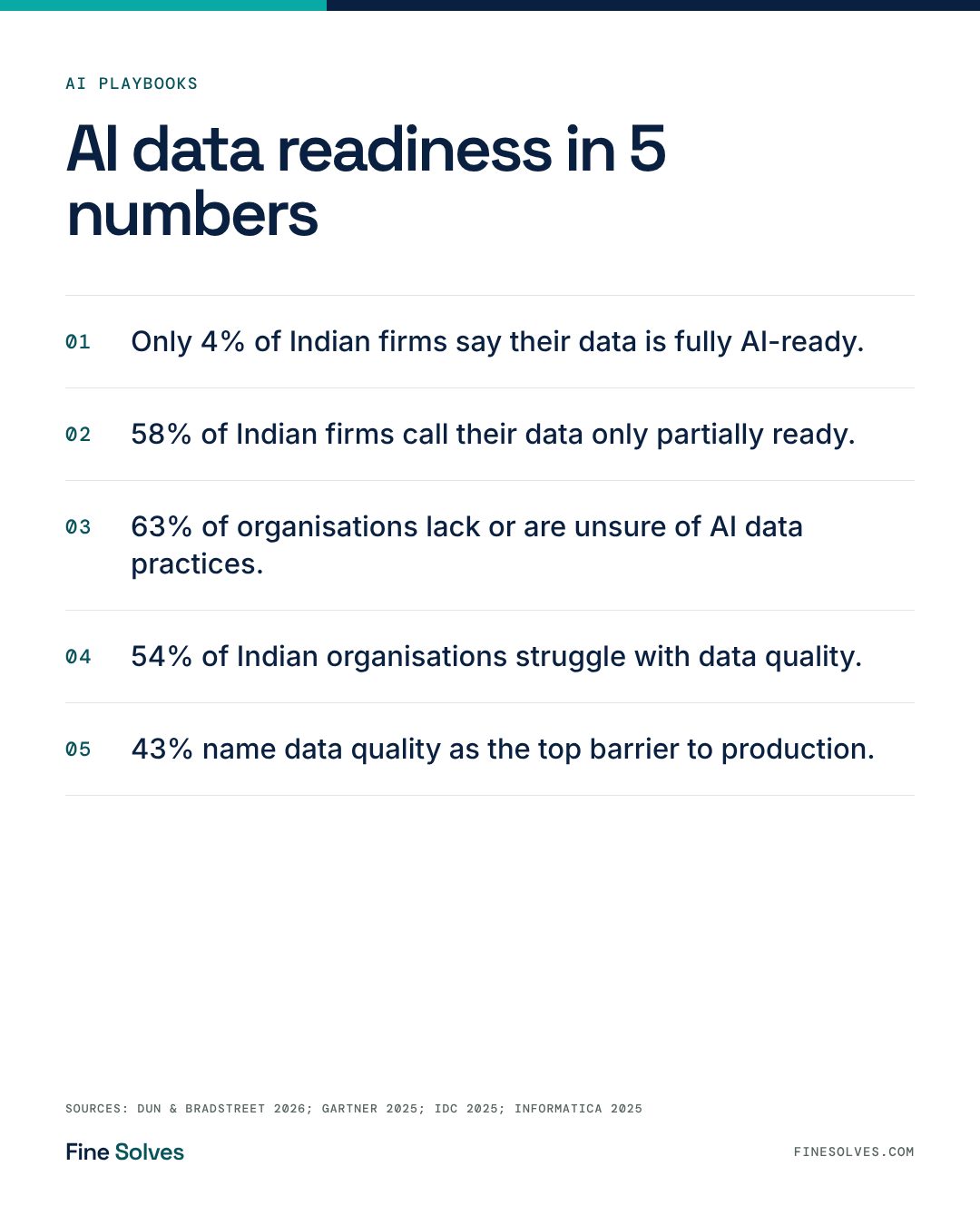
AI data readiness is how accurate, connected, governed and accessible your data is for training, grounding and running AI in production. In India, only 4% of organisations say their enterprise data is fully ready to support AI at scale, according to a 2026 Dun & Bradstreet survey, even though every firm it surveyed already has AI projects underway.
That gap is now the main reason AI pilots stall. Gartner predicted in February 2025 that, through 2026, organisations will abandon 60% of AI projects that are not supported by AI-ready data. We are in the last two months of that window. For a CIO, COO or founder at an Indian manufacturer, distributor, hospital or lender, the useful question is no longer which model to pick. It is whether your ERP, CRM and spreadsheet data can carry the weight.
TL;DR
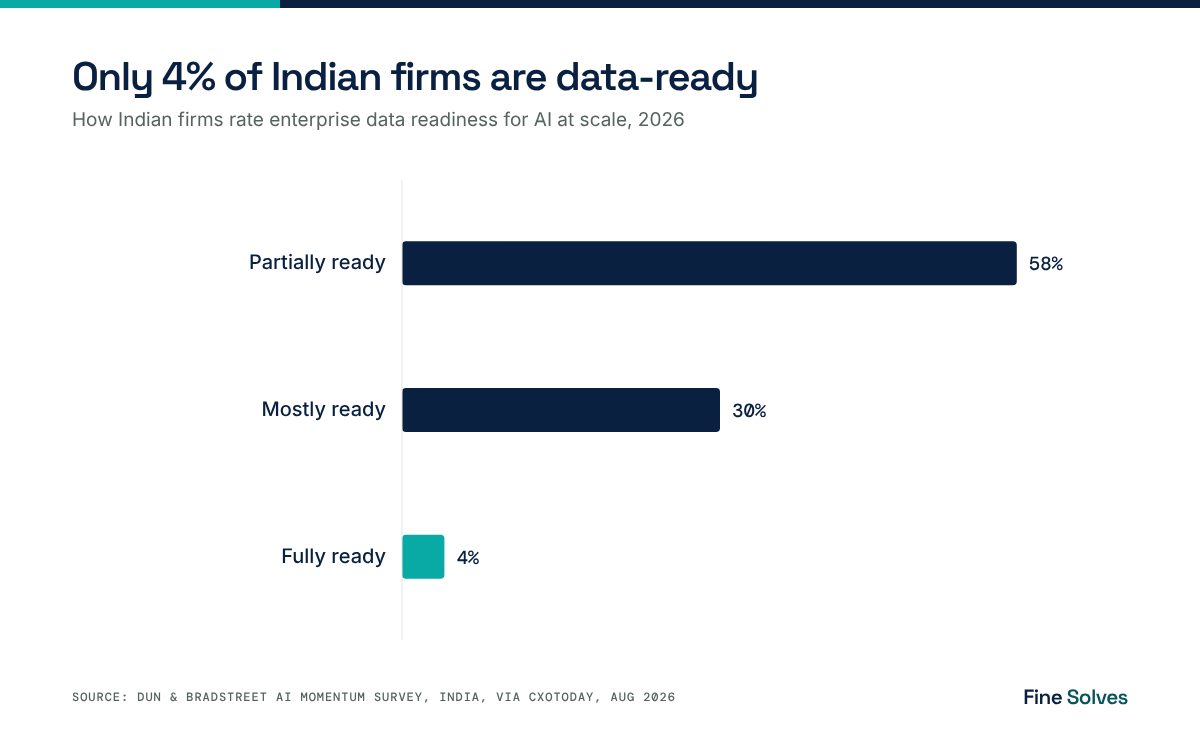
- Only 4% of Indian firms call their enterprise data fully ready for AI at scale; 58% say it is partially ready, Dun & Bradstreet found.
- Gartner says 63% of organisations lack, or are unsure they have, the right data management practices for AI.
- 54% of Indian organisations struggle with data quality, the highest rate in Asia-Pacific, according to IDC.
- 43% of data leaders name data quality and readiness as the biggest obstacle to getting AI into production, an Informatica study reports.
- Only 26% of chief data officers are confident their data can support new AI-enabled revenue, IBM's 2025 CDO study shows.
What is AI data readiness?
AI data readiness means your data is accurate, consistently defined, connected across systems, governed and accessible enough for an AI system to use it reliably in production.
It is not the same as having a lot of data. A plant with ten years of machine logs in disconnected historians, or a hospital with patient records split across three billing systems, has volume but not readiness. In practice, AI-ready data has five properties: it is correct, it means the same thing in every system, it can be joined, someone owns it, and the AI system is allowed to use it under your privacy and DPDP obligations.
Gartner's survey of 1,203 data management leaders found that 63% of organisations either do not have the right data management practices for AI or are not sure whether they do. Precisely and Drexel University's LeBow College found that only 12% of organisations say their data is of sufficient quality and accessibility for effective AI.
How ready is Indian enterprise data for AI?
Not very: most Indian firms describe their data as partially ready, and only a small minority say it is fully ready for AI at scale.
According to the Dun & Bradstreet survey reported in August 2026, 4% of Indian organisations say their data is fully ready, 30% say mostly ready and 58% say partially ready. The same survey shows ambition running ahead of foundations: 69% plan to increase AI investment, and 73% report some measurable return, but only 23% report broad or strong ROI across multiple projects.
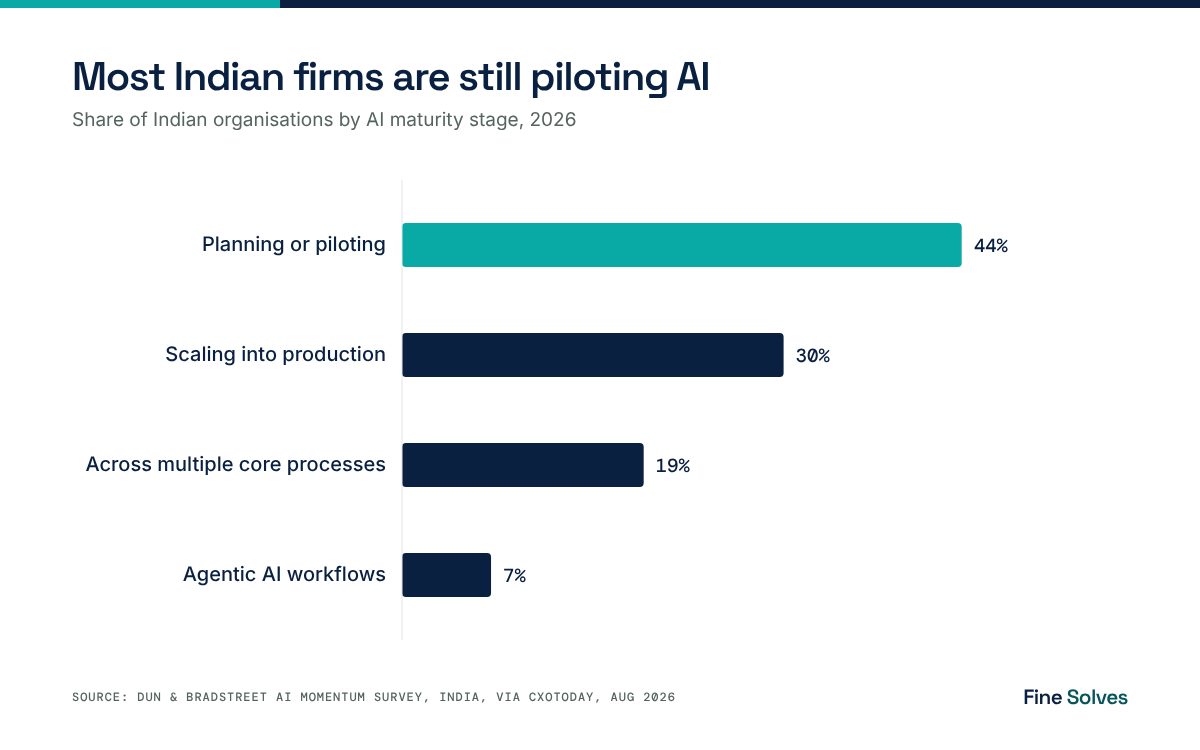
The maturity curve tells the same story. Dun & Bradstreet found 44% of Indian firms still in planning or piloting, 30% scaling AI into production, 19% running AI across multiple core processes, and 7% deploying agentic AI workflows. Each step up that curve needs cleaner, better-connected data than the one before.
Other surveys put the number at different points but in the same direction. Hitachi Vantara's survey, reported in January 2026, found 55% of Indian organisations at mature data-readiness stages, while 45% rely on weaker systems. An IDC study for Qlik found that 54% of Indian organisations struggle with data quality, and only 22% report measurable outcomes from their AI and machine learning deployments.
Why do AI projects stall on data?
AI projects stall on data because pilots run on a cleaned sample, while production has to run on live, messy, siloed data that nobody has reconciled.
Informatica's survey of 600 data leaders found that only 38% of AI projects had moved into production, and 67% of firms had seen fewer than half of their generative AI pilots reach production. 41% had slowed, paused or halted generative AI work in the past year. The top reason, cited by 43%, was a lack of data quality and readiness.
The symptoms show up quickly once a model is live. A Salesforce report found 94% of leaders with AI in production had seen inaccurate or misleading outputs, and 50% said they had wasted significant resources training AI on bad data. The same report estimates that 26% of organisational data is siloed and inaccessible.
Silos are the most common root cause. IBM's 2025 study of 1,700 chief data officers found 83% say data silos hinder innovation and real-time analytics. Precisely's research found 77% of organisations rate their own data quality as average or worse.
Is India ahead of or behind the world on AI-ready data?
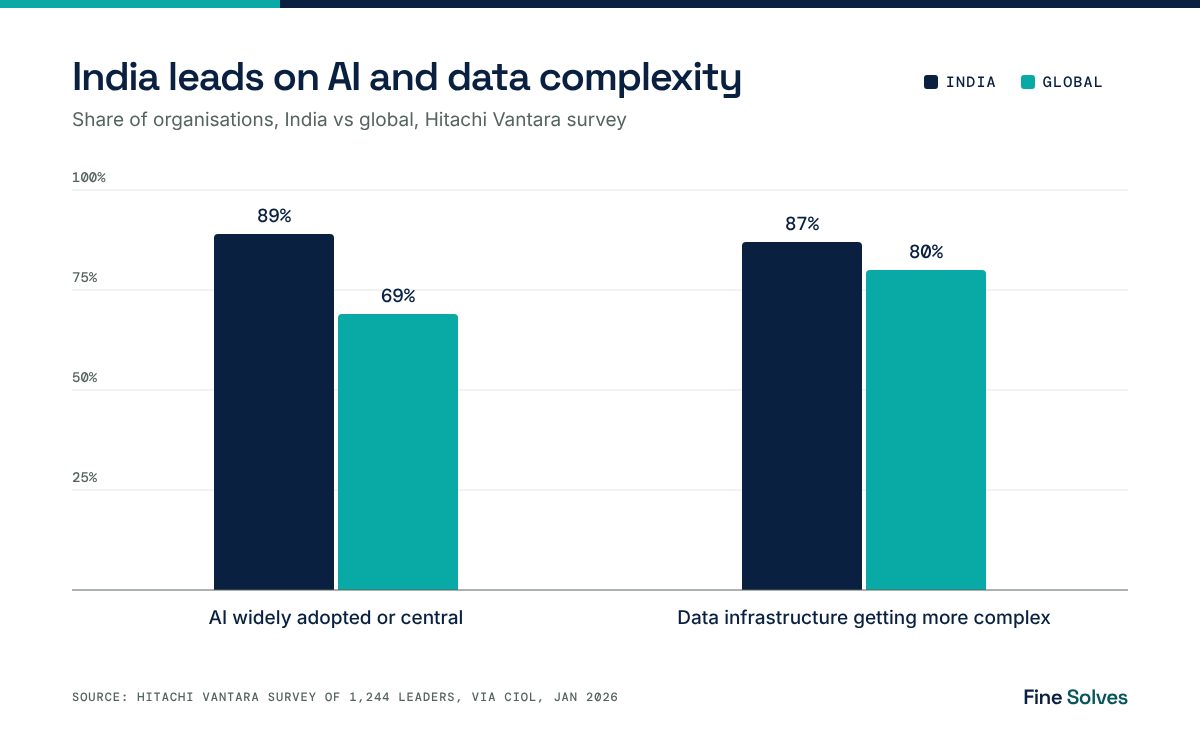
India is ahead on AI adoption but carries a heavier data-quality and infrastructure burden than most peers.
Hitachi Vantara found that 89% of Indian organisations have widely adopted AI or made it central to operations, against 69% globally. But 87% of Indian respondents say their data infrastructure is getting more complex, against 80% globally. On quality, IDC reports Indian data quality concerns at 54%, above the APAC figure of 50.4%. Concern about AI data bias is also higher in India, at 28%.
Governance is the other weak point. IDC found 62% of Indian organisations see shortcomings in their data governance and privacy frameworks. Under the DPDP Act, that gap carries compliance risk as well as model risk.
AI data readiness benchmarks at a glance
| Benchmark | Figure | Scope | Source |
|---|---|---|---|
| Enterprise data fully ready for AI at scale | 4% | India | Dun & Bradstreet, 2026 |
| Firms at mature data-readiness stages | 55% | India | Hitachi Vantara, 2026 |
| Firms struggling with data quality | 54% | India | IDC for Qlik, 2025 |
| Lack or unsure of AI data management practices | 63% | Global | Gartner, 2025 |
| Data quality is the top obstacle to production | 43% | Global | Informatica, 2025 |
| CDOs confident data supports new AI revenue | 26% | Global | IBM IBV, 2025 |
| Data quality and access sufficient for AI | 12% | Global | Precisely and Drexel, 2024 |
Source: Dun & Bradstreet (via CXOtoday), Hitachi Vantara (via CIOL), IDC (via Voice&Data), Gartner, Informatica (via ITPro), IBM Institute for Business Value, Precisely.
Read the table as a range, not a single score. Surveys define "ready" differently, so the honest benchmark for an Indian mid-market firm is this: assume your data is partially ready until a use-case-specific check proves otherwise.
How do you make your data AI-ready?
Make data AI-ready one use case at a time: pick the decision, trace the data it needs, fix quality and ownership there, then automate the checks.
A data lake programme that tries to clean everything first rarely finishes. From the way we build AI systems for Indian firms, this sequence works better:
- Pick one decision, not one dataset. For example, next month's dispatch plan, a claim submission or a credit check. Name the person who acts on the output.
- Trace the data lineage. List every table, sheet and system that feeds that decision. Most firms find two or three spreadsheets in the path that nobody owns.
- Agree on definitions. Write down what "order", "customer", "SKU" or "admission" means in each system, and map the differences.
- Measure quality on that slice. Check completeness, duplicates, freshness and outliers on the exact fields the model will use. Record a baseline.
- Assign an owner and a fix loop. Every critical field gets a business owner, and errors go back to the source system, not a cleanup script.
- Check consent and access. Confirm the AI system may use the data under your DPDP and sector obligations, and log who can see what.
- Automate the checks before go-live. Run quality tests on every data load, alert on drift, and stop the model from acting on records that fail.
The governance step pays back on its own. Precisely's research found that among organisations that invested in data governance, many reported better data quality and better analytics, before any AI was involved.
What this means for Indian businesses
Indian firms are spending fast. IDC projects India's AI spending will reach $9.2 billion by 2028, growing at a 35% compound annual rate. If most of that spend lands on partially ready data, the result is more pilots that never reach production.
The firms that pull ahead will treat data readiness as part of each AI project's scope, not as a separate IT programme. IBM found 78% of CDOs believe proprietary data will help them stand out, and in India your proprietary data usually sits in Tally, a home-grown ERP, a hospital management system and a lot of WhatsApp-to-Excel workflows. Hitachi Vantara found 76% of Indian organisations already use outside partners for parts of their AI work.
A practical rule: budget for data work in every AI pilot, and do not sign off a pilot as a success until it has run on live production data for at least one full business cycle. If you want a second view on how ready your data is for a specific use case, Talk to Fine Solves.
Frequently asked questions
What does AI-ready data mean?
AI-ready data is data that is accurate, consistently defined across systems, connected, owned by someone and permitted for AI use. It must hold up on live production records, not just a cleaned pilot sample. Gartner found 63% of organisations lack, or are unsure they have, the data management practices needed to get there.
How many Indian companies have AI-ready data?
Very few. A 2026 Dun & Bradstreet survey found only 4% of Indian organisations say their enterprise data is fully ready to support AI at scale. Another 30% say it is mostly ready and 58% say partially ready, so most Indian firms need data work before AI can scale.
Why do most AI pilots fail to reach production?
Mostly because of data. An Informatica survey of 600 data leaders found only 38% of AI projects had reached production, and 43% named data quality and readiness as the biggest obstacle. Pilots use cleaned samples; production must handle siloed, inconsistent live data with no clear owner.
How long does it take to make data AI-ready?
It depends on scope. Making all enterprise data ready can take years, but preparing the data behind one decision, such as a demand forecast or a claims check, is far smaller. Trace that decision's data, fix definitions and ownership, measure quality and automate the checks before go-live.
Is data quality worse in India than elsewhere?
Surveys suggest the burden is higher. IDC found 54% of Indian organisations struggle with data quality, above the APAC figure of 50.4%. Hitachi Vantara found 87% of Indian firms say their data infrastructure is getting more complex, against 80% globally, even as Indian AI adoption runs ahead of the global average.
Sources
- Dun & Bradstreet AI Momentum Survey: Indian firms and data readiness — CXOtoday, 2026
- Lack of AI-Ready Data Puts AI Projects at Risk — Gartner, 2025
- Indian firms lead in AI adoption but 45% lack solid foundation (Hitachi Vantara) — CIOL, 2026
- Poor data quality and governance challenge India's AI ambitions (IDC for Qlik) — Voice&Data, 2025
- Only a handful of generative AI projects make it into production (Informatica) — ITPro, 2025
- What 1,700 chief data officers are saying about data and AI — IBM Institute for Business Value, 2025
- New global research points to lack of data quality and governance as major obstacles to AI readiness — Precisely and Drexel LeBow, 2024
- Salesforce report on data strategy for AI — Telangana Today (IANS), 2025
Last updated: 4 November 2026. Published by Fine Solves — an AI software development company in Ahmedabad building custom software and AI systems for Indian businesses. finesolves.com