AI Adoption in India: 75% Still Await Returns
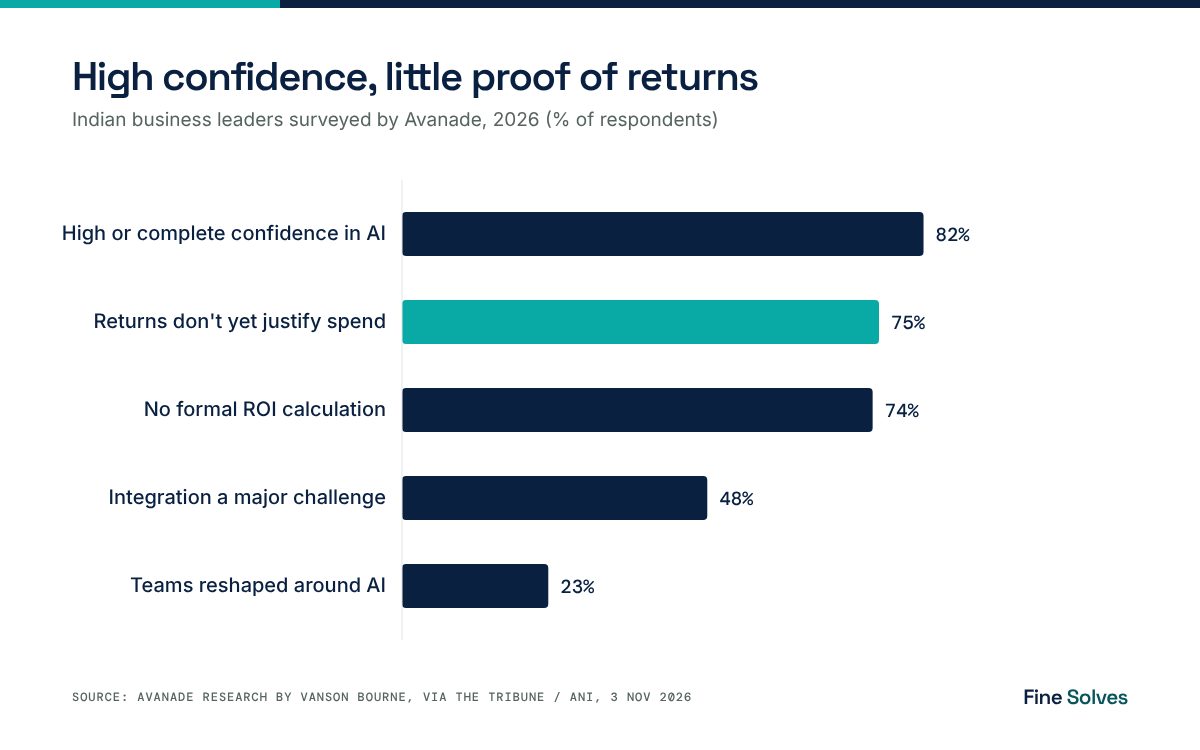
AI adoption in India is ahead on autonomy and behind on proof. Avanade research published on 3 November 2026 found 82% of Indian business leaders have high or complete confidence in their AI use, yet 75% say AI has not delivered returns that justify the money and effort, and 74% have never formally calculated AI ROI with finance.
Two reports landed this week. Avanade's survey, run by Vanson Bourne with 3,600 decision-makers at firms above $500 million in annual revenue, shows Indian companies let AI act with less human sign-off than peers in other markets. Two days later, an Ayre Think Tank analysis estimated AI could add $79.1 billion to India's GDP over ten years. Put together with earlier work from Deloitte, Zinnov, SAP and EY-CII, the picture for an Indian ops or IT head is clear: usage is not the problem any more. Measurement, integration and control are.
TL;DR
- 82% of Indian leaders trust their AI use, but 75% say returns do not yet justify the spend (Avanade, November 2026).
- 28% of Indian firms let generative AI finish defined processes end-to-end without routine human approval, against 19% across all surveyed markets.
- Only 24% require explicit human approval before generative AI acts, versus 29% globally.
- India ranked first for measurable efficiency gains at 44%, against a 36% all-market average.
- 48% name integration with core systems and data as a major challenge, the most practical blocker in the survey.
What did the Avanade AI report find about India?
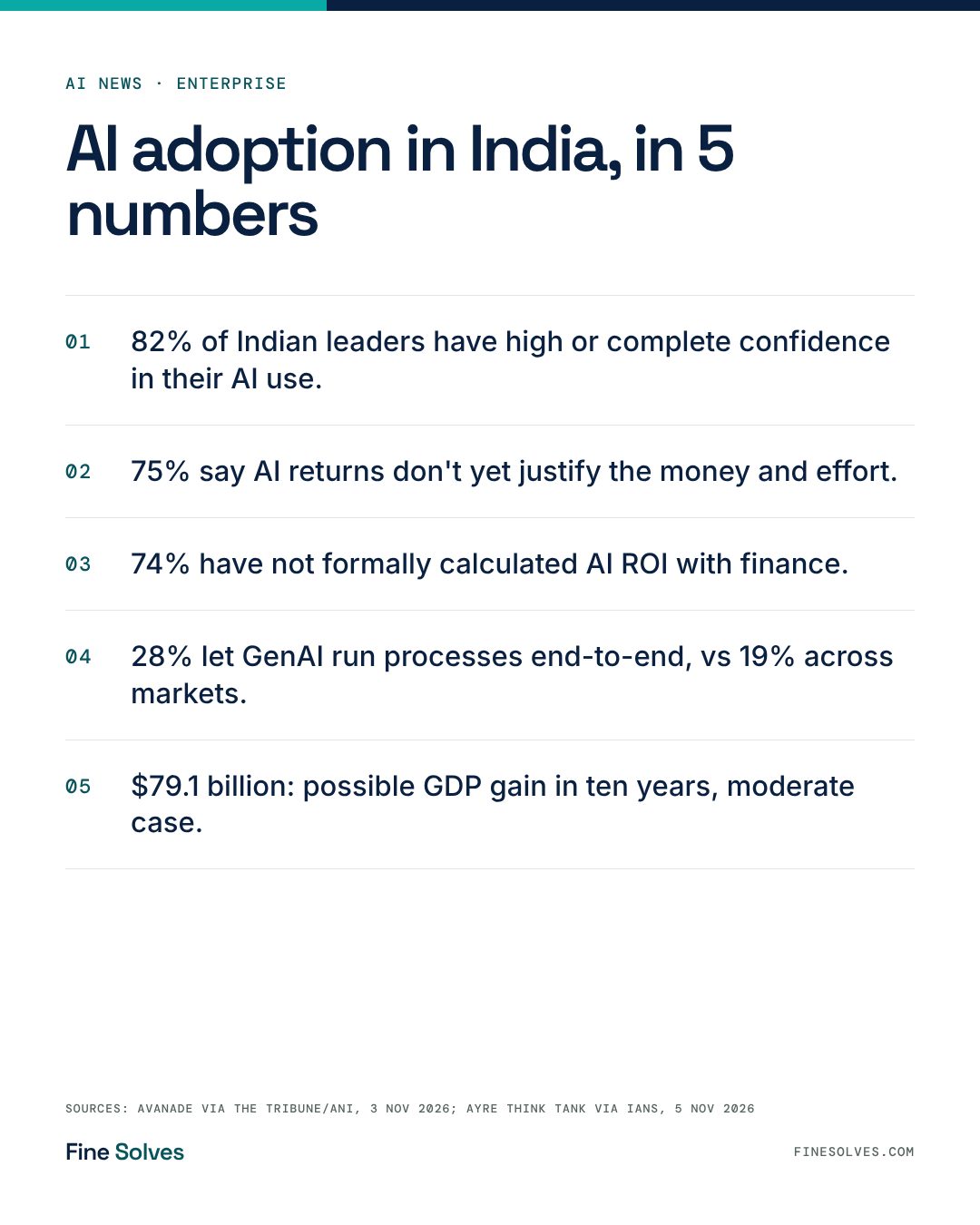
The Avanade AI report found Indian firms are more confident and more autonomous with AI than peers, but most cannot yet show finance a return. According to the survey, 82% of Indian leaders have high or complete confidence in their organisation's AI use. Only 23% say their teams have fundamentally reshaped how they operate around it.
That gap between confidence and change is the story. The report found 75% of Indian respondents say AI has yet to deliver returns that justify the investment, and 74% have not formally calculated AI ROI and had it reviewed by finance or senior leadership. In other words, three in four companies are running AI on belief rather than a business case. That is fine during a pilot. It becomes a budget risk when the AI line item starts showing up in annual plans.
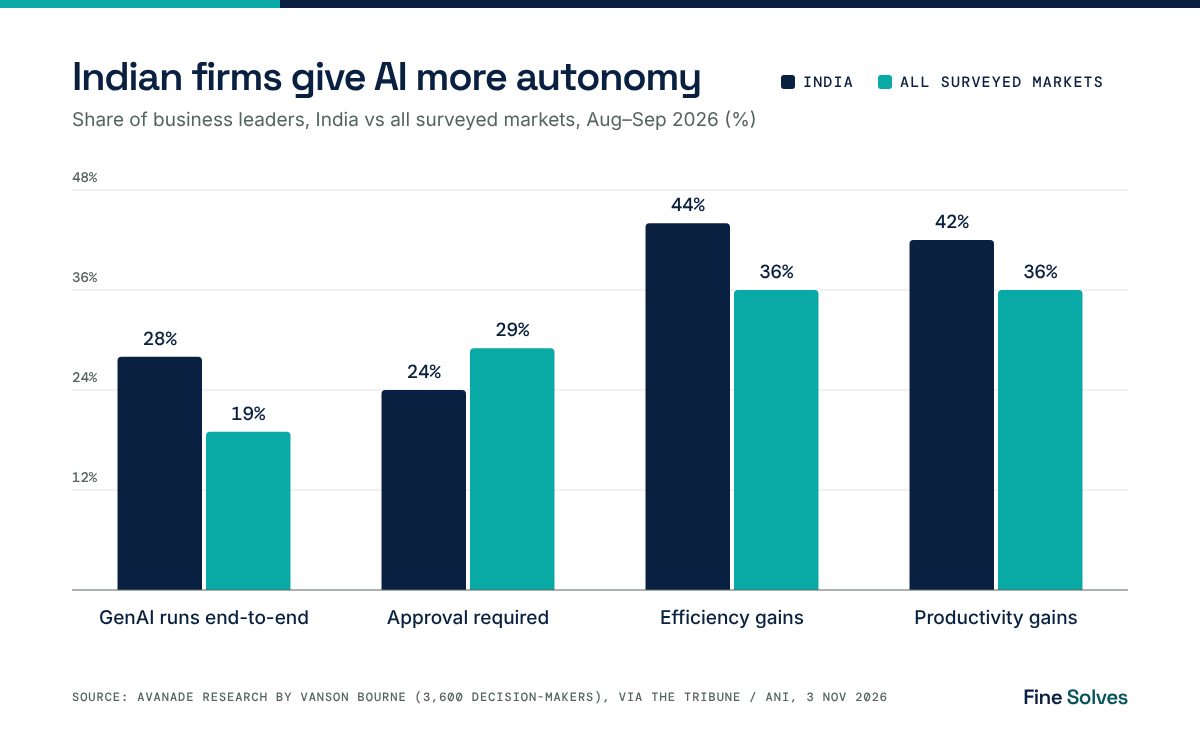
| Avanade survey measure | India | All surveyed markets |
|---|---|---|
| GenAI completes defined processes end-to-end without routine approval | 28% | 19% |
| Explicit human approval required before GenAI acts | 24% | 29% |
| Significant, measurable operational efficiency gains | 44% | 36% |
| Significant employee productivity gains | 42% | 36% |
Source: Avanade research conducted by Vanson Bourne, August–September 2026, reported by The Tribune (ANI), 3 November 2026.
Why do Indian firms give AI more autonomy than global peers?
Indian firms give AI more autonomy because they adopt fast and buy for speed, often before governance catches up. The Avanade data shows 28% let generative AI finish processes without routine sign-off, against 19% across markets, while fewer require explicit approval.
Other studies point the same way. Deloitte's State of AI in the Enterprise 2026 India insights report 40% of Indian respondents with significant or full AI usage, compared with a global average of about 28%. EY-CII research reported 47% of Indian enterprises with multiple generative AI use cases live and another 23% in pilot. Speed has a cost, though. SAP's Value of AI Report 2025 found 67% of Indian organisations worried about shadow AI, meaning tools staff use outside approved channels. More autonomy with less approval is efficient only when the guardrails are designed in, not added later.
Is AI adoption in India actually producing returns?
Partly: AI adoption in India is producing operational gains, but few firms can prove financial returns. Avanade found India first among surveyed markets for measurable efficiency improvements at 44%, and 42% reported significant productivity gains, both above the 36% all-market average.
The problem is converting hours saved into rupees. SAP's study reported Indian businesses earning an average AI ROI of 15% in 2025, which respondents expect to reach 31% within two years, and 93% expect positive returns in under three years. Expectations are high. Yet Zinnov's India AI Adoption Edge 2026 study found 19% of its "Enforcer" archetype, which made up 26% of surveyed enterprises, entirely unable to measure any value from AI. Productivity that is not measured does not survive a budget review.
What is holding back AI ROI in Indian companies?
Integration is the biggest practical blocker: 48% of Indian respondents told Avanade that connecting AI to core systems and data is a major challenge. Another 41% cited data, cloud or integration limits as barriers to becoming an AI leader.
This matches what other surveys say about data and governance. SAP found only 42% of Indian businesses report adequate data readiness for AI. Deloitte's respondents named regulatory and compliance requirements as their top integration challenge at 39%, and 68% put security and compliance controls at the top of their AI investment list. Budgets are also thin relative to ambition: EY-CII found more than 95% of organisations allocate less than 20% of IT budgets to AI, and only 4% have crossed that threshold. Few firms are spending enough on plumbing to make AI pay.
Where are Indian enterprises using AI at scale?
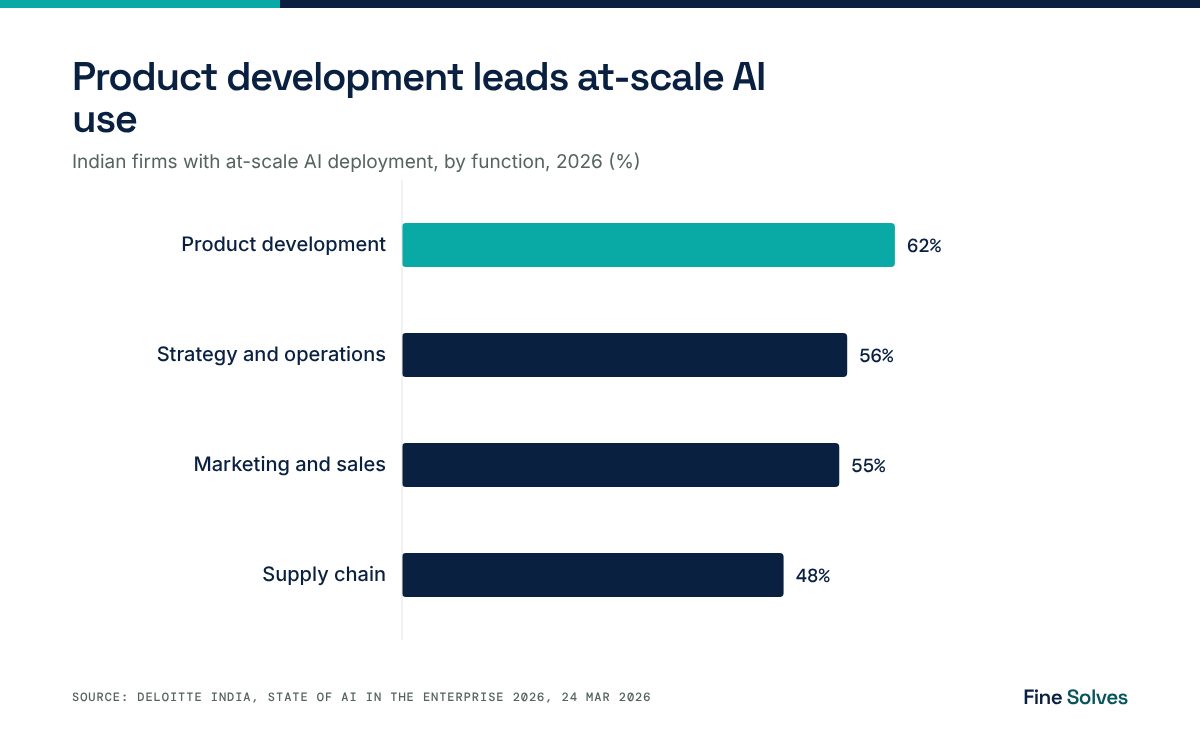
Indian enterprises use AI at scale most in product development, strategy and operations, and marketing, with supply chain close behind. Deloitte's 2026 India data shows at-scale deployment at 62% in product development, 56% in strategy and operations, 55% in marketing and sales, and 48% in supply chain.
The sourcing pattern matters for anyone planning a build. Deloitte reported 49% of Indian firms use blended buy-build strategies, 31% rely on off-the-shelf tools, and 19% build custom, in-house solutions. Only 17% are pursuing fundamental reinvention of core processes and business models. For most companies, AI is being bolted onto existing workflows. That explains why the Avanade numbers show strong efficiency gains but little operating-model change: a copilot inside an old process saves time without moving the P&L much.
How big is the economic prize from AI for India?
The Ayre Think Tank estimates AI could add $79.1 billion to India's GDP after ten years in a moderate scenario. Its range runs from $39.6 billion under conservative assumptions to $118.7 billion in an optimistic case, making India the second-largest opportunity in the Commonwealth.
The same analysis flags the constraint: 86% of young Indian workers are in the informal sector, even though 89% of young Indians want to use AI for education or work within a year. Deloitte found 94% of Indian organisations expect AI spend to rise over the next year. Spend will grow either way. Whether it lands in the high or low end of that GDP range depends on whether firms move from pilots to measured, integrated systems. Zinnov's data shows 46% of Indian enterprises are still early adopters scaling pilots, and 5% have not started.
How should Indian companies prove AI ROI? A 6-step checklist
- Pick one process, not one tool. Choose a workflow with a clear baseline: invoice matching, purchase order approval, claims triage, demand planning.
- Record the baseline before go-live. Cycle time, error rate, cost per transaction, headcount hours. Get finance to sign off on these numbers.
- Define the autonomy level in writing. Which steps AI can complete end-to-end, which need human approval, and what triggers an exception. This is your AI governance policy in miniature.
- Budget for integration first. Connecting to the ERP, HMS or WMS is where projects stall. Scope APIs, data quality fixes and access controls before choosing a model.
- Log every AI action. An audit trail of what the system did, when, and on whose authority makes compliance reviews and ROI calculations possible.
- Review at 90 days with finance. Compare against the baseline, convert hours into rupees, and decide to scale, fix or stop.
What this means for Indian businesses
The next round of AI budget will go to the companies that can show a number. That holds for a CXO at a manufacturer, logistics firm, hospital chain or NBFC alike. Three decisions follow. Treat integration with core systems as the main project, not an afterthought. Write down how much autonomy each AI workflow has before it goes live. And make ROI a finance-reviewed metric from day one, since three in four Indian firms in the Avanade survey have not done that yet.
From the way we build AI systems for Indian companies, the cheapest moment to add approval rules, logging and baseline metrics is at design time, not after the first budget review. If you want a second opinion on an AI rollout that is running but not yet paying back, Talk to Fine Solves.
Frequently asked questions
What is the Avanade AI report?
It is research by Avanade, conducted by Vanson Bourne, that interviewed 3,600 business decision-makers in August and September 2026 at organisations with more than $500 million in annual revenue across the Americas, Europe, the Middle East, India and Asia-Pacific. The India findings, reported on 3 November 2026, focus on AI autonomy, confidence and returns.
What percentage of Indian companies see returns from AI?
According to Avanade, 75% of Indian business leaders say AI has not yet delivered returns that justify the money and effort spent, and 74% have not formally calculated AI ROI. SAP's 2025 study reported an average AI ROI of 15% among Indian businesses, expected to reach 31% within two years.
Is AI adoption in India higher than the global average?
On most measures, yes. Deloitte found 40% of Indian respondents report significant or full AI usage, against a global average of about 28%. Avanade found Indian firms let generative AI complete processes end-to-end without routine approval more often, at 28% against 19% across all surveyed markets.
What is the biggest barrier to AI ROI in India?
Integration. Avanade found 48% of Indian respondents name connecting AI to existing core systems and data as a major challenge, and 41% cite data, cloud or integration limits. SAP found only 42% of Indian businesses report adequate data readiness for AI, so data work usually comes before model choice.
How much could AI add to India's GDP?
The Ayre Think Tank, in an analysis reported on 5 November 2026, estimates AI could raise India's GDP by $79.1 billion after ten years in a moderate scenario. The range runs from $39.6 billion in a conservative case to $118.7 billion in an optimistic one.
Sources
- Indian companies trust AI with greater autonomy but struggle to prove financial returns: Report (Avanade) — The Tribune / ANI, 2026
- AI could add $79 billion to India's economy in a decade: Report (Ayre Think Tank) — IANS, 2026
- Indian enterprises lead global peers in at-scale AI adoption across most functions — Deloitte India, 2026
- The India AI Adoption Edge 2026 — Zinnov, Z47 and OpenAI, 2026
- 93% Indian Businesses Expect Positive Returns on AI Investments Within Three Years: SAP Value of AI Report 2025 — SAP India, 2025
- India Reaches GenAI Turning Point As 47% Of Enterprises Deploy Multiple Use Cases, Says EY–CII Study — Free Press Journal (IANS), 2025
Last updated: 6 November 2026. Published by Fine Solves — an AI software development company in Ahmedabad building custom software and AI systems for Indian businesses. finesolves.com