Agentic AI ROI in 2026: Benchmarks for Indian Firms
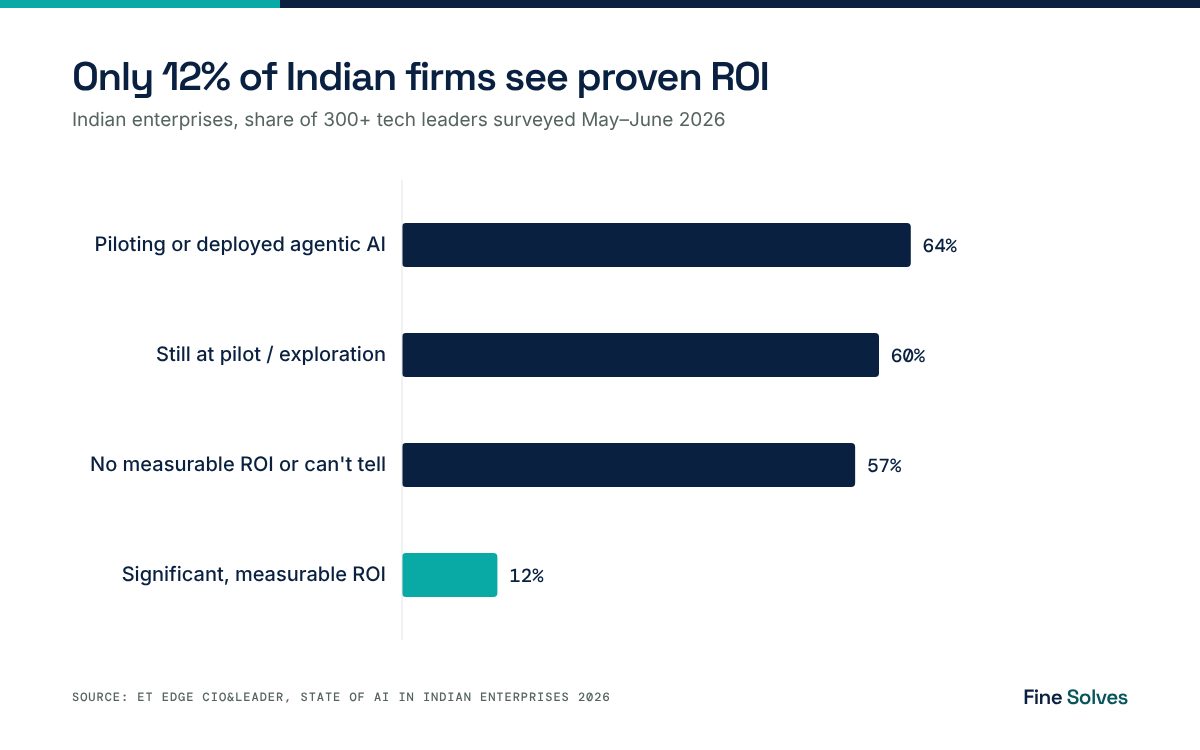
Agentic AI ROI is still rare in India. According to ET Edge CIO&Leader's State of AI in Indian Enterprises 2026, 64% of surveyed technology leaders say their organisations are piloting or running agentic AI, but only 12% can point to significant, measurable return on AI investment. The gap is not the model. It is workflow choice, data, governance and cost tracking.
This matters now because budgets for AI agents are being set for FY27, and global analysts are already forecasting a shake-out. Below are the benchmarks worth knowing, drawn from Gartner, McKinsey, Deloitte, EY, SAP, MIT and OutSystems, plus a practical playbook for Indian operations and IT heads who need agents to pay for themselves.
TL;DR
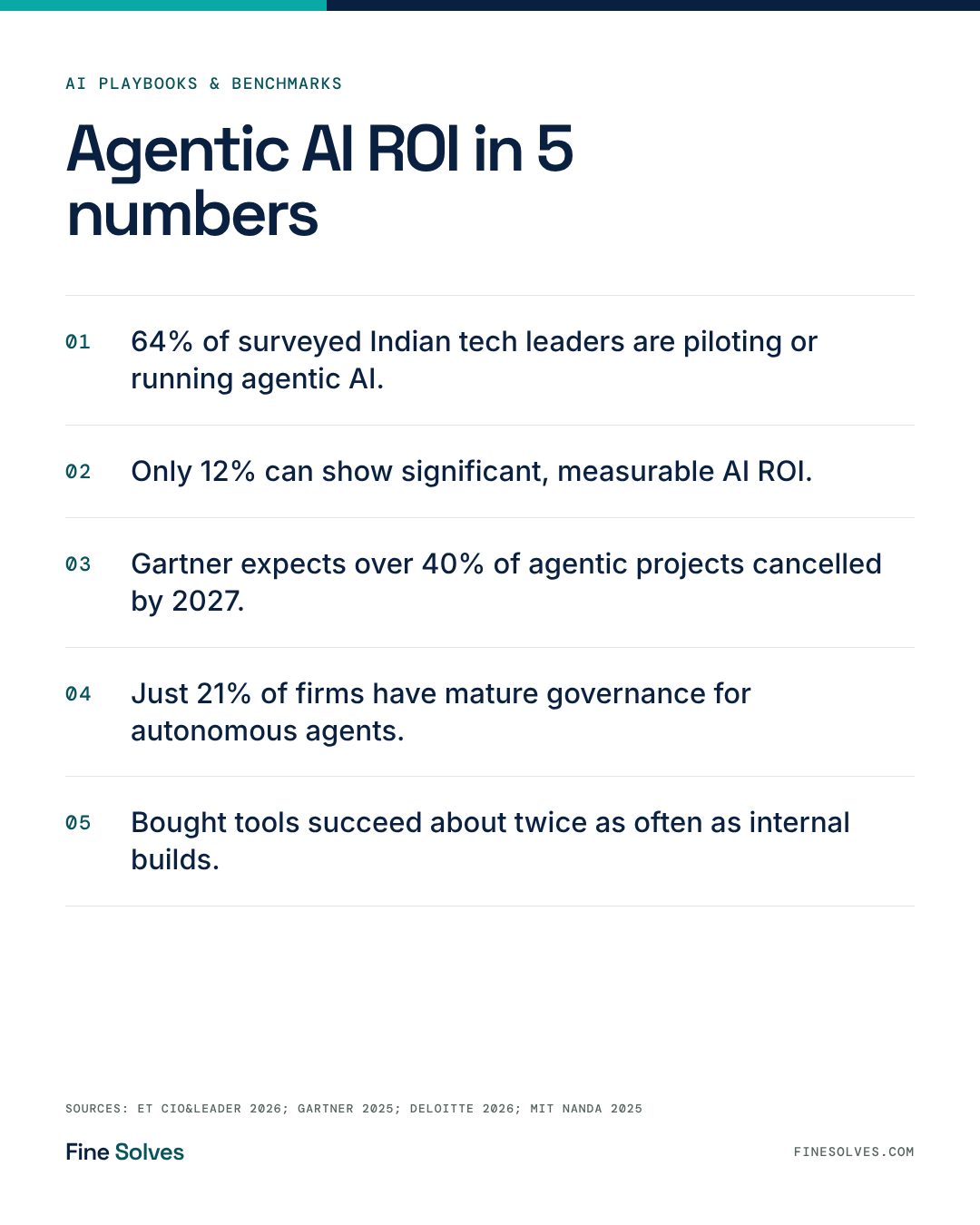
- 64% of surveyed Indian tech leaders are piloting or running agentic AI; only 12% report significant, measurable ROI (ET CIO&Leader, 2026).
- Gartner forecasts that more than 40% of agentic AI projects will be cancelled by the end of 2027.
- Globally, 23% of organisations are scaling an agentic system, and no more than 10% are scaling agents in any single function (McKinsey).
- Only 21% of companies have a mature governance model for autonomous agents (Deloitte, 2026).
- 55% of Indian organisations either had AI cost overruns or do not track AI spend separately, which makes ROI impossible to prove.
What is agentic AI ROI, and how should you measure it?
Agentic AI ROI is the measurable business value an AI agent produces, such as cost removed, cycle time cut or revenue added, minus the full cost of building, running and governing it.
AI agents differ from chatbots because they take actions: raise a purchase order, reconcile an invoice, reroute a shipment, close an IT ticket. That means the value is measured in operational metrics, not in "time saved writing emails". It also means the cost side includes integration with your ERP, WMS or HMS, human review, monitoring and model usage.
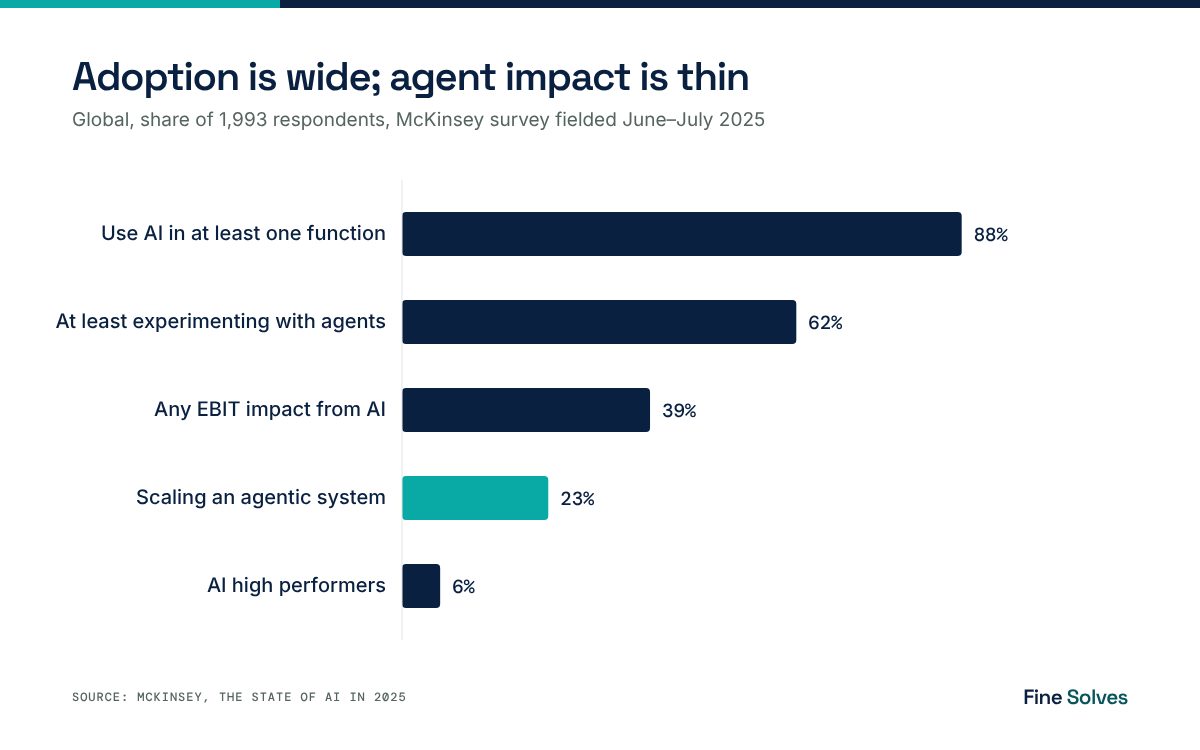
McKinsey's State of AI 2025 survey of 1,993 respondents shows how hard this is to get right. While 88% of organisations regularly use AI in at least one function, only 39% attribute any EBIT impact to it, and most of those say less than 5% of their EBIT comes from AI. McKinsey classes just 6% of respondents as AI high performers.
How many Indian enterprises are actually getting agentic AI ROI?
About one in eight: ET Edge CIO&Leader found that only 12% of Indian organisations can show significant, measurable return on AI investment.
The same 2026 study, based on more than 300 senior technology leaders surveyed in May and June 2026, reports that 60% of organisations are still at the pilot or exploration stage after two or more years of AI spending. Another 57% either see no measurable ROI or cannot tell whether returns exist. Meanwhile, 58% allocate less than 10% of their IT budget to AI, so most programmes are still small.
Other surveys paint a rosier picture, and the difference is worth noting. SAP's Value of AI Report 2026, built with Oxford Economics, reports that 74% of Indian businesses are satisfied with their current AI ROI and that 67% are piloting agentic use cases. EY's India C-suite survey found 47% of organisations have multiple GenAI use cases live in production. Satisfaction and production use are not the same as proven, audited returns.
Agentic AI benchmarks at a glance
The table pulls together the most useful benchmarks for planning an agent programme in India.
| Benchmark | Value | Scope | Source |
|---|---|---|---|
| Piloting or running agentic AI | 64% | India | ET CIO&Leader 2026 |
| Significant, measurable AI ROI | 12% | India | ET CIO&Leader 2026 |
| Data-ready for AI (up from 42%) | 63% | India | SAP 2026 |
| Highly prepared for DPDP Act | 19% | India | ET CIO&Leader 2026 |
| Scaling an agentic system | 23% | Global | McKinsey 2025 |
| Mature governance for autonomous agents | 21% | Global | Deloitte 2026 |
| Agentic projects cancelled by end-2027 (forecast) | over 40% | Global | Gartner 2025 |
| GenAI pilots that never scale | 95% | Global | MIT NANDA 2025 |
Source: ET Edge CIO&Leader 2026; SAP Value of AI Report 2026; McKinsey State of AI 2025; Deloitte State of AI in the Enterprise 2026; Gartner (June 2025); MIT NANDA 2025.
Why do so many agentic AI projects fail to pay back?
Most fail on cost, unclear value and weak risk controls, which are the three reasons Gartner gives for its forecast that over 40% of agentic projects will be cancelled.
Gartner's January 2025 poll of 3,412 webinar attendees showed how unevenly firms are committing: 19% had made significant investments in agentic AI, 42% conservative investments, 8% none, and 31% were waiting or unsure. Gartner also estimates only about 130 vendors offer genuinely agentic products, with many others relabelling existing products as agentic, a practice it calls "agent washing".
The MIT NANDA study of the "GenAI divide", reported by Computing, found 95% of pilots stall and never reach scaled adoption, while only 5% achieved rapid revenue growth. It also reports that more than half of corporate AI budgets go to sales and marketing, even though the strongest returns show up in back-office functions.
Legacy plumbing is a recurring blocker. OutSystems' 2026 State of AI Development report, a global survey of 1,879 IT leaders, found 38% of organisations say legacy systems are the main reason agentic projects stalled entirely.
Is it cheaper to buy or build AI agents?
Buying usually reaches production faster: MIT NANDA found externally sourced tools succeed about two-thirds of the time, versus about one-third for internally built systems.
Speed is also what Indian buyers say they care about. EY reports that 91% of Indian respondents rank speed of deployment as the top factor in buy-vs-build decisions. But an off-the-shelf agent rarely fits a plant's ERP customisations or a hospital's billing rules. Deloitte found 85% of companies expect to customise agents to their needs.
The practical answer is usually a hybrid: buy the platform pieces (models, orchestration, observability) and build the thin layer that connects agents to your own systems and approval rules. Model costs are falling fast. Stanford's AI Index reports the price of querying a high-end LLM fell from $20 to $0.07 per million tokens in about 18 months, and enterprise AI hardware costs fell 30% in a year. Integration and change management, not tokens, now dominate the bill.
How should Indian firms govern AI agents?
Govern agents like new employees with system access: give each one a defined scope, an owner, spending and action limits, audit logs and a human approval step for anything irreversible.
The governance gap is wide. Deloitte reports that 74% of companies plan to deploy agentic AI within two years, while 23% use it at least moderately today, and only 21% have a mature governance model for autonomous agents. OutSystems found 36% of organisations take a centralised approach to agentic AI governance.
For Indian firms, the DPDP Act adds weight. ET CIO&Leader found 81% of technology leaders name data privacy and compliance as their leading AI concern, yet only 19% describe themselves as highly prepared for DPDP obligations. An agent that reads patient records, salary data or customer KYC needs consent handling and access controls designed in from day one.
Agentic AI ROI playbook: 7 steps from pilot to production
- Pick a back-office workflow with a clean metric. Invoice matching, GRN reconciliation, IT service desk triage, claims pre-checks. MIT's research points to back-office work for the strongest returns.
- Baseline before you build. Record today's cycle time, error rate, cost per transaction and backlog. Without a baseline you will join the 57% who cannot tell if returns exist.
- Track AI spend as its own line. Tag model usage, integration and review effort separately from general IT; 55% of Indian firms either had AI cost overruns last year or do not track AI spend separately.
- Fix the data the agent touches. SAP found 76% of Indian businesses face incomplete-data challenges. Clean the master data for that one workflow first.
- Keep a human in the loop for irreversible actions. Payments, dispatches and clinical decisions get approval steps; read-only and draft actions can run autonomously.
- Set kill criteria up front. Define the metric and the date by which the agent must beat the baseline, so you cancel by design rather than by drift.
- Scale one function before the next. McKinsey found no more than 10% of firms are scaling agents in any single function. Depth in one process beats ten shallow pilots.
What does the next two years look like?
Expect agents to become a standard feature of enterprise software, with Gartner forecasting 33% of enterprise apps will include agentic AI by 2028, up from less than 1%.
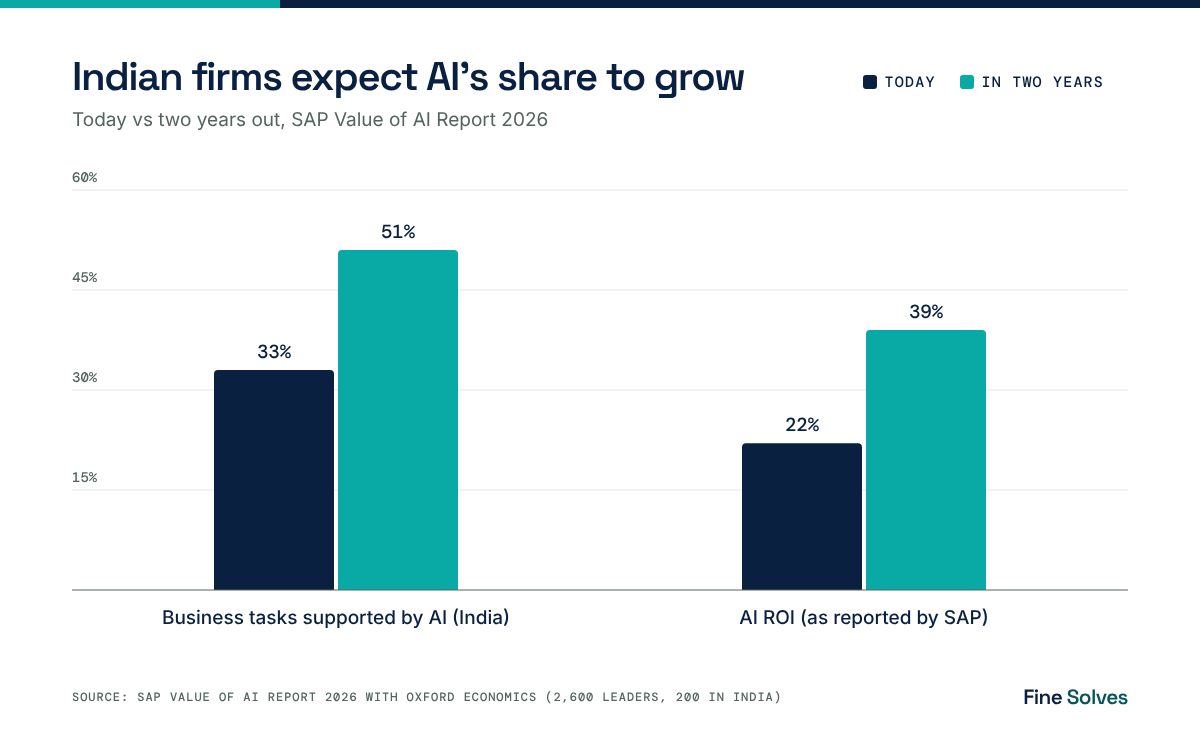
Gartner also expects at least 15% of day-to-day work decisions to be made autonomously by agentic AI by 2028. In India, SAP's survey projects AI will support 51% of business tasks within two years, up from 33% today, and reports AI ROI rising from 22% to 39% over the same period (SAP's release does not say whether the ROI figure is India-only). Indian organisations plan to invest US$25.9 million in AI, according to the same study.
What this means for Indian businesses
The data points one way: fewer, deeper agent projects tied to a measurable operating metric. Indian firms have an advantage on readiness, with SAP reporting 63% now data-ready for AI, and OutSystems finding 50% of Indian respondents already see ROI from IT development and productivity, the highest of any country surveyed. The risk is spreading budget across many pilots that never cross into production.
From the way we build at Fine Solves, the agent projects that hold up start with one workflow, one owner and one number to move, and treat integration with existing ERP, WMS or HMS systems as the main job rather than an afterthought. If you are scoping your first or next agent, Talk to Fine Solves.
Frequently asked questions
What is a realistic agentic AI ROI benchmark for 2026?
There is no single number, but the evidence says proven returns are rare. Only 12% of Indian organisations report significant, measurable AI ROI, according to ET CIO&Leader's 2026 survey, and McKinsey classes just 6% of global respondents as AI high performers. Set your own benchmark against a baseline metric for one workflow.
Why does Gartner expect so many agentic AI projects to be cancelled?
Gartner forecasts that more than 40% of agentic AI projects will be cancelled by the end of 2027 because of rising costs, unclear business value and insufficient risk controls. It also warns that many vendors relabel existing products as agentic, which inflates expectations.
Which workflows deliver the fastest agentic AI ROI?
Back-office workflows with high volume and clear rules tend to pay back first: invoice matching, reconciliation, IT service desk triage and document checks. MIT NANDA's research found the strongest returns in back-office functions, even though more than half of AI budgets go to sales and marketing.
How much governance do AI agents need?
Enough that every agent has an owner, a defined scope, action limits, audit logs and human approval for irreversible steps. Deloitte found only 21% of companies have a mature governance model for autonomous agents, and in India only 19% feel highly prepared for DPDP Act obligations.
Should Indian SMBs wait before investing in AI agents?
Not necessarily, but they should start narrow. Model costs have dropped sharply, from $20 to $0.07 per million tokens for high-end LLMs according to Stanford's AI Index, so the main costs are integration and change management. A single, well-measured workflow is a low-risk way to test value.
Sources
- State of AI in Indian Enterprises 2026 — ET Edge CIO&Leader, via CXOToday, 2026
- Gartner agentic AI forecast — via IT Brief, 2025
- The state of AI in 2025: Agents, innovation, and transformation — McKinsey, 2025
- Deloitte State of AI in the Enterprise — via Accounting Today, 2026
- SAP Value of AI Report 2026 (with Oxford Economics) — SAP India, 2026
- EY India C-suite GenAI survey (The AIdea of India) — EY, 2025
- MIT NANDA, The GenAI Divide — via Computing, 2025
- Stanford HAI AI Index 2025 — via Tom's Hardware, 2025
- OutSystems 2026 State of AI Development — via TechWire Asia, 2026
Last updated: 1 November 2026. Published by Fine Solves — an AI software development company in Ahmedabad building custom software and AI systems for Indian businesses. finesolves.com