
ABDM Integration for Hospitals: 2026 Adoption Data
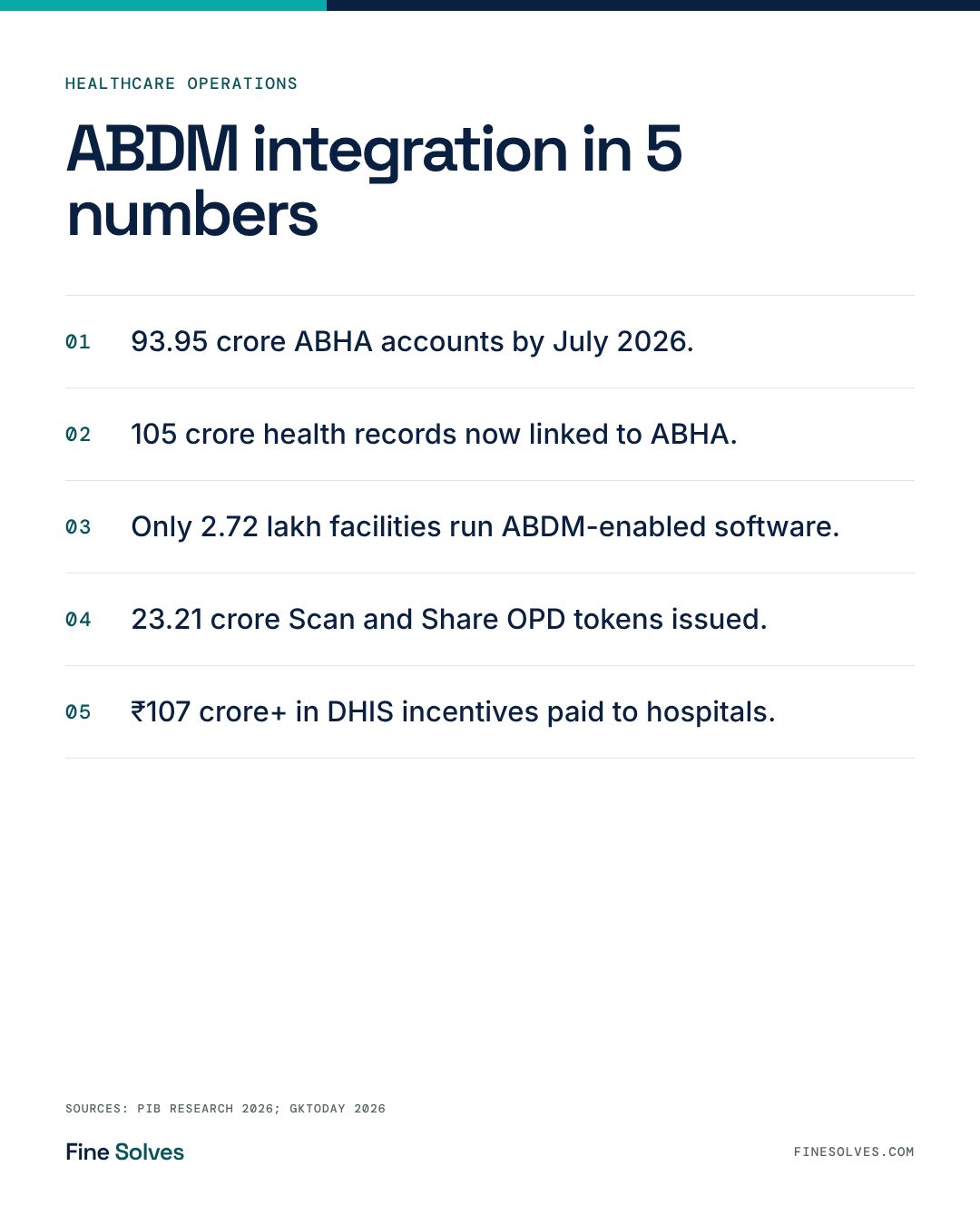
ABDM integration means connecting your hospital's software to India's Ayushman Bharat Digital Mission so patient records link to a patient's ABHA, OPD registration works by QR scan, and records move between facilities with consent. Government data shows 93.95 crore ABHA accounts by July 2026, but only about 2.72 lakh facilities run ABDM-enabled software. Most of the gap is on the provider side.
This matters now because the patient side of ABDM is close to saturation and the provider side is not. When nearly every patient walking into your OPD already has an ABHA, a hospital that can't read or write to it is the slow counter in the building. Incentive money is also flowing: the government reports more than ₹107 crore paid to hospitals under the Digital Health Incentive Scheme. This guide puts the 2024 and 2026 numbers side by side and gives an integration checklist for hospital operations and IT heads.
TL;DR
- ABHA accounts grew from 14.7 crore in 2021 to 93.95 crore by July 2026, according to official figures.
- Linked health records more than doubled from 50 crore in February 2025 to 105 crore by July 2026.
- Scan and Share issued 23.21 crore OPD tokens by June 2026, up from 4 crore in August 2024.
- Only 2.72 lakh of 5.33 lakh registered facilities had adopted ABDM-enabled software.
- DHIS has paid hospitals more than ₹107 crore and software companies more than ₹26 crore.
- In one hospital survey, 58% of doctors named the lack of dedicated IT staff as a barrier to digital records.
What is ABDM integration, in plain terms?
ABDM integration is the work of making your hospital management software talk to the national ABDM building blocks: ABHA, the facility and professional registries, and the consent-based record exchange.
In practice there are three milestones. The first is registering the facility on the Health Facility Registry and doctors on the Healthcare Professionals Registry. The second is creating and verifying ABHA at registration, including the QR-based Scan and Share flow at the OPD counter. The third is linking each care record, such as a prescription, lab report or discharge summary, to the patient's ABHA and sharing it when the patient consents. ABHA itself is a 14-digit health identifier. ABDM was launched in September 2021, according to the PIB Research note on the mission.
How fast has ABHA adoption grown since 2021?
Very fast: official data shows cumulative ABHA accounts rising more than six-fold, from 14.7 crore in 2021 to 93.95 crore by 10 July 2026.
IndiaMedToday's summary of official data puts cumulative accounts at 30.4 crore in 2022, 50.6 crore in 2023, 72.2 crore in 2024 and 84.5 crore in 2025, before the count crossed 90 crore in 2026. Women hold around 49.75% of accounts, and Uttar Pradesh alone has over 15.3 crore. The PIB Research note of 6 July 2026 reports over 104 crore health records linked to over 93 crore ABHA accounts, a figure News On AIR carried the same day. Five days later, GKToday reported 105 crore records and 93.95 crore accounts after the Mission Steering Group meeting.
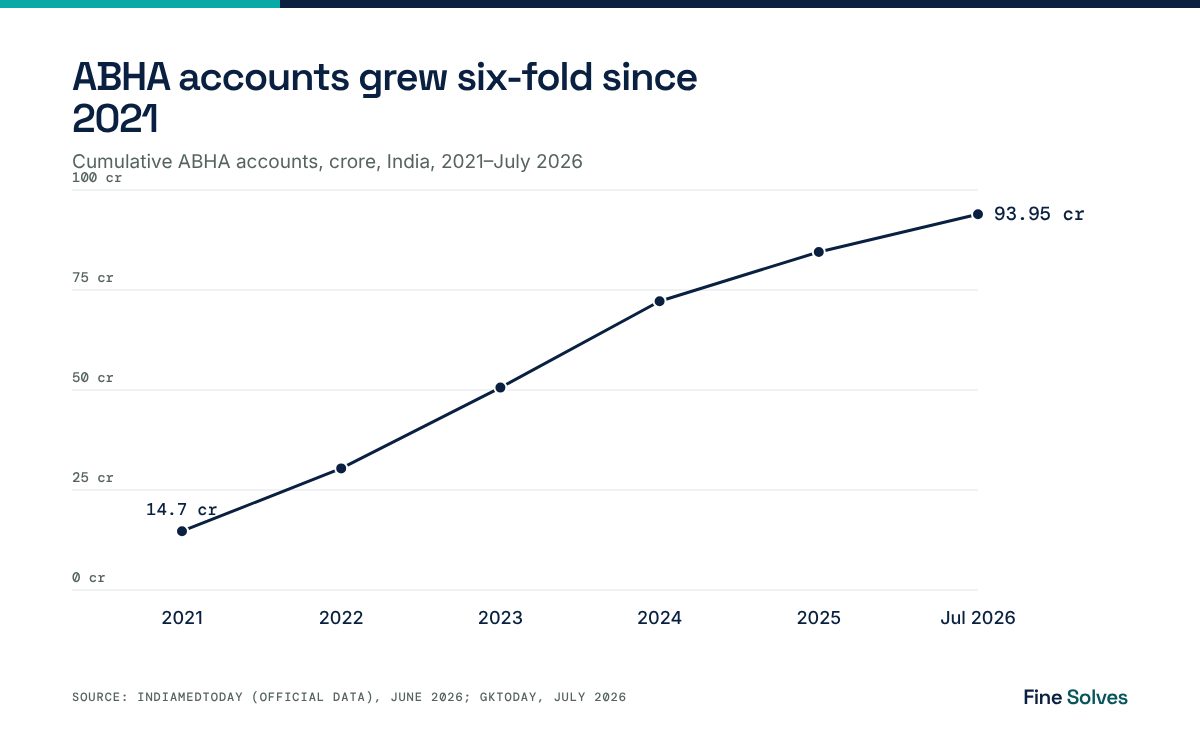
The slowdown in growth is the signal. The 2024-to-2025 increase was well under the previous year's, and 2026 has added fewer so far. Patient enrolment is reaching its ceiling. The next phase of ABDM is about what providers do with those identities.
Is the provider side keeping up with ABHA?
No. About 2.72 lakh facilities had adopted ABDM-enabled software by July 2026, roughly half of the 5.33 lakh facilities registered on the national registries.
The trend is still upward. In September 2024, IANS reported over 1.3 lakh ABDM-enabled facilities, alongside more than 67 crore ABHA and more than 42 crore linked records. So enabled facilities roughly doubled in under two years. Registered professionals stand at 9.85 lakh. Records are the clearest growth line: Indian Pharma Post reports that nearly 10 crore health records are now linked every two to three months.
| ABDM metric | September 2024 | June–July 2026 |
|---|---|---|
| ABHA accounts | 67 crore | 93.95 crore |
| Health records linked to ABHA | 42 crore | 105 crore |
| Facilities on ABDM-enabled software | 1.3 lakh | 2.72 lakh |
| Scan and Share OPD tokens | 5 crore | 23.21 crore |
Source: OrissaPOST/IANS, September 2024; GKToday, July 2026; PIB Research, July 2026 (tokens as on 18 June 2026).
Why does Scan and Share matter for OPD operations?
Scan and Share cuts OPD registration to a QR scan, and the PIB note cites an IIHMR study showing waiting time falling from about an hour to 2 to 5 minutes.
Adoption has compounded. Medical Dialogues reported 2 crore OPD tokens in February 2024 and 4 crore by August 2024, with an average of 2.2 lakh people using the service daily and about 76% of users being first-timers. By September 2024 the ministry put the count at over 5 crore tokens and estimated 2.5 crore man-hours saved. The PIB note reports over 23.21 crore tokens as on 18 June 2026, and GKToday cites nearly 24 crore a month later.
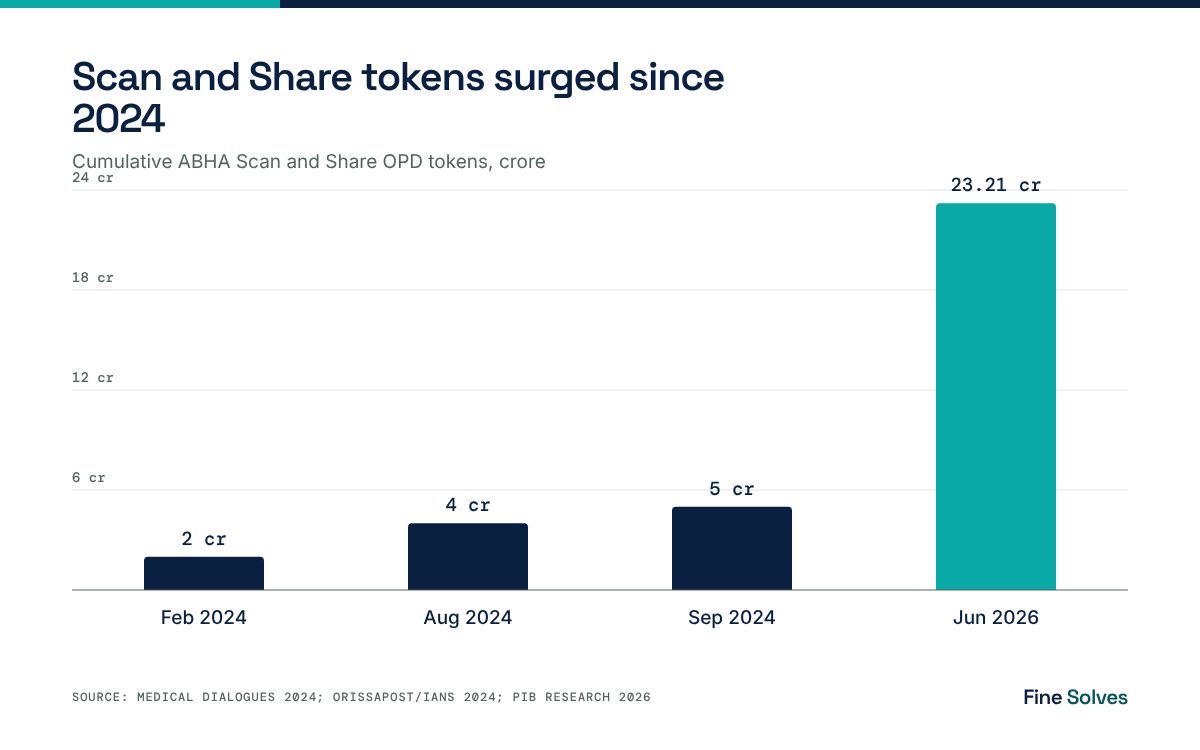
For an operations head, the token count is a proxy for queue time you are not spending. A registration desk that still types demographics by hand is now a visible bottleneck, and patients who used Scan and Share at a government hospital expect it elsewhere.
How much has the Digital Health Incentive Scheme paid out?
As on 18 June 2026, DHIS had paid more than ₹107 crore to hospitals, more than ₹26 crore to digital solution companies and ₹2.95 crore to labs, diagnostics and pharmacies.
When the scheme was announced, ThePrint reported incentives of up to ₹4 crore, linked to the number of digital health records a facility creates and links to ABHA, with hospitals of 10 or more beds eligible. The structure rewards volume of linked records, not just registration. That is why the integration that matters is the one that links every prescription and report automatically, not one that needs a front-desk clerk to remember a button.
| DHIS recipient category | Amount paid (as on 18 June 2026) |
|---|---|
| Hospitals | ₹107 crore+ |
| Digital solution companies | ₹26 crore+ |
| Diagnostics, labs and pharmacies | ₹2.95 crore |
Source: PIB Research, Ayushman Bharat Digital Mission, July 2026.
What stops hospitals from going digital?
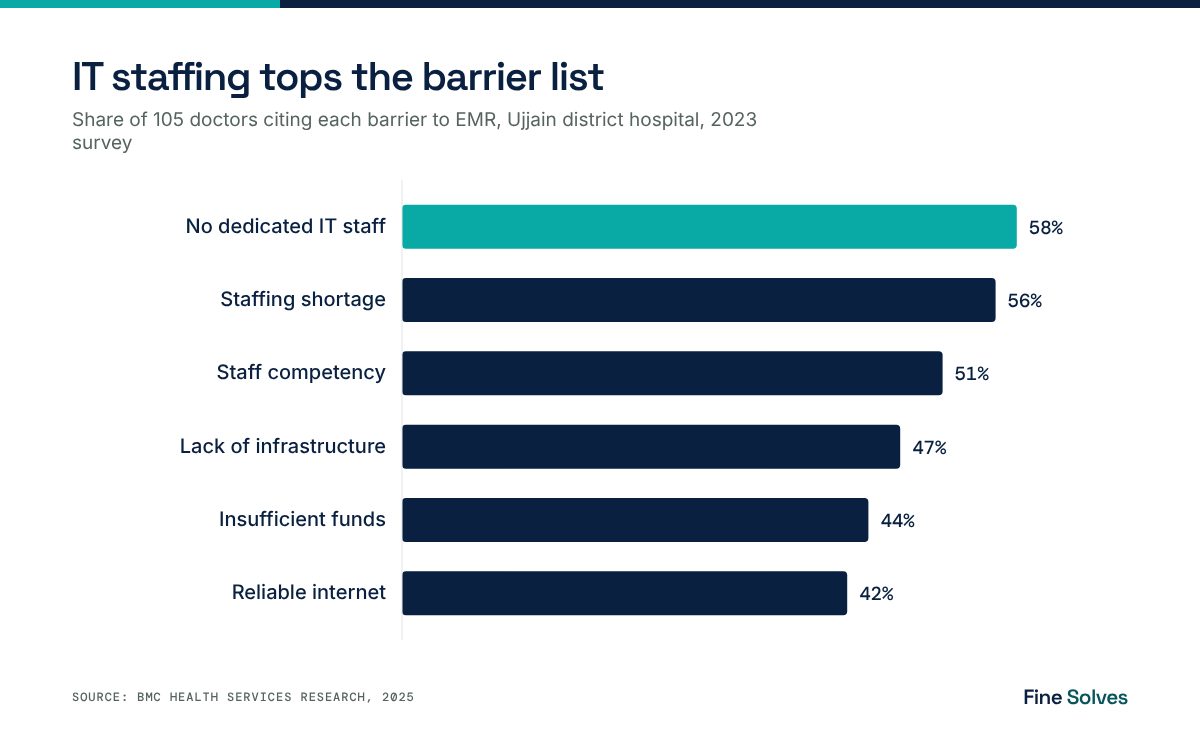
People and infrastructure, more than willingness: in a 2025 study of 105 doctors at a private hospital in Ujjain district, 93% agreed electronic records were needed in inpatient departments.
The same study, published in BMC Health Services Research, found 58% citing the absence of dedicated IT personnel and 56% citing staffing shortages. Staff competency was named by 51%, lack of infrastructure by 47%, insufficient funds by 44% and reliable internet access by 42%. On the benefit side, 79% expected easier retrieval of clinical data. It is a single-centre survey, so treat it as a direction, not a national benchmark. The direction is familiar to anyone who has run an HMS rollout outside a metro.
How should a hospital plan ABDM integration?
Treat it as a workflow project with a software component, in roughly this order:
- Register first. Get the facility onto the Health Facility Registry and every consulting doctor onto the Healthcare Professionals Registry. Nothing else links without these IDs.
- Check your hospital management software. Ask your vendor which ABDM milestones it has cleared and whether it is listed among the integrated solutions. Indian Pharma Post counts more than 450 public and private health technology solutions integrated with ABDM, so a vendor with no answer is a red flag.
- Fix the registration desk. Put Scan and Share QR codes at every OPD counter and make ABHA creation or verification part of the standard registration screen, not a separate step.
- Automate record linking. Every prescription, lab report and discharge summary should link to ABHA as a side effect of being saved. Manual linking is where counts, and incentive claims, quietly fall apart.
- Design consent and sharing. Decide who answers a consent request, how fast, and what record types you share. Write it down.
- Staff it. Given the survey data on IT staffing, name one owner for ABDM operations and train desk staff on the QR and ABHA flows.
- Measure monthly. Track the share of OPD visits with an ABHA, records linked per visit, average registration time and DHIS claims filed.
What this means for Indian businesses
For hospitals, clinics and diagnostic chains, ABDM integration has moved from a compliance item to an operations item. With 93.95 crore ABHA accounts in circulation, the patient is ready. The open question is whether your registration desk, your HMS and your record workflows are. For smaller hospitals the barrier is usually not the API but the absence of someone who owns the integration, which matches what the Ujjain survey found.
From the way we build hospital software at Fine Solves, the integrations that hold up are the ones built into the daily workflow: ABHA at registration, automatic linking on every saved record, and reports that reach patients on WhatsApp. FineHealth by Fine Solves is our hospital management system built around those flows. If you are planning an HMS upgrade or an ABDM rollout, talk to Fine Solves.
Frequently asked questions
Is ABDM integration mandatory for private hospitals?
For most private hospitals the push today comes from incentives and patient expectations rather than a single national mandate. With ABHA accounts at 93.95 crore by July 2026 and Scan and Share in wide use at public hospitals, patients increasingly expect QR registration and digital records. Check current state and scheme rules, such as empanelment conditions, which may set their own requirements.
How many ABHA accounts and linked records are there in 2026?
Government-cited figures show more than 93.95 crore ABHA accounts and over 105 crore linked health records as of 10 July 2026. The PIB Research note of 6 July 2026 reported over 104 crore records linked to over 93 crore accounts, so the counts are rising by several crore records per month.
What is Scan and Share and how much time does it save?
Scan and Share lets a patient scan a QR code at the OPD counter and share ABHA details instantly, skipping manual form entry. An IIHMR study cited by PIB found waiting time fell from about an hour to 2 to 5 minutes. Over 23.21 crore tokens had been issued as on 18 June 2026.
How does the Digital Health Incentive Scheme pay hospitals?
DHIS pays incentives based on the number of digital health records a facility creates and links to ABHA, with hospitals of 10 or more beds eligible when the scheme launched. As on 18 June 2026, hospitals had received more than ₹107 crore in total. Rates and conditions change, so check the latest NHA guidelines before planning around them.
Does our existing hospital management software support ABDM?
Many do: more than 450 public and private health technology solutions are integrated with ABDM, according to Indian Pharma Post. Ask your vendor which milestones they have cleared, whether record linking is automatic, and whether Scan and Share works in your registration screen. If the answers are vague, plan for an upgrade or a custom integration.
Sources
- Ayushman Bharat Digital Mission: India's Digital Health Backbone — PIB Research, 2026
- Over 104 crore health records linked to over 93 crore ABHA accounts, says Govt — News On AIR, 2026
- Ayushman Bharat Digital Mission crosses 93.95 crore health accounts — GKToday, 2026
- Ayushman Bharat Digital Mission crosses 90 crore ABHA accounts milestone — IndiaMedToday, 2026
- ABDM crosses 100 crore ABHA-linked health records milestone — Indian Pharma Post, 2026
- Over 67 crore Ayushman Bharat Health Accounts created: Centre — OrissaPOST (IANS), 2024
- 2 crore OPD tokens generated using ABHA-based Scan and Share service — Medical Dialogues, 2024
- 4 crore OPD tokens generated through ABHA-based Scan and Share service — Medical Dialogues, 2024
- Perceived benefits and barriers of medical doctors regarding electronic medical record systems in an Indian private-sector healthcare facility — BMC Health Services Research, 2025
- Incentive scheme announced to boost digital health transactions under Ayushman Bharat — ThePrint (PTI), 2022
Last updated: 7 November 2026. Published by Fine Solves — an AI software development company in Ahmedabad building custom software and AI systems for Indian businesses. finesolves.com